Paraphimosis
Historical document, translated for reference. It reflects medical knowledge of the 1920s–30s and is not medical advice.
Summary
Paraphimosis is a condition where the foreskin is retracted behind the glans penis and becomes trapped, causing swelling and potential complications. This article describes the causes, diagnosis, and treatment methods for paraphimosis as understood in the 1930s.
Encyclopedia article (1928–1936)
PARAPHIMOSIS, paraphimosis (popular names "strangler" - according to the mechanism of origin and "Spanish collar" according to appearance), incarceration of the glans penis by the retracted foreskin (fig. 1).
A necessary condition for the formation of P. is the presence of the prepuce (the disease is impossible in circumcised individuals). Normally, the preputial fold is sufficiently elastic and wide that even in the erect state of the penis, it can be freely retracted behind the glans and completely uncover it. But under certain conditions, for example, with a short and inelastic frenulum, the glans penis, when the foreskin is retracted (praeputii), deviates downward, the groove behind the upper circumference of the glans (sulcus retroglandularis) becomes deeper, the prepuce gathers into a tense fold, and its replacement back becomes difficult. In some cases, the opening of the preputial sac is narrow from birth and therefore uncovering the glans is impossible (see Phimosis). With a moderate degree of narrowing of the preputial opening, exposure of the glans occurs with difficulty, and the narrowed part that has been placed behind the glans does not return to its original position. A long prepuce, with unclean care, is subject to frequent inflammations (see Balanitis and balanoposthitis) of the inner lamina due to the decomposition of accumulated smegma (lubricant), leading to erosive processes and subsequent scarring. The development of gonorrheal ulcers, as well as the disease of soft chancre located at the edge of the preputial opening or on the inner lamina, create conditions for the development of scar constrictions, and hence phimosis as the initial factor of P. The moment that contributes to the placement of the constricting ring behind the glans is sexual intercourse or an act of masturbation. The erect glans of the penis hinders the return of the prepuce to its place, the outflow of blood from the cavernous tissue of the glans is delayed, and this leads to the prolonged presence of the constricting ring behind the glans. As a result, stagnation develops both in the glans and in the incarcerated inner lamina of the prepuce. Following this, edema of the inner lamina develops, and the constricting ring quickly gangrenizes and ulcerates. In childhood, the development of P. can occur as a result of mischief or when it is necessary to uncover the glans of the penis to carry out certain hygienic measures.
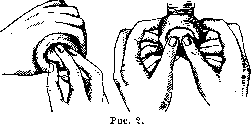
Diagnosis does not present difficulties. The penis on examination is club-shaped thickened downward, the glans is dry, dark blue in color, surrounded by a glassy shiny, sometimes transparent ridge of edematous inner lamina, which usually covers the constricting ring. On profile examination, the penis is curved downward directly behind the glans. When the ridge is turned back, changes in the form of ulcers or gangrene of the constricting ring and surrounding areas can be seen underneath. Prevention of paraphimosis comes down to timely incision or circular circumcision of the prepuce in phimosis. Treatment in the initial stages of P. consists of an attempt at reduction. The glans and inner lamina of the prepuce are smeared with vaseline. The penis is grasped with the thumb and index finger of the left hand behind the constricting ring (fig. 2). With the right hand, by light pressure and kneading, they try to reduce the swelling of the glans and inner lamina of the prepuce, pushing the edematous fluid back behind the ring. Then, gradually, starting from the dorsal part, the glans is replaced back behind the constricting ring. The operation of reduction is painful and requires preliminary injection of morphine. Local anesthesia is inappropriate, as it increases tissue swelling. If reduction was not successful, an incision of the constricting ring is performed under local anesthesia. A grooved probe is passed under it from behind and an incision is made on it. After reduction or incision, the penis is bandaged upward (to the abdomen) for better outflow of edematous fluid. As soon as the swelling subsides and the resulting ulcers heal, it is necessary to prevent recurrence of P. by performing an operation of incision or circular circumcision of the prepuce.
Related articles
Mentioned in
Cite this page
“Paraphimosis.” Soviet Medical Encyclopedia. English translation of Bolshaya Meditsinskaya Entsiklopediya, 1st ed. (Moscow, 1928–1936), ed. N. A. Semashko. https://sovietmedicalencyclopedia.pages.dev/article/paraphimosis/