Morphine
Historical document, translated for reference. It reflects medical knowledge of the 1920s–30s and is not medical advice.
Summary
This article from the 1st edition of the Great Medical Encyclopedia (1928–1936) details the chemical properties, isolation, methods of qualitative and quantitative analysis, and structural formulas of morphine.
Encyclopedia article (1928–1936)
MORPHINE, Morphium, s. Morphinum, C17H19NO3+H2O, an opium alkaloid contained therein in the form of salts of meconic [C6H(OH)(COOH)2], sulfuric, and lactic acids in amounts from 3% to 26%, averaging 8%–12%. Morphine was first isolated from opium in a mixture with narcotine—another opium alkaloid—in 1803 by Derosne. Independently of him, morphine, also in an incompletely pure form, was obtained in 1804 by Seguin and Sertürner, and was isolated in pure form by the latter author in 1806. Sertürner defined the newly obtained compound as a base capable of forming salts with acids, indicated its hypnotic action, and gave it the name morphine (Morphium) after the god of bright dreams, the mythical Morpheus. At present, morphine is obtained from opium by the method of Robertson, improved by Gregory and Anderson. An aqueous extract of opium is treated with a solution of calcium chloride, which precipitates meconic acid as a calcium salt and converts the alkaloids into chlorides. The solution containing them, after being freed from the precipitate, is evaporated. Upon this, the hydrochloric salts of morphine and codeine crystallize out. After purification by repeated crystallization, morphine is separated from codeine using caustic alkali. Other known methods for obtaining morphine are based on the use of sodium carbonate (Merck's method) or slaked lime (Mohr's method) for displacing morphine from its salts. Morphine precipitates from an alcoholic solution upon evaporation in crystalline form, usually in the form of shiny needles or dull rhombic prisms containing one molecule of water of crystallization (C17H19NO3·H2O). Morphine rotates the plane of polarization to the left; for the hydrochloride salt [α]D = -98.41°, for pure morphine = -130.9°; morphine is odorless and has a bitter taste. When heated to 90–100°, it loses its water of crystallization; at 230° it melts, decomposing. Morphine is sparingly soluble in water: in hot water about 1:400, in cold water (at 15°) 0.288:1000. In boiling alcohol it dissolves 7.5:100, in cold alcohol—5:100. Morphine is easily oxidized; it reduces gold and silver salts in the cold; atmospheric oxygen oxidizes morphine in alcoholic solution, just as it is oxidized by nitrous acid, potassium permanganate, and potassium ferricyanide. In all these cases, a non-toxic compound, pseudomorphine (oxydimorphine), of the composition C34H36O6N2 is formed. Substances that remove water, such as oxalic, sulfuric, hydrochloric, phosphoric acids, alkalis, and a concentrated solution of zinc chloride, affect morphine in two ways: under some conditions they cause a condensation of the molecule with the formation of trimorphine, tetramorphine, etc.; under others, they remove a molecule of water with the formation of apomorphine: C17H19NO3 = C17H17NO2 + H2O. Morphine has fairly strongly expressed basic properties, and its salts are comparatively stable. All of them crystallize well and in most cases are easily soluble in water and alcohol; insoluble in ether; have a bitter taste, and are similar in physiological action. Of the morphine salts, the hydrochloric salt has the greatest practical significance. There are a number of methods for the quantitative determination of morphine in opium (see). Of these, Dietrich's method is the most reliable, in which the alkaloid is weighed in a pure crystalline form. For the qualitative determination of the presence of morphine, color reactions based on its reducing properties are most often used. In an acidic solution, morphine reacts extremely easily with nitrous acid, wherein even traces of morphine give a clear yellow coloration with a drop of nitrite solution, turning orange upon the addition of alkalis. When small amounts of the free alkaloid are dissolved in a few drops of methyl or ethyl alcohol and a crystal of uranyl nitrate is added to the solution, the latter turns red. The same coloration is obtained from the addition of a crystal of uranyl acetate or a few drops of a saturated solution of the latter to a solution of morphine hydrochloride. Upon the addition of acids or caustic alkalis, the red coloration disappears. This reaction makes it possible to detect 1/10 mg of morphine. Morphine and its salts also give the diazo reaction, with the reaction succeeding best with diazosulfanilic acid. For the qualitative detection of morphine, a solution of one of its salts is mixed with a freshly prepared 2% aqueous solution of diazosulfanilic acid and then the solution is alkalized with sodium carbonate or bicarbonate; upon this, it acquires a red coloration of varying intensity depending on the concentration. This coloration becomes orange upon the addition of dilute acids. The sensitivity limit of the reaction is below 1:10,000. Other opium alkaloids, including artificial ones such as dionine, heroin, peronine, do not give true diazo colors. The morphinediazo dye is destroyed by reducing agents. However, this reaction, like the other color reactions, is not completely specific for morphine. (The detection of morphine in forensic cases—see below.) The most reliable method for its determination consists in obtaining its crystals and determining their melting point. Straub proposed a biological test for morphine. White mice, when poisoned with morphine by subcutaneous administration, hold their tails raised and curved in the shape of the Latin letter S. Such tail holding is also observed in the poisoning of mice with other poisons, which is why this test can hardly be considered particularly characteristic. The reaction for the purity of the preparation is given in the Pharmacopoeia VII. Morphine salts must dissolve in sulfuric acid, forming a colorless solution, with only a fleeting pink coloration being permissible (other alkaloids and foreign organic substances). A solution of the salt (1:30) must not become turbid upon the addition of tannin (narcotin). Upon the addition of an excess of sodium hydroxide solution to 20 cm3 of the salt solution, the precipitate formed at first must dissolve completely, and upon shaking the resulting alkaline solution with 10 cm3 of ether, after separating the ethereal layer and subsequently evaporating it, no weighable residue should be obtained (narcotin and other alkaloids). To 5 cm3 of the salt solution (1:3), a drop of potassium carbonate solution (1:3) is added, left to stand for 1 hour in an open test tube with frequent shaking; the solution must not turn green, when shaken with ether it must not color the ether red, and when shaken with chloroform it must not color it violet (apomorphine). In blood, according to van Rijn, morphine can be detected in the following manner: 1 drop of blood in 2 cm3 H2O + 1 drop HCl (5%) is taken; then 2 drops of 15% H2O2 and 1 drop of 10% NH3 are added; upon shaking, a vigorous evolution of O2 occurs, after which the liquid acquires a red or brownish-red coloration in the case of the presence of morphine and a yellowish coloration in the absence thereof. In urine, morphine is detected (in addition to the general reactions for morphine described earlier) also by the iodometric method specifically proposed by Wachtel for the determination of morphine in animal excretions. The structural formula of morphine cannot be considered definitively established (Robinson). According to Pschorr, morphine is a derivative of phenanthrene (groups I, II, III) and isoquinoline (groups III and IV), wherein in morphine one benzene ring (III) is common to phenanthrene and isoquinoline. According to Knorr-Hörlein and Freund-Speyer (Knorr u. Hörlein, 1906–07; M. Freund u. Speyer, 1916), morphine does not contain an isoquinoline group, and the nitrogen is contained in a seven-membered hydrogenated ring (IV) entering into the composition of phenanthrene by only four members.
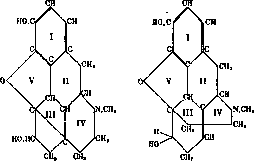
Pschorr's formula. Knorr and Hörlein's formula.
Taking into consideration these discrepancies, the following main features of the structure of morphine can be considered established: 1) morphine contains a phenanthrene group (I, II, and III); 2) the latter contains two hydroxyls: phenolic (in ring I) and alcoholic (in ring III); 3) the carbons making up the terminal rings of the phenanthrene groups I and III are connected through an oxygen atom, thus forming a furan-type ring (V). At the same time, the following relationship between the structure of morphine and its physiological action has been established. The presence of an unclosed phenolic hydroxyl (in ring I) is very important for the character of the action of morphine. The replacement of hydrogen in this hydroxyl by an alkyl, acid, or aromatic radical leads to the formation of compounds of the codeine series, which possess a less pronounced narcotic (and analgesic) and a stronger tetanic action. Thus, the combination of morphine with a methyl radical yields codeine (see), with an ethyl radical yields codetiline, the hydrochloric acid salt of which is known under the name of dionin (see). Both compounds are significantly less toxic than morphine and possess a pronounced reflex-enhancing action. Combination with two acetic acid radicals yields heroin (see). The latter shares many common features with codeine, but is significantly more toxic than the latter, acting as a strong depressant on the respiratory center. It has still not been possible to establish a definite connection between the presence of particular atomic groups in morphine and its analgesic and narcotic action. While Pschorr links the analgesic action of morphine with the isoquinoline group, other authors, denying its presence in morphine, attribute this action to the phenanthrene group. Phenanthrene, to be sure, in itself lacks the characteristic morphine action, but some of its nitrogen-containing derivatives, especially 9-amino-10-hydroxyphenanthrene, named morphigenin by Fahlen, and N-methyldiphenyleneimidazole (epiosine)
OH
N I
! !
epiosin possess a certain narcotic and analgesic action, which is why it is possible to assume that this action of morphine depends on the phenanthrene contained within it, which is in this connection linked to the nitrogen-containing group (IV). As for the exciting action of morphine, manifested in increased reflexes and a tetanizing effect, especially pronounced in certain species of animals, this action can more easily be linked to the phenanthrene group, since phenanthrene derivatives containing a hydroxyl group—phenanthrols—possess such a reflex-exciting action. Morphine is not a protoplasmic poison. Bacteria and molds can develop in a 1% solution of morphine. The germination of maize and beans is not delayed by morphine, while the germination of wheat and peas is somewhat delayed. Morphine also has a weak effect on enzymatic processes. On infusoria, morphine acts weaker than all other alkaloids. Similarly, it does not affect Ascaris, while Daphnia continue to move rapidly in a 1% morphine solution. Local action. On intact skin, morphine and its salts do not have a noticeable effect. Investigations by numerous authors on the effect of subcutaneous administration have not yielded entirely consistent results. A number of authors observed an anesthetic effect of morphine, as well as of other opium alkaloids, which depends on the action of morphine on the corresponding nerve endings. Apparently, morphine also affects nerve trunks. According to Eulenburg, upon subcutaneous administration of morphine, the analgesic effect extends to the area where the nerve branches of the trunk are located, near which the morphine was injected. F. Hacker, who observed the same pain-relieving effect upon the introduction of the hydrochloric acid salt of morphine, attributes this action to hydrochloric acid, since he did not observe it upon the introduction of morphine salts of succinic and meconic acids, as well as the free base (the latter, however, in view of its poor solubility, was introduced at a significantly lower concentration). In any case, everyone agrees that the local anesthetic effect of morphine is very weakly expressed, and the effect of pain reduction observed when morphine is injected into a painful area depends mainly on the resorptive action of morphine on the central nervous system. A more pronounced local action, apparently, is possessed by morphine in relation to the endings of sensory nerves in the intestine (see below). On motor nerves, the action of morphine is even weaker than on sensory nerves. Locally, morphine also affects the walls of capillaries, increasing their permeability to blood plasma, which is why after intradermal injection of morphine, cases of urticaria accompanied by itching have been described at the injection site. Finally, locally, morphine has an effect on smooth muscle elements (see below). Absorption of morphine, its fate in the organism, and its excretion. Morphine is not absorbed from aqueous solutions by intact skin, but is absorbed rapidly by skin deprived of the epidermis. By mucous membranes, morphine, like all other alkaloids, is absorbed, but not everywhere equally rapidly, and the rate of absorption depends on a number of conditions, of which the nature of the solvent and the site of absorption are of particular importance (see). Some mucous membranes, including the gastric mucosa, absorb morphine very slowly, significantly slower than the intestinal mucosa. From the subcutaneous tissue, upon subcutaneous administration, morphine is absorbed rapidly. Absorbed morphine for the most part very rapidly disappears from the blood, with part of it being destroyed, part retained by the organism, and part excreted. The destruction of morphine can occur with varying intensity, and habituation to morphine is of particular importance, during which the destruction of morphine increases, while the amount of excreted morphine, as shown by Faust's experiments on animals and observations on humans by Bornträger, drops. Of the organs, morphine is retained most of all by the liver. According to Marquis, 1/4 hour after the intravenous administration of 0.06 of morphine to a cat, about 33% of the administered amount was found in the liver, 5% in the kidneys, 3% in the stomach, 1.3% in the blood, 1% each in the brain and lungs, and 0.85% in the spleen. The amount of morphine in the liver decreased rapidly; after 1 hour it was equal to 10%, and after 2 hours 1.6%; in the remaining organs the fluctuations are not large; later morphine also appears in the intestine—after 2 1/2 hours in the small intestine (1.7%) and large intestine and feces (1.6%). Morphine is retained in the organs partly in an unchanged form, partly in combination with some other not yet precisely determined chemical components. Excretion of morphine is mostly through feces, even with parenteral administration. It enters the digestive tract along with the secretion of digestive glands. Morphine excreted into the stomach or intestine can be reabsorbed. Experiments on animals have shown that repeated gastric lavage and the removal of morphine in this way can save an animal to which a lethal dose of poison has been administered. A smaller part of morphine is excreted in the urine. In the latter, morphine is found both in unchanged form and in the form of oxydimorphine and other not precisely determined products. The resorptive action of morphine is manifested mainly on the central nervous system, and this action in various species of animals differs both in strength and in the character of the action. As a general rule, it can be stated that the lower a given species stands in the evolutionary series, the larger the dose of morphine (calculated per unit of living weight) is needed to poison the animal. This dependence can be explained by the fact that in lower species the upper (anterior) parts of the brain, which morphine affects most strongly, are less developed and play a smaller role in the general vital economy than in species standing at higher stages of development. It is more difficult to explain the resistance to morphine on the part of some highly organized species, such as pigs and goats. The most marked difference in the character of morphine's action on various species of animals is that in some animals morphine causes mainly depression, while in others it causes excitation. Thus, in the rabbit and dog, morphine causes stupor, immobility, and a tendency to sleep; in the dog, moreover, vomiting is characteristic, and with large doses, diarrhea; in ungulates, a urge to move is observed—the animals cannot stand still in one place; the domestic cat becomes unusually timid and rushes about the cage disorderly. In addition, in some animals, and not only in those on which morphine acts depressant, but also in those which it excites (cat, horse, donkey), morphine affects the higher centers that determine the expediency of animal behavior, while in others, specifically those that tolerate particularly large doses, these centers turn out to be little affected. The latter difference indicates that the higher parts of the brain (located in the cortex) in some animal species are less susceptible to morphine (perhaps because under the conditions of nutrition, the ancestors of these animals had to develop insensitivity to morphine or alkaloids close to it). As for the question of why morphine acts depressant on some animals and exciting on others, this question is all the more interesting since a similar difference in the action of morphine is also observed in humans. While morphine acts on humans as a rule depressantly, certain Eastern races (especially Malays), and among Europeans some neurotics, react to morphine not with depression, but with excitation. Such a dual action of morphine can be explained in the following way. The phenomena of depression depend on the damage to the corresponding departments of the central nervous system, and the departments located in the cerebral cortex suffer. It should be noted that the depression of the latter is also observed in those animals in which morphine causes excitation. After the administration of morphine, the cat is not only excited and timid, but also "insane": all acquired conditioned reflexes disappear in it, and it orients itself poorly in the surrounding environment, the consequence of which is a series of completely inappropriate movements. The phenomena of excitation with morphine, as with alcohol, depend to a large extent on the inhibition of higher inhibitory centers. According to Hitzig, animals poisoned with morphine behave like decerebrated ones. However, one can also assume a direct exciting action of morphine on certain brain functions, especially motor functions (perhaps through primary excitation of subcortical centers). The possibility of a direct exciting action of morphine is supported by a number of facts observed not only in animals excited by this alkaloid, but also in humans and in animals depressed by morphine, for example: the revitalization of certain vital processes at the initial action of morphine in humans; the deepening of respiration in certain phases of morphine action; central vomiting in dogs and neuropaths; the position of the tail in mice, depending on the excitation of certain departments of the spinal cord; the exciting action on smooth muscles; and finally, the undoubtedly exciting action on the central nervous system of the closest derivatives of morphine—codeine and thebaine. It should be noted that the phenomena of morphine depression are also explained by some prominent scientific authorities as the direct excitation of the "sleep center." This center, recognized nowadays by the majority of physiologists (including I. P. Pavlov), is localized in the subcortical region.
According to Kohnstamm and Economo, the sleep center, like all centers governing periodic activity where one phase is replaced by another—the opposite one—consists of two mutually antagonistic sections: the «sleep center» (in the narrow sense) and the «wakefulness center». Hans Meyer and Pick, who recognize the direct excitation of the «sleep center» by morphine (as well as scopolamine), assume only its indirect excitation under the action of hypnotic drugs of the fatty series as a result of the depression of the «wakefulness center». These centers (of sleep and wakefulness) are in interaction with the cortex and are inhibited by it. The depression of the cortex, undoubtedly existing under morphine, indirectly excites the «sleep center» in humans. In the cat, the same depression of the cortex indirectly excites the «wakefulness center». According to this explanation, morphine, by eliminating the influence of the cortex, indirectly excites both the «sleep center» and the «wakefulness center», upon which it probably also acts in a directly excitatory manner. Such a dual action of morphine is sometimes possible to observe directly, as for example in certain cases of idiosyncrasy to morphine in humans, when a sharp increase in reflexes is observed during morphine sleep. Usually, however, as already indicated above, phenomena of depression or phenomena of excitation sharply predominate. This depends on the fact that the opposite centers mentioned above (of wakefulness and sleep) act on each other (like the centers of antagonistic muscles) in a mutually inhibiting manner, which is why the excitation of some is accompanied by the depression of others. Thus, the final effect is a consequence of the predominance of one or the other center over the opposite one. In view of the fact that in some animal species the «wakefulness center» (motor) is more excitable, and in others the «sleep center» (inhibitory), the action of morphine is essentially the same for all animals, and can outwardly manifest itself as excitation in some animals and depression in others. The same explanation is applicable to humans, in whom racial differences, constitution, and the state of the nervous system determine the relative degree of excitability of these centers. However, the frequently observed phenomena of excitation under the influence of morphine among Eastern peoples can also be explained by the large percentage of opiophagists among them, in whom the phenomena of poisoning proceed differently than in persons unaccustomed to opiates, since habituation is created predominantly to the depressing, rather than the exciting, action of poisons. The picture of the action of morphine in humans varies depending on the dose. At minimal doses (5 mg), a certain decrease in pain sensitivity, a certain depression of respiration, and a weakening of cough, if present, are observed. At the same time, any other unpleasant sensations are also depressed, such as the feeling of hunger, fatigue, and similar somatic sensations, as well as unpleasant experiences of a psychological character, for example, fear. All this appears more sharply after 10 mg, especially when administered subcutaneously; at the same time, pain sensitivity drops sharply, and clear euphoria sets in. The capacity for external perceptions, as studies by Kraepelin have shown, is not depressed at this point, nor are intellectual abilities for work that does not require special strain. Fantasy becomes even more vivid than under normal conditions, but the perception of time and space is less distinct, and the arising fantastic images resemble dreams. At the same time, the concentration of attention is difficult, and the capacity for volitional acts necessary for the production of movements is reduced. At the same dose (10 mg), some time after taking morphine, there is a tendency toward sleep, which sets in the easier the fewer external stimuli are present, while in the presence of the latter, for example noise, sleep may not occur at all. Sleep at this dose is superficial, accompanied by dreams, and it is not difficult to wake the sleeper. After large doses (15-30 mg), sleep becomes very deep, without dreams. Although it is possible to wake someone from such sleep, the awakened person, if special measures are not taken, immediately falls asleep again. Other characteristic symptoms of the action of morphine at large doses are a significant slowing and irregularity of respiration and narrowing of the pupils, the more pronounced the higher the dose. The face at large doses acquires a crimson color, the skin is hot at a low internal temperature. Difficulty in urination is observed. At even larger, poisoning doses, the poisoned fall into a stuporous state and coma, the complexion pales and takes on a cyanotic hue, the pupils have the appearance of pinpoints, and breathing may become Cheyne-Stokes. For an adult human unaccustomed to morphine, poisoning doses, according to Gottlieb, begin at 0.03-0.05. The minimal lethal doses are 0.2, and the average lethal is 0.3-0.4. According to Kunkel, the minimal lethal dose is 0.09; the usual lethal is 0.1, the absolute lethal is 0.2. According to Kobert and Erben, the lethal dose per os is 0.3-0.4; with subcutaneous administration, it is 0.2-0.25. Children are especially sensitive to morphine; according to Gottlieb, ¾ of the cases of poisoning with morphine or opium occur in children under five years of age; newborns are even more sensitive. Therefore, when prescribing morphine to children, especially under 5 years of age, extreme caution is required, and its prescription, as well as opium, to children under 1 year of age is completely contraindicated. Caution is also required when prescribing morphine to nursing women in view of the possibility of morphine passing, albeit in small quantities, into milk. For pregnant women (but not women in labor), the administration of morphine is permissible, since morphine affects the respiratory center, which is inactive in the fetus; the intake of morphine immediately before childbirth is dangerous in that the infant may be born with a paralyzed respiratory center. Morphine has an effect on all parts of the central nervous system. After the brain, morphine affects the medulla oblongata and finally the spinal cord, differing in this respect from narcotics of the fatty series, which affect the spinal cord before the medulla oblongata. In the brain, as can be seen from the picture of poisoning, the parts perceiving pain sensations are depressed earliest of all, and unlike the action of substances of the fatty series, such as chloroform and ether, the pain-relieving effect is observed without depression of consciousness. The weakening of the sensation of pain is expressed especially sharply in relation to continuous pains, whereas sudden stimuli are perceived (according to Cushny) almost in the same way as without morphine. Cushny explains this by a weakening of attention to constant stimuli. According to Head, this effect concerns the synapses in the region of the basal ganglia of the brain, thanks to which the pain sensation does not reach the cortex. The revival of fantasy observed under morphine along with the easier production of undemanding mental work may partly depend on the exciting action of morphine, but may also be a consequence of depression...
7 6 in view of the removal of inhibitory influences (Johnson). According to some authors, this indirect effect of morphine is of primary importance. Subjectively, this effect of morphine is perceived as an increase in mental powers and, along with the reduction of all painful and unpleasant sensations, serves as the basis for the onset of euphoria, which, however, is observed only with small doses of morphine. With large doses, depression phenomena sharply manifest themselves, which is expressed in the form of sleep, a soporose state, and coma. However, such complete depression of the cortex by morphine, as occurs with fatty-series narcotics, cannot be achieved even under the strongest morphine action. In response to electrical stimulation of the corresponding section of the cortex, a motor reaction is always obtained (Hitzig). The action of morphine on the medulla oblongata is expressed in its effect on the respiratory, vasomotor, and vagus nerve centers located within it. In view of the fact that morphine acts on the medulla oblongata earlier than on the spinal cord, death in warm-blooded animals and humans from morphine poisoning occurs before all aspects of its spinal cord action are fully developed, so that usually only the initial stages of this action can be observed, namely, some weakening of spinal cord reflexes. If, however, the animal's life is maintained by artificial respiration even after the paralysis of the respiratory center, the excitation of the reflex apparatus can be observed. Reflexes sharply increase, and convulsions resembling those of strychnine may appear. Sometimes, if death does not occur for a long time, the same phenomena are observed even with natural breathing (even in humans). Considerably more sharply than in warm-blooded animals, reflexes increase in the late period of morphine action in frogs, which can also be observed in decapitated animals. The latter proves the direct dependence of the phenomena in question on the spinal cord. On human respiration, morphine acts chiefly in a depressing manner. This effect manifests itself already after small doses of morphine (5 mg) and is expressed in a lesser excitability of the respiratory centers. Various stimulants of the latter, including the rise of CO2 in the blood, cause, as experiments by Levy, Lindhard, and others (Loewy, Lindhard) have shown, a significantly smaller effect than under normal conditions. Here, the respiratory rate decreases earliest of all. As for its depth, according to Cushny, with small doses it may first decrease and then increase with a slowing of the rhythm, while the total amount of ventilation air usually still remains reduced. Observations by Higgins and Means, who applied 5 mg on humans, yielded somewhat different results. The indicated dose, without reducing the respiratory rate, lowered the amount of ventilation air; in other words, it lowered the depth of respiration. At the same time, the CO2 content in the alveolar air increased, while the amount of O2 absorbed per unit of time remained unchanged. According to B. v. Issekutz, the preceding state of respiration is of decisive importance for the effect of morphine on respiratory depth. If shortness of breath was observed before taking morphine, morphine eliminates it, breathing becomes deeper, and the amount of air ventilating the lungs increases, whereas on normal breathing morphine acts in a depressing manner, lowering the energy of each individual breath. With large doses of morphine, respiration, apart from weakening, becomes irregular and may acquire the character of Cheyne-Stokes respiration. According to experimental data by Schmidt and Hager, morphine has a stronger effect on the expiratory section than on the inspiratory section of the respiratory nervous apparatus. According to these authors, the depressing action of morphine precisely on the first section, by making the onset of expiration difficult, slows down the respiratory rhythm. The deepening of respiration sometimes observed under the influence of morphine can also be explained by the same action, since the depression of the expiratory section contributes to a more complete activity of the inspiratory section. Currently, physiologists recognize the existence of respiratory centers in the brain as well, in addition to the main bulbar and accessory spinal respiratory centers. From the experiments of R. Schön, who investigated the effect of morphine on rabbits with removed parts of the brain, it follows that morphine affects the midbrain center (in the region of the posterior colliculi), exciting respiration (acceleration and deepening of respiration), and has a depressing effect on the centers of the optic thalamus, the corpus striatum, and (probably) the cerebrum (slowing and disturbance of the regularity of respiration). Thus, the dual nature of morphine's action is confirmed here as well, as was pointed out in the general characterization of its action on antagonistic centers. An essential difference between the action of morphine on respiration and specific stimulants of the latter, such as CO2 and lobeline, is, according to Schön, the localization of action. While morphine affects superbulbar centers (exciting some and depressing others), CO2 and lobeline act through bulbar centers. The Cheyne-Stokes respiration observed in poisoning with large doses of morphine depends, according to Schön, on the effect of morphine on the centers located in the optic thalamus, corpus striatum, and cerebrum, since it is not observed in decerebrate animals lacking the aforementioned centers. Furthermore, along with a decrease in the sensitivity of the respiratory centers to the pH of the blood, morphine also lowers their reflex excitability. Irritation of the sensory nerves of the oral cavity, nose, and larynx—the trigeminal and superior laryngeal nerves—does not produce the usual effect; for example, a rabbit's inhalation of ammonia vapors does not so easily cause a cessation of respiration. This action of morphine is undoubtedly connected with the general depression of sensitivity by morphine. In decerebrate rabbits, morphine increased the reflex effect of ammonia inhalation (Cushny). Along with its depressing effect on respiration, morphine affects in a similar manner the cough center, which is closely linked to the respiratory center. The antitussive action of morphine, as already indicated, manifests itself with the use of very small doses of morphine. In view of the fact that cough movements are predominantly expiratory, the data cited above on the depression of the expiratory section by morphine are of particular interest. In the action of morphine on coughing, an essential moment is the reduction of reflexes from the sensory nerves of the respiratory apparatus (especially the superior laryngeal nerve). This action of morphine is especially pronounced in this case because the irritation here is continuous rather than intermittent, i.e., it has precisely the character in which the action of morphine manifests itself most strongly, according to Cushny. The effect of morphine on the lumen of the respiratory tract is uncharacteristic. Morphine exerts a much smaller effect on circulation than on respiration, so that its influence is usually not taken into account at all in therapy. Therapeutic doses, as well as large ones, initially exert a certain stimulating effect on the heart in humans, expressed in the acceleration and strengthening of heart contractions, which is then replaced by some slowing of the pulse, especially upon the onset of sleep. The pulse rhythm with large doses may become irregular, ventricular contraction may not coincide with atrial contractions, and the disturbance of cardiac conduction can reach complete atrioventricular block. All these phenomena can be eliminated by poisoning the endings of the vagus nerve with atropine, by cutting this nerve, and finally by even larger doses of morphine paralyzing the vagus nerve center. In dogs, the pronounced slowing of the pulse from morphine is also caused by an increase in the tone of the vagus nerve centers, which Gottlieb attributes to morphine's depression of the cortex, which inhibits the vagus nerve center during wakefulness; but it is also possible to assume the excitation of this center by morphine via the sleep center, as well as a direct excitation, evidenced by the persistence of this symptom during habituation to morphine, while symptoms of depression extremely weaken. According to Smirnov's experiments on dogs, morphine sharply increases the vagotropic action of calcium, which this author explains by the elimination of the cortex's influence on the vagus nerve center. Very large doses of morphine weaken heart activity, with the weakening of respiration and the resulting anoxemia playing a significant role here, alongside vasomotor disorder. The direct action of morphine on the heart is even less pronounced. On the isolated heart of the cat and rabbit (Vinci, Arbuzov), morphine in small doses exerts first a stimulating and then a depressing action. A high concentration (0.5–1.0:1000) of morphine in the nutrient fluid depresses the heart. The dog's heart is especially sensitive to morphine. The rabbit's heart is the least sensitive. Blood pressure under the influence of morphine remains within normal limits for a long time. The dilation of the facial and bodily vessels already observed at initial degrees of morphine poisoning, causing their crimson color and, after the development of asphyxia, a bluish color, depends on the action of morphine on the vasomotor center; this partial vasodilation does not affect blood pressure, because it is compensated either by the heart or by the tone of the internal vessels. In deep poisoning and dilation of internal vessels, the face may become paler while retaining a bluish tint.
On the vessels of the lesser circulation, as recent experiments by Luisada and Schweitzer have shown, morphine begins to exert a certain effect only at doses significantly exceeding therapeutic ones. The speed of blood circulation under the influence of morphine, as shown by Shcherbak's studies on dogs, first increases and then, at toxic doses with vasodilation and weakening of cardiac activity, sharply drops, especially in veins. Frequently, morphine in large doses, both when taken orally and subcutaneously, causes nausea and even vomiting, which, however, is more often observed already in the after-effect period. In dogs, vomiting is observed as a rule still in the first period of action. Vomiting here is central and does not depend on the irritating action of morphine on the sensory nerves of the stomach and intestines, since it can be caused, as experiments by Eggleston and Hatcher have shown, in animals with excised viscera. Along with this, preliminary administration of morphine even in small doses prevents vomiting caused by apomorphine, which still has not received an exhaustive explanation. Probably the vomiting caused by morphine and apomorphine depends on the action of these alkaloids on different centers. In that case, the antiemetic effect of morphine against apomorphine can be explained by the depressing action of morphine on the center excited by apomorphine. The difference between the centers from which vomiting is elicited by apomorphine and morphine is proved, among other things, by the fact that by using morphine
as an unconditional stimulus, Krylov obtained a conditioned reflex of vomiting in a dog to an injection or even to being placed in a machine, whereas when using apomorphine, which excites another (lower) center, a similar effect cannot be obtained. On digestion, morphine has an effect by influencing the secretory and motor functions of the digestive apparatus. This effect is expressed in the following: in humans under the influence of morphine, a decrease in saliva secretion and dryness in the mouth are observed. The secretion of the gastric glands is first inhibited, and then after a latent period (from 1/2 to several hours) sharply increases; the excretion of bile, pancreatic juice, and intestinal glands decreases. The same in general is observed in animals, although in dogs salivation is observed, associated with a period of nausea and vomiting. On the chemistry of digestion, morphine generally has a weak effect, and the effect, consisting in some cases in improvement and in others in deterioration of digestion, according to the experiments of Fujitani (Ri, Nash) (in vitro) depends not on the alkaloid itself, but on the acid residues associated with it. Thus, according to Fujitani's experiments, 1% and 2% solutions of morphine hydrochloride increase the digesting power of pepsin, and 0.01%-2% morphine sulfate decreases it. - On the motor function of the digestive tract, morphine acts very complexly. This effect is partly of a local, partly of a resorptive character and is a consequence of the influence of morphine on the central nervous system and on the endocrine apparatus. At the same time, the effect of morphine in various animals is different, and the causes of this difference are not yet fully elucidated. As a general rule, small and moderate doses of morphine in all species of animals cause phenomena of constipation, while large doses in some species, such as cats and dogs, cause phenomena of diarrhea. In humans, constipation is observed at all doses. - The local action of morphine is expressed here in the following. Morphine causes, as Magnus's experiments on cats have shown, a prolonged closure of the pylorus (spasm of the prepyloric, then pyloric sphincter), due to which the contents of the stomach are retained in it for a long time (up to 20-30 hours). This effect, especially sharply expressed in cats, and partly in dogs, is, according to Magnus, the main cause of morphine constipation in cats, and in cats it is observed even when all nerves going to the digestive tract are cut, which proves the local origin of the phenomenon. In humans, the closure of the pylorus by morphine is weakly expressed and moreover only at a young age and at relatively large doses (starting from 0.01). At 0.005 (when administered subcutaneously or per os) there is no closure of the pylorus, and due to increased gastric peristalsis, food passes from the stomach into the duodenum even earlier than normal. Along with the closure of the pylorus, morphine causes spasmodic closure of other sphincters - the ileocecal and rectal. The action of morphine on the intestine of various animals also presents much diversity. According to the experiments of P. Trendelenburg, morphine acts on an isolated loop of the intestine of a guinea pig, inhibiting peristalsis and lowering the tone of the intestine. A similar effect is exerted by morphine, according to Gottlieb, probably also on the human intestine, while on the isolated intestine of other animals (rabbit, dog) morphine, as well as codeine and thebaine, has an excitatory effect. The local locking action of morphine is probably reinforced (although this is not recognized by all researchers) by its central action through the splanchnic nerve. The centers of the latter, which inhibit peristalsis and cause spasm of the intestinal sphincters, are excited by morphine similarly to how this happens during physiological sleep. In this same effect of the inhibitory influence of the splanchnic nerves, an increase in the blood under the influence of morphine of the adrenaline content, this specific exciter of the nerve endings of the sympathetic system, to which the splanchnic nerve also belongs, can also play a certain role. The slowing down of peristalsis and the closure of the intestinal sphincters entail a longer stay of the contents in it. This in turn contributes to greater absorption of water by the intestine, which makes the consistency of the contents denser. The decrease in the secretion of the digestive glands also acts in the same direction. Furthermore, peristalsis is also slowed down because morphine acts in a depressing manner on the endings of sensory nerves in the intestine, as a result of which local irritations do not have the same effect on intestinal movement as in normal conditions. Finally, in those cases where peristalsis is enhanced due to excitation of the vagus nerve system, morphine has a calming effect, paralyzing the endings of the vagi nerves, as Jacobi's experiments have shown. In general, in humans under the influence of morphine, food is not retained in the stomach, and sometimes leaves it even earlier than normal; along the small intestines it moves slower than normal; the main cause of constipation depends on the retention of food in the large intestines. In addition to the intestine, morphine also affects other organs with smooth musculature. A characteristic phenomenon in morphine poisoning is constriction of the pupils. It is observed only in humans and those animals on which morphine acts depressingly; at severe degrees of poisoning, the pupils can take the size of pinheads. Awakening from morphine sleep is not immediately accompanied by dilation of the pupils, as happens, for example, during chloral sleep. Upon the onset of asphyxia in the final stage of poisoning, pupil constriction is replaced by dilation. In animals on which morphine acts excitingly, it causes not constriction, but dilation of the pupils. Morphine pupillary constriction is of central origin, is not caused by the local application of morphine to the eye, and depends on an increase in the tone of the oculomotor nerve center. Atropine, which paralyzes the endings of the oculomotor nerves, destroys the constriction. As for the causes of the increase in the tone of the mentioned center, apparently a phenomenon analogous to the excitation by morphine of the vagus nerve center and depending on the depression of the cortical inhibitors of the oculomotor nerve center takes place here. Excitation of the oculomotor nerve center, occurring as a consequence of the excitation of the "sleep center," is also possible, since in all types of sleep, both natural and narcotic, this center is directly or indirectly excited and the pupils constrict. Finally, the possibility of direct excitation by morphine of the oculomotor nerve center is not excluded. Morphine causes simultaneously with pupil constriction an increase in the ability to diverge the visual axes. The ability to converge, as well as to movements of the eyeball in general, decreases. Changes in the pupil and mobility of the eye muscles, as well as sometimes observed temporary accommodation disorder (spasm), can affect visual acuity. Morphine acts excitingly on the uterus. In view of the fact that this action has also been detected in experiments on isolated uteri of cats and guinea pigs, it follows that it is at least partly of peripheral origin. Morphine also acts excitingly on the sphincter of the bladder, which is why during morphine poisoning difficulty in urination is observed, sometimes accompanied by painful urges for the latter. Like pupil constriction, sphincter spasm can also be observed in the after-effect period after awakening from morphine sleep. Gottlieb explains this action of morphine by the depression of those sections of the nervous system that inhibit the center controlling the sphincter; but other explanations are also possible here (e.g., through the sleep center) analogous to the just-cited explanations of morphine miosis. It should be noted that atropine does not always terminate bladder sphincter spasm. - When examining the local action of morphine, it was already pointed out that the subcutaneous administration of this alkaloid sometimes causes itching, urticaria phenomena, and edema around the injection site. Similar phenomena are observed in some individuals possessing an idosyncrasy to morphine, and as a result of resorptive action, and these skin phenomena are sometimes accompanied by chills. Usually, when using even therapeutic doses of morphine, a somewhat increased sweat excretion is observed, which deserves special attention in view of the fact that morphine has an inhibitory effect on almost all glands. The action of morphine on metabolism is very complex. Here there is a number of indirect influences, such as the influences of morphine on motor functions, on respiration, on the endocrine apparatus, on temperature, etc., i.e., a number of influences, all of which undoubtedly exert one or another influence on metabolism. In addition, the possibility of a direct action of morphine on the centers that control metabolism is not excluded. It is often not possible to establish what the mechanism of one or another final effect is, especially since the result of the action of morphine in various cases can bear a far from identical character. Influencing the general behavior of the animal, morphine in those animals on which it acts calmingly lowers gas exchange, and in those on which it acts excitingly, raises it. It was indicated above that morphine lowers the sensitivity of the respiratory center to CO2; therefore, CO2 excretion in people after taking therapeutic doses of morphine decreases, while O2 absorption remains normal (Higgins and Means, Heymans).
With large doses, oxygen consumption also decreases, while at the same time the content of lactic acid in the blood and urine increases, and acidosis increases. Under the influence of morphine, body temperature drops, which largely depends on the depressing effect of morphine on the thermoregulatory center. At the same time, with morphine, there is also an easier increase in body temperature compared to the norm at a high ambient temperature, and this is because the organism no longer protects its temperature from either lowering or raising to the same extent as in the norm. A certain drop in temperature, however, occurs in animals even after the removal of the brain sections containing the thermoregulatory center. Morphine has a relatively weak effect on general nitrogen metabolism; purine metabolism, however, decreases quite sharply. The effect of morphine on carbohydrate metabolism is not always the same. Thus, morphine, especially in large doses, is capable of causing the disappearance of glycogen from the liver, hyperglycemia, and glycosuria. At the same time, as experiments by some authors have shown, morphine excites the sympathetic nervous system center. Excitement from the latter is transmitted to the adrenal glands, which thereby increase the release of adrenaline, which in turn contributes to the mobilization of liver glycogen. It should be noted that the removal of adrenal glands only temporarily lowers morphine hyperglycemia, which indicates the presence of other causes causing the latter. On the other hand, in some cases, as for example in diabetes, morphine lowers hyperglycemia and glycosuria. The mechanism of action is not entirely clear here either. According to Ahlgren, morphine acts in this case insulin-like, and the effect is associated with certain features of the structure of the morphine molecule. Morphine belongs to the number of substances to which a habit is easily formed (see below - morphinism). The therapeutic use of morphine and opium containing it is extremely great, and the saying of one of Paracelsus's pupils, Sylvius de le Boe, has not yet lost its meaning: "Nollem praxim medicam exercere, si carerem opio" ("I would not want to practice the medical art if I were deprived of opium"). Morphine (and opium) is used for the following purposes: 1) To alleviate and eliminate pain, in particular in various types of colic. However, sudden pains are suppressed weakly by morphine, which is why it cannot be used by itself in surgical operations. The benefit of morphine as an analgesic is not limited to reducing the sufferer's pain, but also partly favorably affects the course of the pathological process, since, by bringing relief, it places the patient in more favorable conditions to fight the disease. A contraindication to the administration of morphine is the chronic nature of the pains, since in this case morphinism easily develops. Therefore, in such diseases, it is advantageous to replace morphine with opium and even better with codeine, to which no habit is formed, but which, on the other hand, also has a weak effect on pain. 2) As a sleeping pill in cases where insomnia is caused by pain, cough, and other unpleasant sensations. 3) For cough, especially dry, and morphine is often given in combination with expectorants (e.g., Dover's powder). Here, the replacement of morphine with codeine and dionin is appropriate. The administration of morphine for cough with abundant secretion is contraindicated, since the retention of the latter in the respiratory tract is undesirable. 4) For shortness of breath of pulmonary origin, morphine may be prescribed in order to reduce the abnormally increased excitability of the respiratory center and contribute to the establishment of a more productive respiratory regimen. In this case, the administration of morphine requires special care. 5) In heart diseases, when shortness of breath is their consequence (circulatory). The benefit here consists, firstly, as with shortness of breath of pulmonary origin, in lowering the excitability of the respiratory center and in reducing shortness of breath as a result; secondly, in calming palpitations, insofar as the latter depends on shortness of breath. In hemorrhages, morphine is useful as a means contributing to the calmer behavior of the patient. 6) In asthma, the administration of morphine requires special circumspection in view of the possibility of the development of morphinism. 7) In diarrhea (preferably opium) - for the sake of calming peristalsis and reducing pain. It is often prescribed after a laxative, with the help of which it is expected to expel substances that caused diarrhea from the intestine. When calomel is used for this purpose, the subsequent administration of morphine requires caution and is possible only with the certainty that all portions of calomel have been excreted. 8) In peritonitis, for the sake of reducing pain and weakening intestinal movements, morphine and opium are prescribed. 9) In lead colic and other spasmodic contractions of the intestine, morphine (opium) is prescribed along with atropine. 10) In mixed anesthesia, and the injection of morphine makes it possible to use the main narcotic in significantly lower doses, e.g., in chloroform + morphine anesthesia, especially in combination with ether (in so-called Rauschnarkose) and narcotics used by non-inhalation methods: hedonal, scopolamine, avertin, magnesium salts, etc. (see General anesthesia). 11) In hemorrhages in the intestine, lungs, and other places inaccessible to mechanical or surgical intervention, for the sake of reducing intestinal movement and calming the patient, which is very important for the independent cessation of bleeding. 12) In nausea, morphine in small doses can sometimes bring benefit, similar to how it acts in apomorphine vomiting (see above). 13) Morphine was prescribed (supposedly with success) in malaria (Cushny), and the mechanism of action has not been clarified. 14) Previously, morphine was sometimes prescribed in diabetes. - Contraindications to the administration of morphine: 1) Childhood age, and up to 5 years it is recommended to use not morphine, but opium, and even then with extreme caution, and up to 1 year to completely refrain from prescribing opium either. 2) Chronic nature of pain - to avoid the development of morphinism. 3) Deep lesion of the respiratory center. Thus, for example, in poisoning with war gases of the asphyxiating group, the administration of morphine requires great caution. 4) Tendency to brain hyperemia, especially in old age, in view of the increase under the influence of morphine of congestive phenomena in the brain, which, among other things, is expressed in some individuals by headaches in the after-effect period. - Diagnosis of morphine or opium poisoning can present certain difficulties. Along with general symptoms of poisoning - red-crimson or pale-cyanotic facial skin, rare, sometimes irregular breathing, weakening of reflexes - the most characteristic sign is extreme narrowing of the pupils and their weak reaction to light. In opium poisoning, a characteristic odor from the mouth is added to this. Treatment of acute poisoning consists first of all in gastric lavage, even in the case of subcutaneous injection of the poison. In the latter case, lavage intends the removal of morphine, which was excreted from the blood into the gastric cavity. Lavage can be performed with water or a weak solution of potassium permanganate (1 : 2,000) in order to destroy morphine. The administration of emetics is not expedient, as it may remain without result. Potassium permanganate is also given per os in a 1 : 250 solution in teaspoons every 10-15 minutes to destroy morphine. For the purpose of adsorption of morphine, it is useful to introduce animal or other, if possible activated, powdered charcoal. It is useful to administer an enema to remove morphine from the intestine. Enemas should be repeated, whereas repeated gastric lavage in later stages of poisoning is hardly expedient in view of the fact that morphine is no longer excreted into the gastric cavity at this time. The further task of the doctor is to maintain the activity of the respiratory center. For this purpose, various external physical and chemical irritants are used: cold water on the back of the head, mustard plasters, rubs, etc. For the same purpose, the patient is prevented from sleeping if possible, forced to walk, being led by the arms ("outpatient" treatment). At this time, they rely on the excitation of the wakefulness center, antagonistic to the sleep center. At the same time, they strive to excite the respiratory center with a number of pharmacological agents: caffeine is used in the form of subcutaneous injections (10% solution 1-3 cm3) and internally in the form of strong coffee and tea, subcutaneous injections of strychnine (Strychninum nitr. 1% solution 1-3 cm3), lobeline (Lobelinum hydrochlor. up to 0.01 subcutaneously or intramuscularly), camphor, inhalation of CO2 (5-7% mixed with air or O2). The use of atropine proposed as an antidote as an antagonist of morphine, exciting respiration, requires special caution. Experiments on various animal species prove the synergism of the action of morphine and atropine used in any significant doses. The use of bloodletting with the expectation of excreting the poison with subsequent infusion of physiological solution with the expectation of washing the poison out of the central nervous system can hardly give particularly favorable results. In case of respiratory arrest, artificial respiration is used, and it is maintained as long as the heart continues to contract. Preparations. - 1. Morphium, s. Morphinum, morphine; properties - see above; in the form of the base is not used in therapy. - 2. Morphinum hydrochloricum, s. muriaticum, morphine hydrochloride;
C17H19ON(OH)2HCl + 3H2O; white, silky, needle-like crystals or white cubic pieces consisting of microscopic intertwining needles, soluble in 25 parts of cold water, 1 part of boiling water, 50 parts of alcohol, 20 parts of glycerin, insoluble in ether. Solutions of hydrochloric morphine are neutral and have a bitter taste. Maximum single dose 0.03, maximum daily dose 0.1 (State Pharmacopoeia VII). Used in solutions, powders, pills, suppositories. For subcutaneous injections in a 1 : 50-100 water solution. -- 3. M. aceticum, morphine acetate, C17H19O3N . CH3COOH + 3H2O; white or yellowish-white loose crystalline powder; smells slightly of vinegar, dissolves in 12 parts of cold water and 3 parts of boiling water, in 30 parts of alcohol. (Upon storage, the salt releases part of acetic acid, after which it no longer yields a transparent solution; the latter is obtained by adding acetic acid.) Used like morphine hydrochloride, but not for subcutaneous injection. -- 4. M. hydrobromicum, morphine hydrobromide, C17H19O3N.HBr + 2H2O; colorless needles, soluble in 25 parts of cold and 1 part of hot water, in 50 parts of cold and 10 parts of boiling alcohol. Used like morphine hydrochloride. -- 5. M. l a c t i c u m, morphine lactate, C17H19O3N.CH3CH[OH]COOH; yellowish powder or fine needles; dissolves in 10 parts of water. Used like morphine hydrochloride. -- 6. M. meconicum, morphine meconate, (C17H19O3N)2.C7H4O7 + 5H2O; white powder, easily soluble in water. Used very rarely, like morphine hydrochloride. -- 7. M. oleinicum, morphine oleate, C17H19O3N.C17H33COOH; available on the market as M. oleinicum solutum; a 20% solution in fatty oil. -- 8. M. p h t h a l i c u m, morphine phthalate, (C17H19O3N)2.C6H4(COOH)2; amorphous yellowish powder, readily soluble in water. Used like morphine hydrochloride. -- 9. M. stearinicum, morphine stearate, C17H19O3N.C17H35COOH; white shiny scales, melting at a temperature of about 85°. Dissolves in fatty oils. Solution in almond oil 0.5:50.0 - Morphin61. -- 10. M. sulfuricum, morphine sulfate, (C17H19O3N)2.H2SO4 + 5H2O; colorless needles; soluble in 20 parts of cold and 1 part of boiling water, sparingly soluble in alcohol. In the air, especially at 30-40°, it loses water of crystallization. Used like morphine hydrochloride. Maximum single dose 0.05, daily dose 0.15 (Hager). -- 11. M. tartaricum, morphine tartrate, (C17H19O3N)2.C4H6O6 + 3H2O; small colorless needles, often combined in small bundles. Easily effervesces in air (already at 20°). Dissolves in 11 parts of water, almost insoluble in alcohol. -- 12. M. valerianicum, morphine valerate, C17H19O3N.C4H9COOH, colorless shiny crystals smelling of valerian acid. Used like morphine hydrochloride. -- 13. N a r c o - p h i n (C. F. Boehringer und Söhne, Mannheim-Waldhof), double salt of morphine and narcotine with meconic acid, C17H19O3N.C22H23O7N.C7H4O7(COOH)2 + 4H2O; white powder, soluble in 12 parts of water and 25 parts of alcohol. 1 part of narcophine and 1 part of water give a syrupy solution, which becomes cloudy upon the addition of water, and clears up again upon its further addition. Contains 33% morphine; 100 parts of narcophine correspond to 32 parts of morphine hydrochloride. The presence of narcotine in the preparation enhances the narcotic effect of morphine without enhancing its side effects. Used like morphine hydrochloride. Together with scopolamine for anesthesia. Single doses 0.015-0.03. -- 14. A m n e s i n, an aqueous solution containing in 1 cm3 0.2 of Chinini dihydrochlorici carbamidati and 0.012 of morphine-narcotine lactate. Used as a painkiller in childbirth. Subcutaneously and intramuscularly 1 cm3. Repeatedly if necessary. -- 15. Dilaudid, hydrochloride salt of dihydromorphinone with the replacement of the alcoholic group by a ketone group. According to Schöna's experiments on rabbits, it acts 10 times (intravenously) to 15 times (subcutaneously) stronger than morphine (judging by reflexes). It acts on respiration 5 times stronger than morphine. The excitation phenomena, noticeable at the beginning of the action, increase with doses. Respiration in small doses is depressed, in large doses excited. Habituation is formed more difficultly than to morphine; for cough 0.0025. -- 16. Dionin (see). -- 17. Heroin (see). -- 18. Codeine (see). -- 19. Morphosan (T. Riedel, Berlin), Morphinum methylobromatum, C17H19O3NCH3Br + H2O; white crystalline needles, easily soluble in water (1 : 20), sparingly in alcohol. Used similarly to morphine, heroin, and dionin; does not cause habituation, and withdrawal is easily tolerated; weaker than morphine by approximately 10 times; dose 0.05-0.2 per os or subcutaneously.
A. Likhachev. Detection in forensic cases. The objects of investigation for morphine can be internal organs, human saliva and urine, as well as medicinal preparations: powders, pills, etc. For the detection of morphine in internal organs (stomach contents, etc.), the latter are crushed and macerated with alcohol acidified with tartaric acid; from time to time the spirit is drained off and replaced with new portions (see Poisons, isolation). The combined alcoholic extracts are filtered and evaporated to the consistency of a syrup in a water bath at a temperature not exceeding 40°, even better in a vacuum. The syrupy mass is treated with alcohol, adding it in small portions, and filtered; the alcohol is evaporated again, the remaining mass is treated with alcohol again, repeating the operation until the alcohol ceases to give a precipitate (proteins). After this, the syrupy mass is mixed with water, filtered, and the filtrate is repeatedly extracted with chloroform until the chloroform still continues to extract something. Next, the aqueous liquid is made alkaline with caustic soda and extracted with chloroform again (purification from other alkaloids). Finally, the solution is mixed with an excess of ammonium chloride (replacing the caustic soda, which converts morphine into a phenolate not extractable by chloroform, by ammonium hydrate) and repeatedly extracted with chloroform. Chloroform is evaporated at room temperature. The residue is purified by repeated dissolution in water with the addition of caustic soda and extraction with chloroform, then isolated again by adding ammonium chloride and extracting with chloroform again. The residue upon evaporation of the chloroform extract from the ammonia solution (ammonium hydrate solution) is tested for morphine (see below). - When extracting morphine from saliva, the latter is acidified with tartaric acid and protein substances are precipitated by adding alcohol in small portions. The alcoholic extract is further processed as in the extraction from internal organs. - When extracting morphine from urine, the latter is acidified with tartaric acid, concentrated by evaporation, and repeatedly extracted with small portions of chloroform. Then the urine is made alkaline with caustic soda and extracted again; finally, after adding an excess of ammonium chloride, morphine is extracted with chloroform (see below). - Reactions of morphine. 1) Marquis' test: the residue tested for morphine is moistened with a few drops of concentrated sulfuric acid containing formaldehyde (1 drop of formalin per 1 cm3 of sulfuric acid): characteristic purple coloration (common with codeine and other morphine derivatives). 2) Froehde's test: the residue is dissolved in concentrated sulfuric acid and a grain of sodium or ammonium molybdate is added: purple coloration turning to pink. 3) Freshly prepared solution of ferric chloride gives a blue coloration (indication of the phenolic character of morphine - distinction from codeine). - For quantitative determination, colorimetric determination can serve - comparison of the morphine solution with a standard solution after adding diazotized sulfanilic acid to them. A. Stepanov. Morphine poisonings occur most frequently for the purpose of suicide. Then accidental, "medical" poisonings are frequent, the majority of which fall on early childhood. Cases of morphine use for the purpose of murder are also known, although morphine is difficult to administer unnoticed due to its bitter taste. Finally, habitual use of morphine leads to chronic poisoning. Statistics of fatal poisonings by morphine (and opium) in the RSFSR according to the data of the chief forensic medical expert for 1924-25 are expressed in the following figures: Fatal poisonings 1924 1925 Total 27 9 Accidents .... From the report on forensic medical expertise of the RSFSR for 1926: murders - 1, suicides - 55, infanticides - 1, accidents - 2, not established - 1. - The pathological-anatomical picture in acute morphine poisoning has not yet been sufficiently studied. In autopsies of persons who died from morphine poisoning, the following phenomena were observed: in internal organs, phenomena of plethora with numerous, in some cases small hemorrhages in various organs. The brain and its membranes, and sometimes the lungs, are sharply hyperemic; the urinary bladder is significantly distended. During prolonged agony, abundant blood clots can be found in the heart; in such cases, secondary edema of the brain and lungs develops. Pupillary constriction, which is sharply expressed during life, is usually absent on the corpse. Upon ingestion of large amounts of morphine, its crystals can sometimes be found in the mouth and stomach. - In chronic morphine poisoning, severe exhaustion and the formation of abscesses and numerous scars at the site of injections are noted. Upon microscopic examination of organs in cases of acute morphine poisoning, Sysak found necroses in the center of the lobules in the liver, a large fat content, as well as a fairly large amount of glycogen at the periphery of the hepatic lobules; in the kidneys - small droplets of fat in Henle's loops and collecting tubules; in the pancreas - a uniform distribution of fat in the islets; non-uniform fatty degeneration of the heart muscle; in nerve cells - phenomena of cloudy swelling, vacuolization of the protoplasm, and chromatolysis. All these pathological-anatomical and histological data in acute morphine poisoning present nothing characteristic. Therefore, forensic medical diagnosis in such cases is based on the totality of all data: anamnesis, clinical data, pathological-anatomical picture, and forensic-chemical investigation of internal organs. Some authors believe that the proof of morphine poisoning is only chemical investigation. Organs are sent for investigation in the usual manner. At the same time, it should be borne in mind that even with subcutaneous administration of morphine, part of it is excreted by the gastric mucosa.
M. Avdeyev. Morphinism. Morphinism is understood as an addiction to morphine as a substance that produces a specific euphoria. As a result of morphinism, on the one hand, phenomena of organism poisoning develop, and on the other hand, upon cessation of morphine use, a number of disorders also arise. The general reason for morphine abuse is its ability to induce in most people a feeling of extreme well-being, during which all unpleasant experiences—physical pain, grief, worries, etc.—disappear. With repeated use, morphine very quickly becomes a necessity, which pushes a person onto the path of morphinism. Among the particular reasons for morphine abuse, the most common is the prescription of this drug by doctors, mainly for the purpose of eliminating pains of various origins: neuralgias, shooting pains in tabes, post-operative pains, in hepatic and renal colics, and in some cases for the purpose of alleviating a severe mental state. Sometimes similar reasons include curiosity and imitation (morphinism of spouses, comrades, neighbors, etc.). The past World War, with its impact on the neuropsychic sphere, significantly contributed to the spread of morphinism both in the USSR and in other countries. Interestingly, the first broad wave of morphinism also arose after a war (the Franco-Prussian War of 1871). Closer study of the neuropsychic makeup of morphinists leads to the conclusion that most of them possessed instability of the neuropsychic sphere even before the onset of morphinism. In a number of individuals, this instability reaches the degree of pronounced psychopathy. When studying the families of morphinists, it turns out that their lineage usually observes a large number of pronounced psychopaths, suicides, and the like. Morphinists themselves in some cases abuse not only morphine, but simultaneously alcohol, cocaine, and other drugs. In terms of constitution, most morphinists are asthenics, whereas chronic alcoholics belong to all constitutional forms. Alcohol is a everyday poison, morphine is a poison of psychopaths. A significant contingent of morphinists consists of individuals for whom morphine is accessible by virtue of their profession: doctors, pharmacists, medical assistants, midwives, nurses. (Out of 1,000 cases of morphinism observed by Rodet, 287 were doctors.) Usually, morphinism involves the subcutaneous administration of morphine. Only in rare cases is its internal use observed. Due to habituation, only a few patients remain on initial doses in the future. Most gradually increase them. Many reach a daily dose of 1.0, some up to 3.0, and individual persons up to 5.0 and higher. Despite the gradual increase in doses, that pleasant state which morphine use brings to patients each time becomes, over time, less and less prolonged and less and less strongly expressed. Symptoms and course. Phenomena of poisoning usually develop 1/2 to 1 year after the start of morphine use and concern both the somatic and the psychic sphere. On the part of the somatic sphere, attention is drawn first of all to a general decline in nutrition. Emaciation develops, the subcutaneous fat layer disappears, the skin becomes flabby, dry, acquires an earthy color, and shows a tendency to the formation of purulence (pustules, boils, and abscesses), depending partly on infection during the very production of morphine injections and partly on the disruption of tissue trophism. Sometimes trophic disorders are observed on the part of the hair (graying), nails (brittleness), and teeth (looseness). Extremely sharp disturbances take place on the part of the digestive tract: dryness in the mouth, sometimes lack of appetite, nausea, vomiting, and stubborn constipation. On the part of the cardiovascular system, palpitations, acceleration and irregularity of cardiac activity, lowering of blood pressure, and puffiness of the skin around the eyes are detected; as consequences of the disruption of the activity of the vasomotor sphere, chills, tinnitus, dizziness, and fainting are observed. The activity of the respiratory organs sometimes also reveals disturbances, especially often in the form of attacks resembling asthmatic ones. Body temperature in individual cases reveals elevations, sometimes of an intermittent type, disappearing with the cessation of morphine use. On the part of the urinary organs, a decrease in the amount of urine and frequent painful urination are often observed. The genital sphere as a rule reveals disturbances: sexual desire is reduced, impotence is observed in men, amenorrhea in women; pregnancy occurs rarely; in those cases where it occurs, it often ends in miscarriage. There is usually a disruption of the activity of the pupillary musculature in the form of pupil constriction. On the part of the skeletal musculature, there is a decrease in muscle tone, sometimes spasmodic contractions of individual muscles, frequently tremor, and usually unsteadiness of movements, which is also reflected in the speech of patients, which in severe cases appears indistinct. On the part of sensitivity, there are subjective disorders in the form of paresthesias and pains in various parts of the body, especially in the region of the heart, bladder, and rectum, and along with this, a general decrease in sensitivity in relation to external stimuli. Reflexes in most cases are reduced. In individual cases, a fully expressed picture of polyneuritis was observed in morphinists, which the authors who observed these cases are inclined to connect with the use of morphine. Sleep is usually sharply disturbed. Before falling asleep, sensory illusions sometimes take place, predominantly on the part of vision. In addition, on the part of the psychic sphere, a number of disturbances are observed concerning the most diverse aspects of personality. On the part of the intellect, memory impairments are detected, especially memorization, and a decrease in mental work capacity. Mood during those periods when the patient feels the need for morphine is irritable, depressed, hypochondriacal; attacks of fear are frequent, which in individual cases lead to suicide. After a morphine injection, patients exhibit liveliness, sociability, and goodwill towards others. The ethical sphere of morphinists presents a number of disturbances, especially striking in actions associated with the use of morphine: forging prescriptions, hiding morphine on oneself upon admission to a medical institution, etc. However, these actions, stemming from the desire to secure morphine for oneself, are not limited to this. Morphinists are generally characterized by a decrease in moral feeling, in particular a tendency to seduce others onto the path of morphinism, a tendency to intrigues, etc. With long-lasting intensive use of morphine, a state of general decline of both the physical and psychic state gradually develops. This state of marasmus, accompanied by an extreme decrease in resistance to external adverse influences, including infections, easily leads to a fatal outcome. An essential role is played here by multiple abscesses that sometimes develop in connection with frequent injections. Abstinence phenomena. Usually 5–6 hours after the expiration of the unfulfilled scheduled injection, general lethargy develops. The patient looks fatigued. Yawning, sneezing, coughing, lacrimation, flushes to the head, salivation, and increased sweating appear. Following this, general motor restlessness develops, accompanied by twitchings of the facial muscles, and acceleration, and sometimes irregularity, of cardiac activity. In addition to the deterioration of general well-being, the patient experiences a headache and a number of unpleasant sensations in various parts of the body: a feeling of tightness in the chest, palpitations, pain in the stomach region. PHINE
In addition, there appear a feeling of fear, lack of appetite, and insomnia that does not yield to ordinary remedies. Subsequently, dizziness, nausea, vomiting, diarrhea, and bladder spasms, general tremor, twitching in various muscle groups, asthmatic attacks and cough attacks, and sometimes albuminuria may take place. The pupils are dilated, sometimes reacting to light with excessive liveliness; usually, there is a paresis of accommodation. Of all abstinence phenomena, the most serious significance is attached to collapse—a sudden attack of cardiac weakness accompanied by irregularity and slowing of the pulse, difficulty in breathing, and, in more severe cases, also a syncopal state. Such an attack in some cases leads to a fatal outcome. Collapse is most frequently observed during the first week after the cessation of morphine use. In some cases, as abstinence phenomena, a delusional state develops resembling delirium tremens. This state usually lasts from several hours to several days and can be a source of danger to patients due to the tendency to suicide sometimes revealed at this time. The severity and duration of abstinence phenomena depend, on the one hand, on the size of the used dose and the duration of morphine use, and, on the other hand, on the individual characteristics of the organism. In milder cases, these phenomena begin to subside after already 2 days; in more severe cases, they last for weeks. The disappearance of abstinence phenomena is indicated by an improvement in appearance, the appearance of sleep, appetite, general revitalization of the psyche, and, in particular, improvement of memory. Usually, at this time, an increase in sexual desire is observed. The diagnosis of morphinism not infrequently presents significant difficulties. As diagnostic signs, fluctuations in the psychological and physical condition of patients corresponding to the periods before and after injections, narrowing of the pupils (in individual cases, masking of this symptom by patients with the help of atropine takes place), and traces of injections, sometimes in the form of suppuration, are of significance. In cases where there is a suspicion regarding the presence of morphinism, the diagnosis can be established with precision by placing the patient in conditions where obtaining morphine is impossible (the appearance of abstinence phenomena in the presence of morphinism). Prognosis. Long-lasting morphinism can ultimately lead to a fatal outcome. A portion of the patients perish in a state of marasmus—from accidental infections or from infection caused by multiple abscesses at the injection sites. Some patients perish in the abstinence period—from collapse or as a result of suicide. Cure by weaning from morphine is possible in a number of cases, but in many patients, relapses are subsequently observed. Prophylaxis. When prescribing morphine (and other opiates) to patients, the physician must observe the greatest caution, especially in those individuals in whom morphine causes a state of sharp euphoria, as well as in psychopaths. Special caution must be exercised with regard to medical and pharmaceutical personnel. Treatment consists of weaning from morphine. In view of the fact that the patient almost never succeeds in stopping the use of morphine by the efforts of his own will, treatment must be carried out in conditions that exclude the possibility of the patient secretly obtaining morphine. It is possible to implement these conditions only in a closed medical institution possessing the necessary means of control and observation (suicide attempts in the abstinence period). Only in exceptional cases is treatment successfully carried out in a home environment. There are three methods of weaning from morphine: sudden, rapid, and gradual. The gradual method, in which weaning lasts for weeks, and sometimes months, with a slow reduction of morphine doses, was introduced by Krafft-Ebing with the expectation of making withdrawal less burdensome for the patient. But as experience has shown, the deprivation of the last syringes also causes abstinence phenomena here, and dragging out the treatment is not always convenient and possible for patients. At the present time, this method is not used. Rapid withdrawal, recommended by Erlenmeyer, consists in the fact that during the first 24 hours of treatment, the patient is administered 1/2–1/3 of the last daily dose used by him (according to his words; the size of this dose is in the majority of cases intentionally exaggerated by the patients) and then this amount is brought to zero within 8–10 days; initially, the patient is deprived of morning injections, then daytime ones, and finally evening ones. With sudden withdrawal, introduced by Levinstein, upon admission to the clinic, the patient is immediately and completely deprived of morphine. The fact that the physician considers it possible to do without morphine immediately, and is not afraid of its withdrawal, acts very well on the unstable psyche of morphinists; the fact that with this method there are no longer any fluctuations also acts well, whereas with the rapid method even, when the condition worsens, the dose is added and the treatment is dragged out. Only in the phenomenon of cardiac weakness does one sometimes have to resort to morphine here as well, but this happens very rarely and in exceptional cases. A number of authors consider the sudden method to be the best. By means of a survey conducted in Germany in 1927 by Wolff, it turned out that out of 24 German university clinics, 18 consider the sudden method to be the best. The reason for the preference of the sudden method by the majority lies in the fact that the latter leads to the goal faster and at the same time apparently does not produce more severe abstinence phenomena than the rapid and gradual methods; the resistance of the organism during the abstinence period is apparently better with the use of the sudden method than with the use of the rapid and gradual methods, during which this resistance undergoes weakening during the time of weaning. During treatment, enhanced nutrition, the longest possible stay in the air, increased drinking of some alkaline water, the use of warm baths followed by cool douches, general massage, and psychotherapy in one form or another are recommended. At the same time, the stay in the clinic must last at least 6 weeks. During treatment, it is necessary to monitor cardiac activity. In case of weakening of the latter—caffeine, camphor. In collapse—injection of morphine (0.03). For restlessness and insomnia—bromides and hypnotics. As means of combating abstinence phenomena, adrenaline and, recently, Ephetonin have been recommended. The use of morphine "substitute" agents (other opium preparations, chloral hydrate, cocaine, scopolamine, etc.) should be avoided. Upon completion of the course of weaning from morphine, prolonged observation of the patient and psychological influence on him by the physician are necessary in order to strengthen his will. Weaning patients from morphine with the help of the described methods succeeds in the majority of cases, but in many patients relapses subsequently take place, the frequency of which in the observations of various authors turns out to be different: Levinstein out of 82 patients observed relapses in 61, i.e., in 74%, Schwarz recently—in 35%, R. Ya. Golant—only in 27%.
Related articles
Mentioned in
Cite this page
“Morphine.” Soviet Medical Encyclopedia. English translation of Bolshaya Meditsinskaya Entsiklopediya, 1st ed. (Moscow, 1928–1936), ed. N. A. Semashko. https://sovietmedicalencyclopedia.pages.dev/article/morphine/