Papaverine
Historical document, translated for reference. It reflects medical knowledge of the 1920s–30s and is not medical advice.
Summary
Papaverine is an opium alkaloid discovered in 1848 and introduced to therapy in 1913. It acts as a smooth muscle relaxant and vasodilator, used for treating spasms of bile ducts, gastrointestinal tract, bronchi, and blood vessels.
Encyclopedia article (1928–1936)
Papaverine (Papaverinum), one of the opium alkaloids, discovered by Georg Merck in 1848 and introduced to therapy by Pal in 1913. It is contained in opium in amounts from 0.6% to 1% and is a derivative of isoquinoline, namely tetramethoxybenzylisoquinoline:
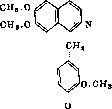
C3 Artificially synthesized by A. Pictet. Papaverine consists of colorless and tasteless prismatic crystals with a melting point of 147°, insoluble in water when cold, but readily soluble in hot alcohol, chloroform, and acetone. Concentrated sulfuric acid dissolves a small amount of P. without coloration when cold; upon heating, a dark violet coloration appears. Commercial P. usually contains cryptopine, which is why coloration occurs even when cold upon dissolution in sulfuric acid. When acted upon by hydroiodic acid, 4 molecules of CH3J and tetraoxybenzylisoquinoline, or papaveroline, are obtained. When fused with caustic potash, P. undergoes oxidation with decomposition of its molecule into dimethoxyisoquinoline (I) and veratric acid (II): CH3O2C6H3OCH3
II Hydrochloride of P., C20H21NO4.HCl, obtained from an alcoholic solution of the basic papaverine by the action of hydrochloric acid or from oxalic acid papaverine by means of calcium chloride, crystallizes from alcohol or water in the form of large rhombic prisms of bitter taste, acidic reaction, with a melting point of about 210°. The solubility of this salt in water is 1:40. On lower animals (amoebae, paramecia, and trypanosomes), papaverine (as well as other opium alkaloids of the isoquinoline group) acts sharply toxic, noticeably stronger than morphine. The toxicity of P. for higher animals, on the contrary, is significantly lower than that of morphine. In rabbits, upon subcutaneous administration of 0.25 g per 1 kg, only mild poisoning symptoms are observed. Carnivores are more sensitive to P., and doses of 0.06 g per 1 kg can already cause severe poisoning, and 0.12 g-death. With large doses in animals, convulsions are observed. The effect of P. on humans is weaker than that of morphine. Poisoning symptoms occur only after taking per os 0.2-0.4 g of P. At this time, half an hour after administration, depression, muscle weakness, and frequent pulse are observed, which after several hours is replaced by a slow one. The narcotic effect, although expressed, is significantly weaker than with morphine. Drowsiness is sometimes observed even on the second day. When P. was prescribed even in large doses (0.5 g) to mentally ill patients, it was not possible to obtain either a pronounced narcotic or a noticeable analgesic effect. The difference in the effect of P. and morphine is especially sharp in relation to the intestine and in general to organs with smooth musculature, on which P. has a relaxing effect (see Morphine and Opium). According to Pal's experiments on the whole animal, P. causes relaxation of the tone of organs with smooth musculature, without however paralyzing them, since their own movements are preserved at the same time. This effect is observed on the digestive tract, gallbladder, bronchi, bladder, kidneys, uterus, and blood vessels. Of the muscle fibers of the intestine, the longitudinal ones are more sensitive to P., on which papaverine acts in a dilution of 1:600,000. The reaction from smooth muscles is especially sharply manifested in those cases when the latter are in a state of excitation. According to Hirz, the effect of P. on organs with smooth muscles depends on the action of P. partly on the muscle elements themselves and partly on the nerve endings of the parasympathetic system. Other authors (Pal) recognize only the effect of P. on the muscles. According to P. Trendelenburg's experiments on the stretched isolated intestine of a guinea pig, on which morphine acts depressingly, P. acts similarly, but 100 times weaker than morphine; at the same time, P. causes a complete stop of peristalsis on the same object, which morphine does not give. According to Macht's experiments on smooth muscle organs of those animals in which morphine causes an increase in tone and enhancement of contractions of these organs, P. acts in the opposite direction, lowering the tone and reducing peristalsis, and with the simultaneous use of morphine and P., the effect of the latter takes precedence even in cases where its concentration is much lower than that of morphine. When acting on vessels after adrenaline, P. causes their relaxation. When therapeutic doses are used in humans, no decrease in blood pressure is observed. P. has a certain local anesthetic effect, surpassing in this respect narcotine, morphine, narceine, codeine, and thebaine, all of which act weaker than it (in the indicated order in descending order of effect). Absorbed P. is broken down in the body. Regarding the possibility of habit formation to it, observational data differ. P. is used in the form of hydrochloride or sulfate. Both salts are colorless, water-soluble substances that do not decompose in aqueous solution. P. is prescribed for spasms of the bile ducts and gastrointestinal canal, especially for pylorospasm; sometimes P. also has an effect in attacks of bronchial asthma. P. is also widely used as a means of relaxing vascular tone and lowering blood pressure in angina pectoris and similar conditions caused by vascular spasm, e.g., in hypertension. The preparations are Papaverinum hydrochloricum (or sulfuricum) 0.04-0.06 per dose, 3-4 times a day, per os, subcutaneously or intravenously. The maximum single dose is 0.2, the daily dose is 0.6. The effect lasts for several hours. As side effects, mild constipation and fatigue are observed. - Papaverinum nitrosum, C20H22N2O8 - a pale yellow fine crystalline powder, difficult to dissolve in alcohol and water and easily soluble in chloroform and acetone; dilates blood vessels; used in tinnitus and hearing loss; administered subcutaneously in 0.05 doses. It is sold in ampoules in a solution of 1 cm3 and is called panitrin (Panitrin). Panitrinum "neu"-a preparation, well soluble in water, represents acid tartaric acid P. Its pharmacological properties and therapeutic action are similar to the previous preparation; dose-1 cm3. For use in angina pectoris, a preparation called perichol was combined by one of the German factories-a mixture of P. and cadechol (Cadechol), representing a compound of camphor and choleic acid (C24H40O4)2. C10H16O. The dosage of perichol is 3 times a day, 1-2 tablets, each containing 0.13 of perichol.
Related articles
Mentioned in
Cite this page
“Papaverine.” Soviet Medical Encyclopedia. English translation of Bolshaya Meditsinskaya Entsiklopediya, 1st ed. (Moscow, 1928–1936), ed. N. A. Semashko. https://sovietmedicalencyclopedia.pages.dev/article/papaverine/