Opium Poppy
Historical document, translated for reference. It reflects medical knowledge of the 1920s–30s and is not medical advice.
Summary
The opium poppy is an annual herbaceous plant cultivated worldwide for its seeds and opium. The article describes its varieties, medicinal uses, and the pharmaceutical preparations made from its immature capsules and seeds.
Encyclopedia article (1928–1936)
Opium poppy, Papaver somniferum, an annual, herbaceous plant of the poppy family (Papaveraceae), growing from 0.5 m to 1.5 m in height; not found in the wild; probably originates from Papaver setigerum DC, which grows in Algeria, Spain, Greece, and on the islands of Corsica, Sicily, and Cyprus. For the purpose of obtaining fatty seeds or opium, the opium poppy is cultivated in all parts of the world where the climate and conditions permit. The varieties of practical importance are: 1) P. s. nigrum with a violet or purple corolla and a dark-violet spot at the base of the petals, with gray-blue or black seeds; 2) P. s. album with a white corolla, with a purple or violet spot at the base of the petal and with white seeds. The second variety is preferred in medicine; from P. s. album, poppy heads and seeds are collected for the preparation of medicinal preparations. Poppy heads, or the immature fruit capsules of the opium poppy (Capita Papaveris or Fructus Papaveris immaturi), not larger than a hazelnut, are collected in July when they contain particularly much milky juice, and are quickly and carefully dried. When preparing medicinal forms from poppy heads, the seeds are removed from the capsules. Large heads, as well as too old, dry ones, contain significantly less milky juice and no longer have medicinal value. The odor of fresh, immature capsules is peculiarly narcotic, the taste when chewed is bitter, opium-like; after drying, the capsules almost completely lose their characteristic odor and bitter taste. The active constituents in fresh, immature poppy heads are the same as in opium (see); in dried heads, the similarity in composition to opium is the less, the stronger the drying and the more mature the heads were. The meconic acid contained in opium cannot always be detected in dry heads, and the amount of alkaloids associated with meconic acid—morphine, codeine, narcene, and others—is negligible. The medicinal value of fresh green poppy heads, from which opium is obtained, is very great, while that of collected immature heads is insignificant, since medicinal preparations made from them have almost completely gone out of use; these preparations: poppy head syrup (Sirupus Diacodii) as a sedative for coughs and Capita Papaveris in the form of a decoction for gargles or for compresses. In folk life, however, poppy heads play a very sad role as a sedative, or rather, a sleeping aid for children, especially during the rush of summer work (harvest), when mothers often give children an infusion not only of dried, but also frequently of fresh immature heads of M., containing all the alkaloids of opium; children are particularly sensitive to the alkaloids of opium and often, after falling asleep, do not wake up again.
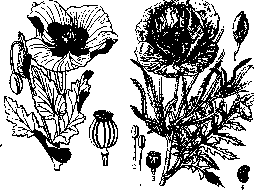
Figure 1.
Figure 2.
Figure 1. Opium poppy: 1-upper part with flower and bud; 2-capsule. Figure 2. Corn poppy: 1-flower bud during the shedding of the calyx; 2-stamens; 3-mature opened capsule; 4-seed. Poppy seed from Papaver somniferum, var. album consists of dry, mature seeds, 0.9 mm to 1.5 mm long and about 1 mm in diameter; the seeds are white, kidney-shaped. Poppy seed as a food product was already known in the times of pile dwellings; the custom of sprinkling bread with poppy seed when baking was also used by the ancient Romans. Poppy seed was eaten with honey or roasted. The taste of fresh poppy seed is pleasant and oily, while that of stored seed shows rancidity. Constituents: fatty oil (47% to 56%), aleurone (protein substance), mucilage, salts (up to 7%, mainly calcium phosphate); morphine and other alkaloids are not present in mature poppy seeds. The medicinal use of poppy seed is limited to preparations made from it, which are emulsions with enveloping and softening properties and serve as a mild nutritional agent. Poppy seeds are eaten in the form of poppy seed cakes with honey, bread rolls and other baked goods sprinkled with poppy seeds. The oil pressed from poppy seeds (Oleum Papaveris) is liquid, light yellow in color, has a pleasant taste and a weak characteristic odor; it belongs to the drying oils. The oil can be used for preparing (false) emulsions if almond oil and other non-drying oils are not available. Poppy oil is highly valued in painting due to its rapid drying, the light color of the film, and its indifferent attitude toward pigments. In medicine, in addition to Papaver somniferum, the field poppy or corn poppy (Papaver rhoeas L.) of the poppy family (Papaveraceae) is also used; it grows wild as a weed in grain fields throughout Europe, except for its northern part. In medicine, the flower petals are used (used in the pharmacopoeias of Austria, Belgium, Britain, France, Spain, Switzerland, Holland, Portugal). The petals of a fresh flower have an obovate shape, a cinnabar-red color with a dark-violet spot at the base of the petals; the flower shows a weak narcotic odor. The commercial product consists of dried, brittle, uniformly dark-violet petals, with a bitter-mucilaginous taste, without odor. In the dry petals, mucilage, sugar, fatty oil, tannin, mineral salts, the non-poisonous alkaloid readin (C21H21NO4), and a coloring substance have been found. The pharmacological action of medicinal preparations made from the petals of P. r. is due to the large amount of mucilage (20%) contained in the petals. For therapeutic purposes, preparations from petals were used as an expectorant (expectorans): syrup (Sirupus Rhoeados) and chest tea (Species pectoralis).
I Poppy seed from Papaver somniferum, var. album consists of dry, mature seeds, 0.9 mm to 1.5 mm long and about 1 mm in diameter; the seeds are white, kidney-shaped. Poppy seed as a food product was already known in the times of pile dwellings; the custom of sprinkling bread with poppy seed when baking was also used by the ancient Romans. Poppy seed was eaten with honey or roasted. The taste of fresh poppy seed is pleasant and oily, while that of stored seed shows rancidity. Constituents: fatty oil (47% to 56%), aleurone (protein substance), mucilage, salts (up to 7%, mainly calcium phosphate); morphine and other alkaloids are not present in mature poppy seeds. The medicinal use of poppy seed is limited to preparations made from it, which are emulsions with enveloping and softening properties and serve as a mild nutritional agent. Poppy seeds are eaten in the form of poppy seed cakes with honey, bread rolls and other baked goods sprinkled with poppy seeds. The oil pressed from poppy seeds (Oleum Papaveris) is liquid, light yellow in color, has a pleasant taste and a weak characteristic odor; it belongs to the drying oils. The oil can be used for preparing (false) emulsions if almond oil and other non-drying oils are not available. Poppy oil is highly valued in painting due to its rapid drying, the light color of the film, and its indifferent attitude toward pigments. In medicine, in addition to Papaver somniferum, the field poppy or corn poppy (Papaver rhoeas L.) of the poppy family (Papaveraceae) is also used; it grows wild as a weed in grain fields throughout Europe, except for its northern part. In medicine, the flower petals are used (used in the pharmacopoeias of Austria, Belgium, Britain, France, Spain, Switzerland, Holland, Portugal). The petals of a fresh flower have an obovate shape, a cinnabar-red color with a dark-violet spot at the base of the petals; the flower shows a weak narcotic odor. The commercial product consists of dried, brittle, uniformly dark-violet petals, with a bitter-mucilaginous taste, without odor. In the dry petals, mucilage, sugar, fatty oil, tannin, mineral salts, the non-poisonous alkaloid readin (C21H21NO4), and a coloring substance have been found. The pharmacological action of medicinal preparations made from the petals of P. r. is due to the large amount of mucilage (20%) contained in the petals. For therapeutic purposes, preparations from petals were used as an expectorant (expectorans): syrup (Sirupus Rhoeados) and chest tea (Species pectoralis).
Related articles
Mentioned in
Cite this page
“Opium Poppy.” Soviet Medical Encyclopedia. English translation of Bolshaya Meditsinskaya Entsiklopediya, 1st ed. (Moscow, 1928–1936), ed. N. A. Semashko. https://sovietmedicalencyclopedia.pages.dev/article/opium-poppy/