Hypernephritis
Historical document, translated for reference. It reflects medical knowledge of the 1920s–30s and is not medical advice.
Summary
This article from the 1928–1936 Soviet Medical Encyclopedia discusses hypernephritis, the inflammation of the adrenal glands, often bilateral, associated with infectious diseases and the spread of inflammation from adjacent tissues. It details forms such as tuberculous, syphilitic, and septic hypernephritis, noting their pathological features and connection to Addison's disease.
Encyclopedia article (1928–1936)
HYPERNEPHRITIS, hypernephritis, inflammation of the adrenal gland, more often of both, observed in infectious diseases as well as upon the spread of inflammation from neighboring tissues; of greatest significance are tuberculosis, syphilis, and septic infections. Tuberculous hypernephritis (bilateral in 89% of cases) is the principal cause of Addison's disease (see); the organ in this condition increases somewhat

V й 2
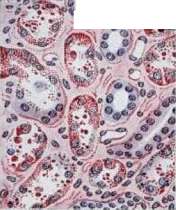
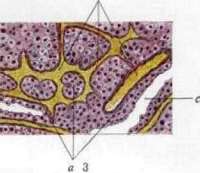
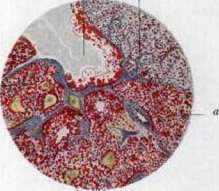
' %1Ш& Figure 1. Gmyk-omkto... Figure 2... [Captions to illustrations and plates omitted for brevity]. 93
94 in volume, becomes denser, and adhesions form around it; on cross-section [see separate plate (pp. 187-188), Fig. 3], extensive caseous areas are visible among the scar tissue, especially in the region of the medullary substance. Mild forms of tuberculous hypernephritis may be clinically silent; however, this also applies to individual cases of significant involvement of both adrenal glands. In 17% of cases, tuberculous hypernephritis may occur with a complete absence of similar changes in other organs; such an isolated (congenital) condition is encountered more often in the presence of simultaneous hypoplasia or atrophy of the adrenal glands. — Syphilitic hypernephritis is congenital and acquired; in the first case, along with an abundance of spirochetes, extensive inflammatory infiltrates are noted in the tissue, and sometimes foci of the miliary abscess type, as well as small necroses of the parenchyma; in the second case, pictures of chronic focal (gummous) or diffuse inflammation with marked tissue sclerosis are observed. In congenital syphilitic hypernephritis, inflammation of the organ's capsule (perihypernephritis) is frequently observed [see separate plate (pp. 183-184), Fig. 5], with transition to the cortex and further sclerosis. — In vulgar, e.g., septic infections, hypernephritis is characterized by the formation of focal and diffuse infiltrates or ordinary abscesses, especially deep within the organ, at the border of the cortex and medullary substance. These processes, like syphilitic hypernephritis, can lead to sclerosis, atrophy of the organ, and the development of Addison's disease. The adrenal cortex in acute hypernephritis is always swollen, edematous, poor in lipoids, causing its color to become gray; hemorrhages and even the formation of hematomas are frequent in this condition.
Related articles
Mentioned in
Cite this page
“Hypernephritis.” Soviet Medical Encyclopedia. English translation of Bolshaya Meditsinskaya Entsiklopediya, 1st ed. (Moscow, 1928–1936), ed. N. A. Semashko. https://sovietmedicalencyclopedia.pages.dev/article/hypernephritis/