Refractory Phase
Historical document, translated for reference. It reflects medical knowledge of the 1920s–30s and is not medical advice.
Summary
This article from the 1928–1936 Soviet medical encyclopedia defines the refractory phase as a temporary state of unexcitability in tissues following a single impulse of excitation. It details the historical discovery by Marey, the measurement of refractory periods in muscle and nerve, and the various theories proposed to explain its nature, including exhaustion of chemical potentials and increased tissue resistance.
Encyclopedia article (1928–1936)
REFRACTORY PHASE, a state of temporary unexcitability observed in tissues after each single excitation impulse. The R. phase was first found by Marey (Maget, 1876) in the study of heart activity; electrical stimulation applied to the heart at the moment of its systole does not cause an additional response in the form of an increased contraction or an additional contraction of the heart muscle. In tissues where the duration of the R. phase is relatively large (tenths of a second), as for example in the heart, it can be easily recorded even with the naked eye. In other cases, special research methods are required, chiefly the registration of the electrical effect associated with each single excitation. If a stimulus falling on a tissue after a known interval of time from the preceding excitation does not cause an electrical reaction in the tissue (appearance of the action current; see Animal Electricity), then it must be admitted that the second stimulus fell during the R. phase. One can also determine the minimum interval of time between two stimuli at which they will give the phenomena of summation of muscular contraction. In this way it was established that the R. phase of muscle is approximately 0.005 sec., the R. phase of motor nerve endings is 0.0025 sec. (K. Lucas), and the R. phase of the motor nerve is 0.0015–0.0020 sec. It is understandable that the insignificance of these intervals of time creates significant difficulties for their precise determination; we see, however, that for nerve and muscle this duration is measured by two to five thousandths of a second. This means that when stimulating these tissues with a frequency exceeding 200–500 stimuli per second, the tissue can no longer respond to an increase in the frequency of stimulation with a higher frequency of single excitation attacks. That this is so is proved by the experiments of Vvedensky (1886), which showed that when passing a certain frequency of stimuli, the tissue transforms the rhythm of stimulation, responding with a lowered frequency of excitation attacks. The phenomenon of the R. phase has central significance for the theoretical interpretation of the phenomena of inhibition, the basis of which a number of physiologists (Vvedensky, Verworn, K. Lucas, Adrian, Brücke, etc.) see as the mechanism of the R. phase. Accordingly, with the views on the nature of the latter, the views on the nature of inhibition also change. For physiologists who see in the R. phase the result of the exhaustion of the chemical potentials of the tissue spent in the process of excitation, inhibition is presented as the result of exhaustion, the disappearance of those chemical compounds, the consumption of which is obligatory for vital activity (Hering, Gaskell, Verworn). An essential objection to this representation lies in the fact that all the biochemical transformations known in active tissues certainly do not reach the exhaustion of the reserves of reacting substances (for example, carbohydrates, creatine-phosphoric acid) with each excitation impulse. The reference to the fact that such compounds theoretically may exist is purely speculative. Another point of view attributes the phenomenon of the R. phase to an increase in the "resistance" of the tissue—a view not sufficiently substantiated by convincing experiments. Finally, the third theory of the refractory phase by Vvedensky and Ukhtomsky assumes that the refractory phase as unexcitability after each wave of excitation does not exist at all, and that in the tissue at the moment of passing the excitation process a sharply increased excitability is observed. The next impulse, catching the tissue in a state of increased excitability, acts as an excessively strong stimulus, causing a state of depression. The R. phase from this point of view does not pre-exist after the first stimulus, but is created as a result of the collision of two waves of excitation (see Parabiosis). Already from the diversity of theories of the R. phase it follows that the resolution of the question of its nature must be a matter of the future. Absolute R. phase, i.e., that interval of time after an attack of excitation when a stimulus of any strength does not cause an excitation effect, is replaced by the so-called relative R. phase, during which only stimuli, strengthened against the threshold, cause an excitation process. Since excitability is a value inverse to the strength of the stimulus necessary to cause excitation, one can say that in the relative R. phase excitability is lowered (in the absolute R. phase it is equal to zero, and according to the parabiosis theory it is so increased that any stimulus appears superstrong and causes depression). In the relative R. phase excitability gradually rises to "norm." The duration of the relative R. phase is always greater than the duration of the absolute R. phase. Some authors consider the weakening of the excitation effect at high frequencies of stimuli (pessimum) as the result of each subsequent stimulus falling into the relative R. phase from the preceding one. The relative R. phase is replaced by the phase of increased excitability or exaltation phase, when a stimulus, "normal" subthreshold, is capable of causing an excitation effect (see figure). The duration of the R. phase as relative and absolute is not a constant, but varies depending on the state of the tissue, for example, during fatigue. In nerve centers the R. phase undoubtedly takes place and is longer than in the nerve fiber and muscle. At the same time in the centers this duration apparently changes especially easily depending on changes in the state of the tissue. For nerve centers, however, the R. phase is studied incomparably less than for muscle and nerve fiber. While some authors (Vvedensky, K. Lucas, Verworn, Brücke) explained a number of mechanisms of central inhibition by the presence of a refractory phase, others (Samoylov, and more recently Sherrington) do not consider it possible to defend this view, since the duration of inhibition in the centers exceeds the duration of the reflex phase. The solution of the question is connected with the solution of the more general problem of the nature of the refractory phase in connection with the character of the excitation process.
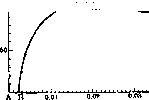
Change in the excitability of the nerve after an attack of excitation (according to K. Lucas): from A to B—absolute refractory phase—excitability is equal to zero; from B to C—relative refractory phase—excitability gradually reaches norm; from C to D—phase of increased excitability [time (in hundredths of a second) after the preceding stimulation].
The duration of the R. phase, both relative and absolute, is not a constant, but varies depending on the state of the tissue, for example, during fatigue. In nerve centers the R. phase undoubtedly takes place and is longer than in the nerve fiber and muscle. At the same time in the centers this duration apparently changes especially easily depending on changes in the state of the tissue. For nerve centers, however, the R. phase is studied incomparably less than for muscle and nerve fiber. While some authors (Vvedensky, K. Lucas, Verworn, Brücke) explained a number of mechanisms of central inhibition by the presence of a refractory phase, others (Samoylov, and more recently Sherrington) do not consider it possible to defend this view, since the duration of inhibition in the centers exceeds the duration of the reflex phase. The solution of the question is connected with the solution of the more general problem of the nature of the refractory phase in connection with the character of the excitation process.
Related articles
Mentioned in
Cite this page
“Refractory Phase.” Soviet Medical Encyclopedia. English translation of Bolshaya Meditsinskaya Entsiklopediya, 1st ed. (Moscow, 1928–1936), ed. N. A. Semashko. https://sovietmedicalencyclopedia.pages.dev/article/refractory-phase/