Stoffel Operation
Historical document, translated for reference. It reflects medical knowledge of the 1920s–30s and is not medical advice.
Summary
The Stoffel operation involves cutting motor nerves in the limbs or within the nerve itself to break the pathological reflex arc. It was developed in 1912 as an alternative to muscle surgeries for treating spastic conditions.
Encyclopedia article (1928–1936)
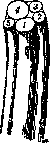
STOFFEL OPERATION (Stoffel), the transection of motor nerves of the extremities either within the substance of the nerve itself (Stoffel I) or of motor branches before their entry into the muscle (Stoffel II). The principle of the method is to interrupt the pathological reflex arc. The operation is indicated for Little's disease, spastic hemiplegias, hypertonicities, and certain forms of athetosis. The best results are obtained in cases involving the lower extremities. Historically, the conceptual foundations for this method were myotomy, tenotomy, tendon lengthening according to Vulpius, and myorexis by Lorenz, which aimed to affect the effector of the reflex arc - the muscle. Operations on the latter often led to the generation of spastic conditions, which gave Ferster the basis for proposing the resection of the posterior sensory roots of the spinal cord to reduce irritation - an operation first performed by Tietze. Stoffel proposed his operation in 1912. Having thoroughly studied the internal topography of nerve trunks-cables, the method of branching of nerves and their distribution within the muscles themselves, he decided to reduce the number of motor nerve impulses reaching the muscle (fig. 1). For
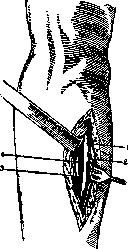
this purpose, according to the scheme developed by Stoffel, the corresponding nerve is exposed (fig. 2) and a partial resection (from one-third to half of the bundle) of motor fibers is performed within it (Stoffel I). The perineurium is sutured, followed by suturing of the soft tissues. This operation gave numerous failures - recurrences of spastic conditions, easily explainable by nerve regeneration. Furthermore, the work of several authors showed that nerve trunks do not run cable-like but loop-like, and that the paths innervating the same muscle groups do not pass through a single point of nerve section, but through different points, sometimes far from each other (Spitzy). All this
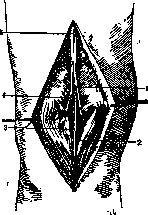
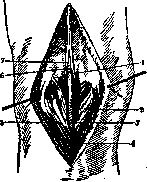
forced Stoffel and others to move to a new modification, consisting of the complete or partial resection (half or one-third of the trunk) of motor branches before their entry into the muscle (Stoffel II) (fig. 3 and 4). The figures below show the Stoffel operation for spastic equinovarus. The motor paths in the wound are identified with a sterile electrode: one or two of the branches are resected, the irritation of which with a weak current produces the strongest muscle contraction. After closing the wound, the pathological position of the extremity is corrected and the result achieved is fixed with a plaster cast. After removal of the cast, massage, electrization, and exercises for the weaker extensors and abductor muscles are undertaken with the aim of balancing their strength with the weakened antagonists.
Similar in principle to the Stoffel operation is the 'operation of reducing the cross-section of the nerve trunk according to Vreden'. The latter believed that since a large nerve is not a cable with separate isolated nerve paths, but consists of interwoven motor, sensory, and sympathetic fibers, the excision of
part of the nerve trunk achieves a decrease in conductivity along all types of nerve paths. How this operation is performed can be seen from the accompanying figure (fig. 5). - In terms of indications for performing this operation, modern orthopedists believe that one should begin with the sectioning or lengthening of muscles and tendons. If after some time a recurrence of contracture position develops, demonstrating that the antagonists cannot cope, the indicated procedure is the additional weakening of the spastically contracted muscles by the Stoffel operation. The further development of the idea of unloading spastic contractures is found in the operation of Spitzy, where the excess tone of strong muscles is transferred to weak ones by transplanting the severed nerve branches into the nerve trunks of the weakened musculature.
Related articles
Cite this page
“Stoffel Operation.” Soviet Medical Encyclopedia. English translation of Bolshaya Meditsinskaya Entsiklopediya, 1st ed. (Moscow, 1928–1936), ed. N. A. Semashko. https://sovietmedicalencyclopedia.pages.dev/article/stoffel-operation/