Tuning Forks
Historical document, translated for reference. It reflects medical knowledge of the 1920s–30s and is not medical advice.
Summary
An overview of tuning forks as acoustic instruments, detailing their physical properties, their use in otolaryngology for hearing diagnostics (air and bone conduction), and their application in physiological research as interrupters.
Encyclopedia article (1928–1936)
TUNING FORKS, fork-shaped bent steel rods, equipped with a stem or handle; the fork consists of two identical branches, or tines. When a tuning fork is struck or brought into an active state with a bow, a sound is produced, the duration of which depends on the obstacles within the body of the tuning fork itself, the quality of the steel, the thickness and length of the branches, air resistance, and the method of holding the stem (e.g., holding it in the hand by the stem reduces the duration of the sound). Sounds and noises produced by the vibration of solid objects always have a complex acoustic structure due to the presence of a greater or lesser number of overtones in the sound waves; in this respect, tuning forks differ from other elastic bodies in that they produce almost pure tones with a very small number of overtones. Transverse vibrations occur in the branches of an active tuning fork, while longitudinal vibrations are also determined in the stem. Pure tones of tuning forks, devoid of overtones, usually sound weak and dull, unlike the sound of other musical instruments. Overtones can appear sharper or weaker depending on the strength and the place of application of the force producing the vibrations. Thus, if a bow is drawn near the upper edge of the branches, a pure fundamental tone clearly emerges with weak harmonic overtones; when drawing the bow near the middle of the branches, one can obtain a very clearly audible 1st additional overtone. Even purer fundamental tones of a tuning fork can be obtained if two movable copper clamps are attached to the upper ends of the branches of the tuning fork (loaded tuning forks; Fig. 1 and 3). This load reduces the duration of the sound and the strength of the tone; moving it downward raises the tone. The divisions marked on the branches indicate the pitch. For amplification of the sound of the tuning fork at various
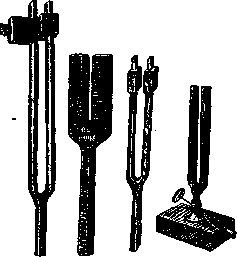
Figure 1. Tuning fork according to Bezold—16 vibrations per sec., C, with loads. Figure 2. Tuning fork c4—2,048 vibrations per second. Figure 3. Tuning fork c—128 vibrations per second. Figure 4. Tuning fork A on a wooden resonator (100 vibrations per sec.) with a rubber hammer for striking. In acoustic experiments, it is mounted on the middle of the lid of an oblong wooden resonator box, open on one of the short sides; the length of this box is equal to 1/4 of the wavelength of the fundamental tone in the air (Figure 4).
Tuning forks for hearing testing. Due to the property of tuning forks to emit pure tones with a specific number of vibrations per second, they are considered the best instruments for examining hearing. By bringing a sounding tuning fork to the ear, one can test the ability of a patient or a normal person to perceive auditory sensation through the air (air conduction); one can also investigate bone conduction if the stem of the tuning fork is placed on the crown of the head or applied to the mastoid process. The state of hearing is judged by the duration of the perception of a particular sound of the tuning fork at different numbers of vibrations, and thus the sensitivity of the ear to low and high tones, or the acuity of hearing, is determined. The lower limit of human hearing corresponds to approximately 16 vibrations per second, and the upper limit to about 22–25 thousand vibrations per second. In practice, the highest tuning fork used has a number of vibrations of 4,096, as tuning forks with a higher number of vibrations sound for a very short time and are inconvenient for examination. They are replaced by organ pipes and the Galton whistle. For a normal ear, the duration of perception of tuning forks of different pitches is not the same: whereas for a C tuning fork without a load with 64 vibrations, the average duration is 175 sec.; for c (128 vibrations)—169 seconds; for c1 (256 vibrations)—273 seconds; for c2 (512 vibrations)—223 sec.; for c3 (1,024 vibrations)—142 sec.; for c4 (2,048 vibrations)—49 sec. (Fig. 2); for c5 (4,096 vibrations)—8 sec.; for c6, the sounding time is so short that it cannot be measured. An error of 2 seconds with a C or c tuning fork has no great practical significance, whereas for c5 it already constitutes 1/4 of the normal perception time. Knowing the normal acuity of hearing, it is easy to orient oneself in pathological cases. The method of examining hearing with tuning forks was developed by a number of authors, among whom it is necessary to note Politzer, Hartmann, Ostmann, and especially Bezold, who, together with the physicist Edelmann, proposed a special grouping of tuning forks, the so-called continuous tone series, containing a scale of tones from 16 to 25,000 vibrations per sec.; with the help of this instrument, the reaction of the ear to all sounds that the human ear perceives can be tested. The set contains 10 tuning forks with movable weights, 4 tuning forks without weights (c3, c4, c5 and c6), 3 organ pipes, and a Galton whistle. The Bezold instrument is necessary for precise examination of hearing, for example, in scientific research, as well as for determining the remnants of hearing in the deaf-mute, which is of great importance when teaching them speech. For a practical physician, instead of this cumbersome instrument, it is quite sufficient to use the Hartmann set, which consists of 5 tuning forks; of these, C (128 vibrations) for low tones and c4 (2,048 vibrations) for high ones (Fig. 5). In most cases, one can get by with only these two; some use a tuning fork with a vibration of about 100 to determine the low zone. With normal hearing and when using the same tuning fork and with an equally strong strike, there is a certain ratio between the duration of air and bone sound conduction. Observations have shown that in certain diseases, deviations from the norm that are quite characteristic of the given disease are obtained. In the absence of objective changes detected by otoscopy and catheterization, in many cases, the data from tuning fork examination are the guiding data for making a diagnosis.

L.—Rabotnov. Tuning fork interrupter—an instrument used in physiological methodology for very frequent current interruptions (100, 200, and up to 500 per second) or for graphic registration of small fractions of a second. The tuning fork interrupter was first constructed by Helmholtz; it is depicted in
Figure 5. Hartmann set of 5 tuning forks c, c1, c2, c3, c4. Figure 6: r and o—terminals through which current from an accumulator flows; k—tuning fork, through which an electric current passes due to the contacts of the platinum wire b with the screw a; I—electromagnet, attracting the branches at the moment the current passes and thus breaking the contact. At this moment, I is demagnetized, b comes into contact with a again, the current appears again in the electromagnet, etc. Sometimes, for graphic registration, a writing pen is attached to one of the branches of the tuning fork. Variants of the tuning fork interrupter have been proposed by Kronecker, Bernstein, Marey, and others.
Related articles
Mentioned in
Cite this page
“Tuning Forks.” Soviet Medical Encyclopedia. English translation of Bolshaya Meditsinskaya Entsiklopediya, 1st ed. (Moscow, 1928–1936), ed. N. A. Semashko. https://sovietmedicalencyclopedia.pages.dev/article/tuning-forks/