Tuberculum Acusticum
Historical document, translated for reference. It reflects medical knowledge of the 1920s–30s and is not medical advice.
Summary
The tuberculum acusticum is a nucleus belonging to the auditory system, located at the floor of the fourth ventricle. It forms part of the acoustic area and contains cells that give rise to the central auditory pathway.
Encyclopedia article (1928–1936)
TUBERCULUM ACUSTICUM, acoustic tubercle, a nucleus belonging to the auditory system, located along the floor of the fourth ventricle, at the level of the lateral recess of the fourth ventricle (Fig. 1), where it
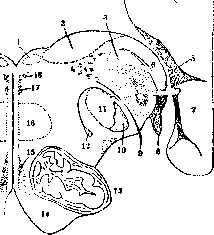
Figure 1. Cross-section of the medulla oblongata in its upper parts: 1-nucl. teres; 2-nucl. vestibularis dorsalis; 3-corpus restiforme; 4-cerebellum; 5-pedunculus flocculi; 6-tuberculum acusticum; 7-flocculus; 8-n. acusticus; 9-n. glossopharyngeus; 10-radix spinalis n. V; 11-substantia grisea Rolandi; 12-nucl. ambiguus; 13-oliva inferior; 14-pyramis; 15-lemniscus medialis; 16-nuclei centrales; 17-fasciculus tectospinalis; 18-fasciculus longitudinalis posterior.
constitutes part of the acoustic area. At the site of the lateral recess, the gray layer of the rhomboid fossa extends onto the outer surface of the corpus restiforme and forms the T. a.; anterior to it is located the nucleus ventralis n. cochleae, and laterally, the cerebellum. When transitioning into the pons, the outer surface of the corpus restiforme ceases to be free, fuses with the cerebellum, and the T. a. disappears, while the anterior auditory nucleus remains. In the T. a., some fibers of the n. acusticus terminate, and from it originates the central auditory pathway, which is represented by the auditory striae, s. striae acusticae Monakov's (see Auditory pathways, centers). The T. a. is formed by cells arranged in a radial direction, having strongly branching dendrites at both ends (Fig. 2); the axial cylinder extends caudally and forms the auditory striae. Centripetal fibers entering the T. a. form "baskets" (Held) around its cells.
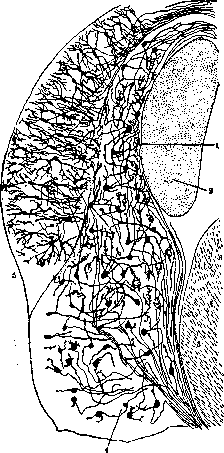
Figure 2. Structure of the acoustic tubercle: 1 and 4 - anterior nucleus of the auditory nerve; 2-corpus restiforme; 3-radix spinalis nervi trigemini; 6-tuberculum acusticum.
Centripetal fibers entering the T. a. form "baskets" (Held) around its cells.
Related articles
Mentioned in
Cite this page
“Tuberculum Acusticum.” Soviet Medical Encyclopedia. English translation of Bolshaya Meditsinskaya Entsiklopediya, 1st ed. (Moscow, 1928–1936), ed. N. A. Semashko. https://sovietmedicalencyclopedia.pages.dev/article/tuberculum-acusticum/