Tuberous Sclerosis
Historical document, translated for reference. It reflects medical knowledge of the 1920s–30s and is not medical advice.
Summary
This article from the 1928–1936 Soviet medical encyclopedia describes tuberous sclerosis as a childhood brain disease characterized by rubbery, whitish cortical nodules. It discusses the condition's histological features, its association with tumors in other organs, and the various theories regarding its pathogenesis, noting that it is rarely diagnosed during life and often leads to intellectual disability.
Encyclopedia article (1928–1936)
TUBEROUS SCLEROSIS (syn. sclerose hypertrophique tubereuse, s. istio-atypie corticale disseminee Pellizzi), a disease of the brain in childhood, characterized by the presen
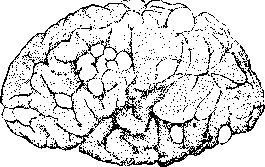
Tuberous sclerosis on the surface of the brain.
ce on the surface of the brain of round or polygonal elevations of a whitish color, smooth, ranging in size from a small pea to a walnut (Fig.); their consistency resembles rubber; the number can reach up to 20. This disease was identified by Bourneville and Brissaud in 1888. In addition to the cerebral cortex, tuberous sclerosis can be observed in the subcortical ganglia (the elevations protrude into the lateral ventricles), in the cerebellum, in the cavity of the IV ventricle, etc.; all these localizations are encountered significantly less frequently. On cross-section, these formations slightly protrude above the cortex; by histological structure, they represent neuroglial sclerosis, mainly fibrillary, but there are also astrocyte cells and round glial cells; sometimes one can also encounter nerve cells that are strongly altered; vessels with hyaline degeneration of the walls; there are no sharp boundaries between tuberous sclerosis and healthy tissue. Heterotopic islands of gray color can be encountered in the white subcortical matter; they have the same structure as in the cortex, but they are characterized by the presence of very large cells of various shapes, with and without processes, with a nucleus located peripherally and having many nucleoli. Very often, tumors are found simultaneously in other organs—in the kidneys (hypernephroma), in the heart (rhabdomyoma), in the skin (adenoma). The pathogenesis of tuberous sclerosis is still not sufficiently clear; there are numerous opinions about its origin: chronic encephalitis with hemorrhages in the pia mater, gliotic sclerosis of an inflammatory nature, a peculiar neoplasm—neuroglioma or ganglionic diffuse neurogliosis—and finally a developmental defect, a deformity; the majority of authors adhere to the latter opinion. Tuberous sclerosis is of only histological interest, is rarely diagnosed during life, since depending on the localization it can give the most diverse clinical picture already in the first months after birth—spastic or flaccid paralysis, rigidity, hypotonia, coordination disorders, hyperkinesia. In the majority of cases, the intellect in the child does not develop or develops insufficiently, and therefore neurological syndromes are accompanied by psychic phenomena: debility, imbecility, or complete idiocy.
Related articles
Cite this page
“Tuberous Sclerosis.” Soviet Medical Encyclopedia. English translation of Bolshaya Meditsinskaya Entsiklopediya, 1st ed. (Moscow, 1928–1936), ed. N. A. Semashko. https://sovietmedicalencyclopedia.pages.dev/article/tuberous-sclerosis/