Adenoma
Historical document, translated for reference. It reflects medical knowledge of the 1920s–30s and is not medical advice.
Summary
This article defines adenoma as a benign glandular tumor that retains the structural characteristics of the gland from which it originates. It discusses the classification, microscopic structure, clinical course, and potential for malignant transformation into adenocarcinoma.
Encyclopedia article (1928–1936)
ADENOMA (from the Greek aden—gland), a glandular tumor, is a true tumor that can develop from the glandular epithelium of any gland and, in its structure, preserves to one degree or another the structural type of the given gland.
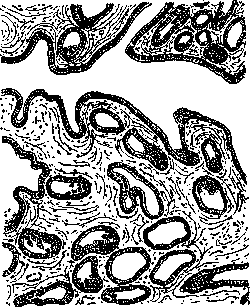
Adenoma of the mammary gland.
Adenomas most often arise in the female mammary gland, in the ovaries, thyroid gland, mucous membrane of the gastrointestinal tract, liver, kidneys, adrenal glands, and uterus; less often in the pancreas, salivary glands, prostate gland, pituitary gland, skin glands, and parathyroid glands. In appearance, an adenoma presents as a node of a rounded shape, enclosed in a capsule and, thanks to this, more or less sharply demarcated from neighboring tissues; adenomas developing from the mucous membranes of hollow organs (e.g., stomach, intestines, uterus) usually protrude on the surface, often even hanging on a stalk, having the character of a polyp (see)—so-called adenomatous polyps. The sizes of adenomas can be various. The microscopic structure of an adenoma depends on the organ from which the tumor develops. In general, adenomas belong to organoid tumors, i.e., they consist of a connective tissue stroma and epithelial parenchyma. The latter, representing as it were the essence of the tumor, is located among the connective tissue in the form of alveoli or tubular passages (see figure), having a clear proper membrane (membrana propria) and lined or filled with epithelium, the cells of which, by their appearance and arrangement, to one degree or another resemble the tissue of the gland from which the tumor originates. In some adenomas, glandular epithelial proliferation predominates (simple adenoma), in others—a significant development of connective tissue (fibroadenomas). Upon the proliferation of the epithelium and the accumulation of secretion in the cavities of the glandular vesicles, their transformation into large cavities—cysts—filled with liquid or mucous or thick, colloid mass can occur; such adenomas are customarily called adenocystomas or cystadenomas, and, depending on the type of epithelial proliferation in them, one speaks either of glandular adenocystomas (proliferation of epithelium by way of gland-like bulges outward from the cavities) or of papillary adenocystomas (proliferation of epithelium into the cavities with the formation of branching papillae within them). The course of adenomas is benign, and their influence on the organism is reduced to the compression of neighboring tissues by the tumor; an exception is constituted by some papillary adenocystomas, in which, with energetic growth of the papillae, the latter can rupture the walls of the cavities, extend beyond the limits of the tumor, and, in the form of papillary masses, proliferate along neighboring parts (e.g., along the peritoneum in papillary adenocystoma of the ovary). Some adenomas and adenocystomas can subsequently transform into true cancer. Malignant or destructive adenoma (adenoma malignum s. destruens) is the term customarily used for epithelial glandular tumors which, possessing significant growth energy, destroy neighboring tissue and produce metastases; these malignant adenomas, observed most often in the uterus and gastrointestinal tract, are more correctly considered from the very beginning of their emergence not as adenomas, but as glandular cancer (adenocarcinoma). The etiology of adenomas is as little clarified as that of tumors in general (see); part of the adenomas arises on the basis of chronic inflammations and regeneration (e.g., adenomas of the liver and kidneys during their cirrhosis). Other adenomas have as their basis defects in tissue development (for example, adenoma of the navel from remnants of the vitelline duct). The treatment of adenomas is exclusively operative.
Related articles
Mentioned in
Cite this page
“Adenoma.” Soviet Medical Encyclopedia. English translation of Bolshaya Meditsinskaya Entsiklopediya, 1st ed. (Moscow, 1928–1936), ed. N. A. Semashko. https://sovietmedicalencyclopedia.pages.dev/article/adenoma/