Substituting Processes
Historical document, translated for reference. It reflects medical knowledge of the 1920s–30s and is not medical advice.
Summary
This article from the 1928–1936 Soviet medical encyclopedia explains the physiological phenomenon of substituting processes, where healthy organs or parts of an organ take over the functions of damaged ones, leading to hypertrophy. It details examples in paired organs, blood-forming systems, and the liver, and discusses the role of chemical irritation and reflexes in this compensation.
Encyclopedia article (1928–1936)
SUBSTITUTING PROCESSES, processes of substitution of one organ by another or of one part of an organ by another, by which compensation is achieved when necessary. The capacity for vicarious, or substitutive, functions is widely developed in the animal organism and is one of the important factors in the preservation or restoration of physiological equilibrium during diseases. Thus, when the function of one of paired organs falls (as a result of the destruction of the organ by a pathological process or its removal by surgical means for special indications), the work of the other remaining organ is taken over, and by developing intensified activity, it becomes hypertrophied. In this way, vicarious hypertrophy of one kidney arises upon the destruction of the other, of one lung upon the destruction of the other lung, of one salivary gland following the death of another, of one adrenal gland upon the removal or disease of the other. But the same is observed in systems of organs, although not paired, but connected by the homogeneity or similarity of their functions. Thus, for example, cases of hyperfunction and hypertrophy of one of the blood-forming organs upon the fall or hypofunction of another: lymph glands following the extirpation of the spleen; hyperplasia of bone marrow under the same conditions; hypertrophy of one internal secretory organ upon the cessation or lowering of the activity of another. In the last case, however, complete compensation is not usually achieved by this means, as illustrated by an example: both the thyroid gland and the anterior lobe of the pituitary gland belong to organs of body growth, and it is precisely the latter that hypertrophies upon thyroidectomy; and yet, early thyroidectomy still leads to retardation of the individual's growth. Vicarious activity occurs under analogous conditions and within the same organ, the remaining healthy parts of which can take over the functions of the dead parts and again become hypertrophied. Experimentally, this possibility has been shown to be particularly demonstrative in the liver: in animals up to s/t of the entire mass of the organ is removed, and the remaining lobes hypertrophy within 1-2 months to enormous sizes (with a weight equal to the entire mass of the intact organ). Similar facts have been noted repeatedly in human pathology, for example, upon the destruction of the entire right lobe of the liver by echinococcus. To substituting processes one should also refer to collateral hyperemia, when, following the occlusion of the supplying artery or draining vein, the capacity of a given section of the circulatory system is maintained by neighboring vessels, which in this case dilate, and their walls, again, by the general law of intensely working organs, thicken and hypertrophy. The same, in essence, significance has in a number of cases the formation of new vessels, for example, in the vascularization of obstructing thrombi, where the newly formed capillaries growing into such a thrombus, by dilating, create to a certain degree paths for the restoration of blood flow, alongside the channels arising from the contraction of the thrombus. Considerable interest is also presented by cases of so-called vicarious hemorrhages, when, in the absence of normal discharges per via naturales during the menstrual period, hemorrhage occurs by another route, for example, into the lip, into a birthmark on the face or nose—a fact giving ground to think that the basis of menstrual hemorrhages lies not only in changes in the mucous membrane of the uterus under the influence of the corresponding ovarian influence, but perhaps also in a certain plethora developing depending on the same influence, from which the organism strives to free itself at all costs. The mechanism of the development of substituting processes is as follows: since working hypertrophy is conditioned, mainly, by purely mechanical moments (cf., for example, hypertrophy of the heart with difficulties in circulation), the decisive significance in the origin of vicarious hypertrophy, as well as of substituting processes in general, is played by chemical irritation; this is evident, among other things, from the experiments of Sacerdotti with the injection of urea and other products of urine into the blood of animals deprived of one kidney, in which a more significant hypertrophy of the remaining kidney developed than in control animals; the same occurs with an extirpated kidney, but without the injection of urea. Only certain cases of the kind of collateral hyperemia are exceptions, in the origin of which, along with the mechanical moment, a significant role is played by the reflex from the anemic area of the body to the vasomotor nerves of neighboring regions (see Hyperemia). The intimate side of the development of vicarious hypertrophy under the influence of chemical irritants, however, consists in the capacity of the organism to react to the expenditure of substances (inseparably connected with the process of intensified work) by the production of the same substances in a quantity greater than is necessary for the replenishment of losses, with a predominance, therefore, of assimilation over dissimilation (see Weigert's biological law). In the field of the endocrine system, however, the biological motives of vicarious hypertrophy are often more complex and not so clear as in the above-mentioned example with the kidneys. Thus, for example, cases of hypertrophy of one ovary or testicle following the extirpation of the other corresponding organ: since both organs possess a great productive capacity specifically in relation to generative elements, one has to think here of purely internal secretory relationships—the necessity for the remaining organ to maintain the endocrine equilibrium, which in the norm is effected from the side of the genital sphere by two homogeneous organs. Nevertheless, there exists an opinion about the supposed alternating change of ovaries in relation to their ovulatory function. It is necessary to add that precisely in the field of the same endocrine system it is often not easy to differentiate between vicarious hypertrophy and antagonistic hypertrophy.
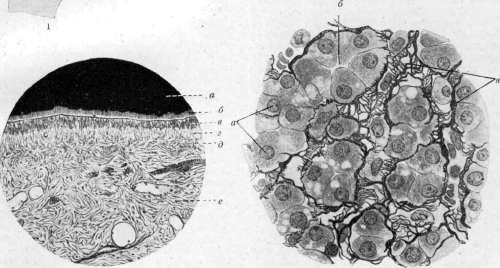
Figure 1. Secretory granules in the intestinal epithelial cells of a salamander (after Heidenhain). Figure 2. Pancreatic cells of a starving dog; abundance of cells with secretory granules. Figure 3. The same cells after stimulation of the vagus nerve; sharp decrease of secretory granules of zymogen. Figure A. a - dentin; b - dentinogenic layer; c - layer of odontoblasts; d - layer of Hertwig's epithelial root sheath; e - dental pulp (b, c and d represent the peripheral layers of the dental pulp). Figure 5. Liver (silver impregnation, high magnification): a - liver cells; b - bile capillaries; c - reticular fibers.
To the article by St. Williger, see: Layers, Reticular Fibers, Excretory Processes.
Related articles
Cite this page
“Substituting Processes.” Soviet Medical Encyclopedia. English translation of Bolshaya Meditsinskaya Entsiklopediya, 1st ed. (Moscow, 1928–1936), ed. N. A. Semashko. https://sovietmedicalencyclopedia.pages.dev/article/substituting-processes/