Otosclerosis
Historical document, translated for reference. It reflects medical knowledge of the 1920s–30s and is not medical advice.
Summary
Otosclerosis is a chronic, progressive ear disease characterized by the replacement of normal bone with spongy tissue, typically leading to stapes fixation and hearing loss. This 1930s article discusses its complex etiology, including hereditary and endocrine factors, and describes its clinical symptoms such as tinnitus and paracusis Willisii.
Encyclopedia article (1928–1936)
OTOSCLEROSIS, otosclerosis (syn.: otospongiosis), a peculiar chronic focal disease of the ears with an undetermined etiology. It usually begins during the period of puberty and is manifested by progressive hearing loss and usually tinnitus. It is one of the most common non-suppurative diseases of the ear, affecting women more often. The process involves small areas of bone tissue, in the vast majority of cases the labyrinthine capsule, causing the replacement of normal compact bone with spongy, spongious bone. This newly formed bone undergoes remodeling again during the process of development. Usually, the process tends to spread further and gradually involve adjacent parts. The favorite site of otosclerotic foci is the labyrinthine wall of the oval window. Spreading from here, the process gradually involves part of the frame of the oval window, the annular ligament, and passes to the stapes footplate [see separate table for the article Deafness (Vol. VII, pp. 423-424), Fig. 6]; further, it may involve the entire footplate, and sometimes even the entire stapes, which in such a case turns out to be, as it were, walled into the bone. Less frequently, spongification involves the round window, various other parts of the cochlea, parts of the semicircular canals, and the internal auditory meatus. Otosclerotic foci are more often single, less often multiple. In the vast majority of cases, they are found in both temporal bones. The extent of the process varies; sometimes the focus is barely distinguishable even microscopically; in other cases, it involves not only the labyrinthine wall but the entire cochlea (see separate table, Figs. 1-4). The histopathological picture is so peculiar that its evaluation is performed differently by various researchers. Earlier authors viewed otosclerosis as an inflammatory disease of the bone, and they differentiated it little from chronic dry (adhesive or sticky) catarrh of the middle ear (Katz, Habermann, Bonnighaus, and others). Manasse called the process chronic metaplastic osteitis. O. Mayer drew attention to the fact that the onset of spongification originates from places where unossified remnants of cartilage remained in the labyrinth; taking into account this circumstance, as well as the nature of the process (a tendency toward proliferation) and the frequent simultaneous finding of hyperostoses in other parts of the body of otosclerosis patients, he came to the conclusion that in otosclerosis one is dealing with a neoplasm (he classified it into the group of hamartomas). Lange considers otosclerotic foci to be bone hypertrophy; Wittmaack explains spongification by local venous stasis; Brunner sees in otosclerosis a manifestation of general dystrophy; Kosokabe, Kaufmann, Komendantov find a similarity to rachitic bone changes, etc. The pathogenesis is not clarified. A significant role of the hereditary-constitutional factor is noted. Inheritance occurs more often by the dominant (Korner, Hammerschlag) than by the recessive type (Albrecht). Numerous works, relating predominantly to recent times, have established a connection between otosclerosis and the endocrine system, but the form of their interrelationship has not yet been clarified. Various authors have found phenomena of dysfunction on the part of one or another gland of internal secretion: the pituitary gland, the thyroid gland, the parathyroid glands. Individual cases have been described where otosclerosis was combined with diseases of the endocrine glands: Basedow's disease, endemic cretinism, obesity on the basis of pituitary disease, acromegaly, etc. The connection with the sex glands is more sharply expressed: otosclerosis most often begins to develop during the period of puberty; in women, it sometimes causes irregularity of the menstrual cycle, intensification of tinnitus during menstruation, etc.; pregnancy usually causes a worsening of the otosclerotic process. In both women and men with otosclerosis, there is often observed a distribution of body hair inconsistent with the sex and symptoms of sexual neurasthenia; in men, moreover, hypoplasia, less often hyperplasia, of the genital organs is encountered in some cases. In a number of cases, other clinical symptoms of a general nature have also been noted—Chvostek's sign, Schultze's phenomenon, increased galvanic excitability, phenomena of spasmophilia, blue color of the sclera, etc. The connection of otosclerosis with the endocrine system and metabolism is also indicated by the latest studies of the chemical composition of the blood of otosclerosis patients. Here, the following was discovered: a decrease in calcium content (according to Leicher in 80% of cases), some decrease in the amount of magnesium, a decrease in cholesterol, and an increase in globulin. Phytopharmacological studies (Stern) are interesting, which indicated that in the blood serum of otosclerosis patients diluted with water, as well as in the blood itself, urine, saliva, lacrimal fluid, and sweat, there are substances acting as poisons on plants cut and placed in one or another of the listed solutions (flowers wither quickly). Nevertheless, in the opinion of modern authors, otosclerosis is not a disease of the endocrine glands. Some believe that both the pathological process in the ear and the dysfunction of the endocrine glands serve as a manifestation of one and the same status degenerativus. Others (Leicher) consider the otosclerosis disease to be primary, and the changes in metabolism to be secondary. Finally, others, without placing them in a causal dependence on one another, admit an adversely acting mutual progressive influence of both factors. According to available data, unfavorable social and living conditions do not play a role in the etiology of otosclerosis, but they apparently contribute to its earlier manifestation and rapid progression. The process is almost always bilateral, although in the second ear it often manifests later, after several months or even years. The course of the process is individually different. Usually, it lasts for months, years, and decades. Sometimes the process stops, but under the influence of certain factors, it begins to progress again in one ear or both; often this happens even without a visible objective cause. Some, admittedly rare, cases have a 'rapid' character; here, hearing impairment or deafness occurs quickly—within a few months or even weeks. In others, the disease progresses slowly or does not progress at all. In a number of cases, secondary phenomena play an unfavorable role: atrophic-degenerative processes in the first neuron of the cochlear pathway. They can be caused by abnormal auditory stimulation of this neuron due to ankylosis of the stapes, an increase in labyrinthine pressure, a change in the chemistry of the labyrinthine fluid, etc. The most important symptoms of the disease are hearing loss and tinnitus. The first of these is considered a clinically mandatory sign. The nature of the hearing impairment depends on the localization and extent of the otosclerotic focus. In pure cases of stapes ankylosis (Group I of Denker's classification), there is a picture of damage to the sound-conducting apparatus (loss of perception of low tones, negative Rinne, prolonged Schwabach), i.e., the presence of a symptom complex known by the name of the Bezold triad. With a focus in the cochlea, the disease proceeds under the guise of otitis interna (Group II). In combined cases (Group III), as well as in those cases where atrophic-degenerative changes on the part of the auditory nerve have developed with existing stapes ankylosis, a mixed picture is observed. Often, the phenomenon of paracusis Willisii is encountered in otosclerosis patients: better hearing of sounds when in a noisy environment (on the street, in a tram, train, etc.). In the statistics of Brühl, covering 1000 cases of clinical otosclerosis, pure stapes ankylosis was observed in 7.5%, ankylosis with damage to the inner ear in 35%, and only the latter was affected in 57.5%. If the otosclerotic focus is located in a part of the pyramid that has no functional significance in the acoustic sense, it may not manifest clinically at all; such rare cases are sometimes accidental anatomical findings. Another symptom—noise or ringing—is frequent, but not always present (according to Bezold, in 77.78%). It serves as an expression of either disturbed blood circulation or irritation of the auditory nerve. In some cases, the noise is so weak that it becomes noticeable to the patient only in complete silence, sometimes it stops completely for a time. In other cases, the noise is extremely intense, not leaving the patient either day or night. Such cases lead to severe psychasthenia. Cases of suicide are known in connection with the impossibility of getting rid of the noise. The character of the noise or ringing is extremely varied: sometimes it is like the noise of a motor, sometimes a train, sometimes a waterfall, sometimes the chirping of a bird, etc. In cases where the focus develops in the vestibular part of the inner ear or when secondary atrophic-degenerative changes develop in the branches of the vestibular nerve, symptoms of irritation of the vestibular apparatus appear (dizziness, disturbance of balance, spontaneous nystagmus, nausea, vomiting, etc.). Such phenomena are comparatively rare and usually pass quickly for a time or forever. In pure forms of otosclerosis, the diagnosis is not difficult. In the anamnesis, the causelessness of the disease, the onset of the process at a young age, and the presence of otosclerotic heredity are valuable.
Upon examination, an absence of pathological phenomena in the ears is discovered, in particular, a normal tympanic membrane; in some cases, the Schwartze sign is observed—translucency of the reddened promontory through the membrane; furthermore, an absence of pathological phenomena in the Eustachian tubes, nose, nasopharynx, and pharynx is noted. The data from the examination of auditory function correspond to the site of the lesion. Cases of the II group, which proceed under the guise of otitis interna, and sometimes cases of the III group, are more difficult to diagnose. At the present time, blood examination (see above) plays a significant role in establishing the diagnosis. The most difficult is the diagnosis of those cases where Otosclerosis is combined with other diseases, for example, with dry catarrh of the middle ear or cochlear neuritis of other origin. Due to the fact that the etiology and pathological anatomy of Otosclerosis remain unclear, prevention and treatment do not yet have a definite basis. Since this disease is often inherited, it should be recommended that those with otosclerosis not have children. If a child is born to a person with otosclerosis, the latter must be placed in the best possible social and living conditions, as this apparently can somewhat delay the onset of the process. Some authors, considering that bone resorption takes place in Otosclerosis, and basing this on some similarity of the otosclerotic process with the rachitic one, gave children phosphorus prophylactically, but this measure also proved to be of little significance. Regarding personal prevention for a person with otosclerosis, it should be taken into account that alcohol, nicotine (smoking), and physical and psychic traumas often cause a worsening of the process. Cold bathing, staying by the sea, or at altitudes above 800 m is not recommended. Quinine acts poorly on the auditory organ. In addition, a latent or florid person with otosclerosis must, more than anyone else, avoid infection and combat metabolic disorders; it has been noted that gout (Wittmaack), arteriosclerosis (Stein), and typhus (Sverzhevsky) cause worsening. In the vast majority of cases, pregnancy adversely affects the course of the otosclerotic process. Alexander (G. Alexander), on the basis of a large amount of material, found that a persistent worsening of hearing occurs during the first pregnancy in 15% of cases, the second in 60%, and the third in more than 80%. This forces one to consider that women with otosclerosis should not allow conception (especially if one also takes into account the possibility of hereditary transmission of this disease to the child); in cases where pregnancy occurs, abortion is indicated on medical grounds. Professional selection plays a significant role in Otosclerosis. Since noise and vibration generally affect the 1st auditory neuron poorly, in Otosclerosis, where there is essentially a tendency toward its degeneration, the significance of this harmful factor is aggravated. By virtue of this, a person with otosclerosis should not work in a noisy environment, for example, be a boilermaker, blacksmith, railway engineer, telephone operator, typist, etc. Furthermore, from the very beginning, a person with otosclerosis, considering the possibility of a sharp worsening of hearing, should subsequently choose a profession that allows for a hearing defect, even if using auxiliary means. (Auditory prostheses, reading from the lips and face of the speaker—see Deafness.) There are an extremely large number of methods for treating Otosclerosis: some of them are applied purely empirically, others are based on one or another assumption about the pathogenesis of this disease, and a third has the task of acting on individual symptoms. Surgical methods (see Deafness, treatment)—removal of the ankylosed stapes
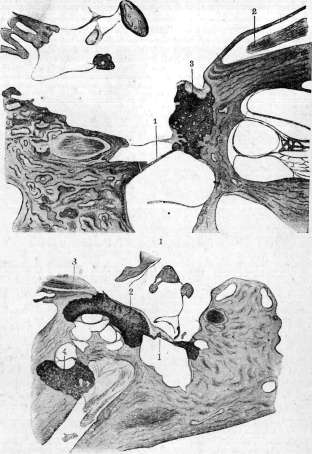
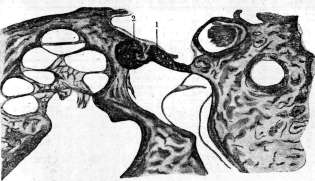
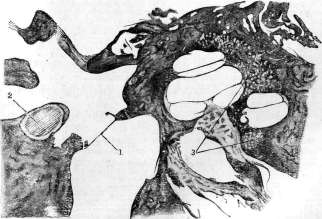
Figure 1. Limited otosclerosis without ankylosis of the stapes. Figure 2. Limited otosclerosis: sclerotic focus in front of the oval window, extending to the stapes footplate; 3-m. tensor tympani; 4- focus near the internal auditory meatus. Figure 3. Otosclerosis of the cochlear capsule without stapes ankylosis: 1-stapes footplate; 2-facial nerve; 3-otosclerotic foci. (Figure 1-4 or drilling of the labyrinthine wall sometimes give a temporary, and more often a negligible or even negative result; furthermore, they are very dangerous (possibility of labyrinthitis).
Systematic inflation of the ears, which was used previously, sometimes gave (apparently in the initial stages of ankylosis) a temporary success, but subsequently usually even accelerated the ankylosis and has now been abandoned. Various physical methods are used: galvanization, faradization, massage, diathermy, iontophoresis, X-ray and radiotherapy, etc. Some recommend rubbing ointments into the area of the mastoid process, injecting medicinal substances under its periosteum, or introducing them through the Eustachian tube, and mud therapy. Various substances (iodine preparations, phosphorus, small doses of quinine or corrosive sublimate, strychnine, pilocarpine, adrenaline, high doses of arsenic, etc.) are given internally or subcutaneously. Autohemotherapy has also been used. For noise, valerian preparations, bromides, etc., are prescribed. For vestibular phenomena, repeated lumbar puncture has been tried. Other methods of treatment are based on the connection of Otosclerosis with a disturbance in the activity of the endocrine system and metabolism: a certain result is apparently given by a preparation of the anterior lobe of the pituitary gland—pituitrin A; thyreoidin has also been used. In appropriate cases, calcium salts (bromide and chloride) are prescribed internally or intravenously. All these methods in a number of cases give a satisfactory result, but not in the sense of curing the process, which at the current state of medicine is essentially impossible, but in terms of weakening certain symptoms and perhaps somewhat slowing the rate of progression of the process.
Related articles
Mentioned in
Cite this page
“Otosclerosis.” Soviet Medical Encyclopedia. English translation of Bolshaya Meditsinskaya Entsiklopediya, 1st ed. (Moscow, 1928–1936), ed. N. A. Semashko. https://sovietmedicalencyclopedia.pages.dev/article/otosclerosis/