Migraine
Historical document, translated for reference. It reflects medical knowledge of the 1920s–30s and is not medical advice.
Summary
Migraine is a specific type of headache recognized as a distinct clinical entity, often with a hereditary pattern. The article discusses its pathogenesis as potentially related to congenital predisposition and constitutional anomalies in the vascular network, with various forms classified based on symptomatology.
Encyclopedia article (1928–1936)
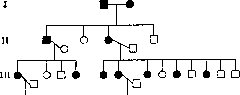
MIGRAINE, or hemicrania (see), a special type of headache, classified as an independent clinical form based on the typicality of the symptom complex. In most cases (with careful collection of anamnesis), M. proves to be a hereditary familial disease—dominant inheritance, partially limited to the female sex (see figure); according to
,Ш1 Ш
Migraine. Dominant inheritance. the opinion of some authors, it may be dominant inheritance through the X chromosome, but this contradicts the occasionally observed fact of direct transmission of M. from father to son. In a subject suffering from M., this symptom complex is stereotypically manifested either spontaneously or under the influence of the most diverse causes (infections, exogenous and endogenous intoxications, emotions, overwork, etc.). Taking into account the above, it is necessary to stop at explaining these facts by congenital predisposition, i.e., to consider a partial constitutional anomaly. The question of the anatomical substrate of this anomaly still remains open, but the most probable assumption can be considered a partial anomaly of the vascular network, namely its innervation apparatus (segments of the sympathetic nervous system) and possibly some areas of the brain (narrowing of one of the foramina of Monro, mismatch between the volume of the skull and the hemisphere of the brain). From this point of view, the pathogenesis of M. fits into the framework of the pathogenesis of headache (see), while the specificity of the symptom complex of M. and its various forms is determined by the quality and localization of the partial anomaly. In cases with unclear etiology, one can speak of "genuine" M., but the need for this term will decrease as clinically carefully studied cases accumulate. In the pathogenesis of an M. attack, it is often possible to establish the significance of reflex irritants. The reflex nature of M. is most evident in diseases of the gastrointestinal tract (migraine duodenale, viscerale according to French authors). In neurotics, especially in hysterical subjects, prolonged attacks of M. are often observed, which gave rise to the term hemicrania permanens for this form of M.; Fere introduced the term etat de mal migraineux, Mobius - status hemicranicus; these terms are clinically not very useful, just like the term "pseudomigraine" proposed to denote cases of hemicrania that do not have the usual recurrent character. The constitutional point of view on the pathogenesis of M. is confirmed by observations of old prominent clinicians (Leiving, Gowers, Mobius) regarding the connection between M. and epilepsy. Since attacks of M. sometimes appear either as precursors (aura) or as equivalents of epilepsy, they can be assessed in such cases as partial symptoms preceding the general symptom complex of epilepsy. The fact that repeatedly established, among the relatives of people suffering from epilepsy, M. is very often found along with explosive psychopathy, dipsomania and other epileptoid signs, brings M. and epilepsy even closer. Since genuine epilepsy (Rudin, Yudin, Davidenkov and Galachyan) is a recessive disease, it is most correct to interpret the above anomalies characteristic of members of an epileptic family as an expression of a heterozygous structure. The constitutional approach allows us to combine the pathogenesis of individual clinical forms of M., which have only symptomatic (localizational) interest, namely: hemicrania ophthalmica (migraine ophthalmique) with predominance of symptoms from the visual system: flickering before one eye (scintillating scotoma) and hemianopia during M. attacks. Hemicrania ophthalmoplegica - see Ophthalmoplegia. Hemicrania facioplegica - recurrent paralysis of the facial nerve. Hemicrania cerebellaris - transient cerebellar disorders of coordination. It is possible that the psychological equivalents of M. should also be assessed from the point of view of an anomaly of the vascular network of various areas of the brain. From this point of view, the mechanism of two forms of M. opposite in type can be explained: Hemicrania angiospastica and H. angioparalytica, in which the narrowing or, conversely, the expansion of blood vessels should be considered as a reaction of defective segments of the sympathetic chain in two opposite respects. Prevention and treatment - see Hemicrania.
Related articles
Mentioned in
Cite this page
“Migraine.” Soviet Medical Encyclopedia. English translation of Bolshaya Meditsinskaya Entsiklopediya, 1st ed. (Moscow, 1928–1936), ed. N. A. Semashko. https://sovietmedicalencyclopedia.pages.dev/article/migraine/