Kola; Flask; Sausage Products
Historical document, translated for reference. It reflects medical knowledge of the 1920s–30s and is not medical advice.
Summary
This entry covers three distinct topics: the botanical and pharmacological properties of the Kola nut, the various types of laboratory flasks used in scientific research, and the classification of sausage products based on their composition and preparation methods.
Encyclopedia article (1928–1936)
KOLA, or guru, Semen Colae, the seeds of the plant Cola vera Schumann and other species of the family Sterculiaceae, which are medium-sized trees growing in tropical Africa (along the Niger and Congo rivers); they are cultivated in the West and East Indies. The seeds, freed from their shell, are large, weighing up to 20 g. In their fresh state, they are light-colored but later turn brown; they are odorless and have a faint taste. The active principles are caffeine (1–2.5%), theobromine (0.023–0.300%), and easily decomposable glycosides—kolanin (which yields caffeine upon decomposition) and kolatin (which does not yield caffeine); in addition, there is starch, sugar, and fatty oil. Since fresh nuts act better, it is believed that the preserved kolanin has the main effect. In general, the composition of Kola is very complex, and there are contradictory indications in the literature. The seeds are often roasted like coffee and cocoa. They are used by the natives as a stimulating spice, and in medicine for neuralgias, migraines, against diarrhea, and as a diuretic for heart diseases and dropsy. The pharmacological effect is conditioned by the presence of caffeine and theobromine. They are given in powders of 1.0–2.0 several times a day, in tincture (Tinctura Colae), or in the form of wine (Vinum Colae), or fluid extract (Extractum Colae fluidum) at 15–20 drops per dose, or in pills of 0.2. In large doses, Kola can cause poisoning: excitation of the nervous system, insomnia, vomiting, convulsions, and even paralysis. The measures for poisoning are the same as for caffeine poisoning. FLASK, a vessel of spherical or conical shape, used mainly for heating liquids in laboratories. Flasks are made of glass, but in some cases, porcelain, quartz, and metal flasks are used. By external shape, one distinguishes flat-bottomed flasks (Figure 1), with a short or long neck; the edge of the neck can be of the same thickness as the walls or thicker; the thickening is made so that the flask can be tightly closed with a stopper without fear of crushing the neck; round-bottomed flasks (Figure 2); they
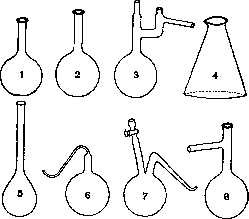
are more durable than flat-bottomed ones when heated; the neck of a round-bottomed flask can be short or long, as, for example, in the Kjeldahl flask (Figure 5). When studying the process of fermentation and for preserving putrefying liquids, Pasteur flasks (Figures 6 and 7) are used; Erlenmeyer, or conical, flasks (Figure 4) are especially convenient for titration, as well as for precipitation reactions in gravimetric analysis, since the precipitate can be easily extracted from them. For distillations at ordinary pressure, a Wurtz flask (Figure 8) is used, and for vacuum distillations, a Claisen flask (Figure 3). SAUSAGE PRODUCTS are divided into the following types: 1. Sausage products proper—meat products prepared from salted large pieces of meat, lungs, liver, etc., and enclosed in intestines, or from coarsely chopped soft parts of pre-boiled hide, enclosed in stomachs and covered with strong hot broth. 2. Sausages—a meat product prepared from minced meat and fat of slaughtered animals, their blood, and lungs, with the addition in some cases of other food substances, as well as spices and salt, taken in specific proportions, and enclosed in cleaned intestines, stomachs, and bladders or in parchment casings. 3. Surrogate sausages—sausages in which minced meat is completely or partially replaced by non-meat food products (peas, groats, etc.). Sausages are divided according to the basic material included in their composition (meat,
blood sausages, those made from offal, headcheese), and by the method of preparation (raw, boiled, smoked). For the manufacture of standard varieties of sausages, raw meat is used in fresh, chilled, and frozen form, as well as salt beef prepared by special curing. Usually, the meat of bulls, oxen, cows, calves, pigs, and sheep is used. For special varieties of sausages, the meat of other animals is used, such as: elk, bear, rabbit, camel, deer, horse, and donkey. The meat must be subjected to veterinary-sanitary inspection and be completely wholesome. Spoiled meat, meat that is not completely fresh, meat covered with mold that has grown deep into the tissue, meat having visible pathological changes, as well as premature calves, calves inflated with air, salt beef with dirty-turbid foamy brine, flabby, viscous, and emitting an unpleasant sour odor, meat and fat of uncastrated boars, and pig fatback having a yellowish color and being soft and oily to the touch are not permitted. The animal offal (lungs, heart, liver), pork head meat, blood (pig, calf), and sometimes eggs and wheat or potato flour used for the manufacture of certain varieties of sausages must also be completely fresh and wholesome. The importance of starch (flour) used in sausage production, which is used for better binding of the sausage forcemeat, should be especially noted, but it is sometimes added in too large quantities (10% or more). Such an admixture can be considered as adulteration, i.e., the replacement of an expensive product—meat—with a cheaper one—starch. Furthermore, sausage rich in starch, by binding a large amount of water and possessing a more diverse nutritional composition, is more susceptible to microbial decomposition processes and is less stable. The Scientific Medical Council of the People's Commissariat of Health of the RSFSR permits the use of starch for binding forcemeat only in lower grades of sausage and in amounts not exceeding 2%. The practice of sausage production allows for the starch-free preparation of boiled sausage without any particular difficulty, since meat itself, and especially fresh meat, possesses sufficient binding properties. Additional materials in sausage production include salt, saltpeter, and various kinds of seasonings. Salt must meet the requirements for 'food-grade table salt' [OST (All-Union Standard of the Committee for Standardization) 616]. Usually, its content in sausage ranges from 2.0% to 2.5%. Saltpeter used in the curing of meat and sausage forcemeat must, in its properties, correspond to the All-Union standard for saltpeter for food purposes (OST 235). Its dosage in sausage has not yet been finally established, but in any case, it should not exceed 0.2%. Sugar used as a seasoning should not be of a low grade (yellow), as the latter promotes rapid fermentation processes and rapid souring of the forcemeat. Onions, garlic, ginger, cardamom, nutmeg, black pepper, allspice, coriander, cinnamon, cloves, marjoram, star anise, and pistachios are used as spices. As casings for sausages and sausage products, the intestines of all slaughtered animals, thoroughly cleaned of contents, soaked, washed, and blown out, may be permitted. If the intestines are not immediately put into sausage production, they are salted or dried. Salted intestines are more durable and prevent the drying out of the forcemeat stuffed into them. Instead of intestines, parchment is sometimes used in the form of glued or sewn sleeves of various diameters. For such products, only good standard parchment must be used (OST 151). There are indications that parchment casings protect sausage from external microbial contamination for a shorter period than intestines; boiled sausage in parchment molds and spoils more quickly during long-term storage. Nevertheless, for quickly consumed varieties of sausages, the use of parchment casing can be considered permissible. The manufacture of sausages comes down to the following: meat intended for sausages is first separated from the bones (deboning) and sorted along the way. Then follows the so-called sinew removal of the meat, i.e., the removal of tendons and membranes. The preparation of the forcemeat is carried out either immediately after the sinew removal of the meat, or the meat is first cut into small pieces and salted. Forcemeat from salted meat is more durable and has more binding. The stuffing of the forcemeat into the intestines is carried out with special syringes, with sausages intended for smoking being stuffed tightly, and sausages for boiling being stuffed relatively loosely. After stuffing, the sausages are either dried at a temperature of 5° (boiled sausages for 12 hours, smoked sausages for 6-8 days) or 'roasted' at a temperature of 70-80°. Boiling of sausages is carried out at a temperature of about 90° in clean water or in broth obtained after boiling ham. Boiling in broth that has stood for more than a day is not permitted. The duration of boiling ranges from a few minutes (sausages 5-10 minutes) to 2 hours and is determined empirically. The degree of readiness of boiled sausage can also be determined by a special needle—a 'prod'—which is inserted into the thickness of the sausage; if the smell of raw meat is felt upon sniffing, then boiling is continued. Smoking of sausages is carried out by the action of smoke at a temperature of 15-20° for 6-14 days. Upon completion of smoking, the sausages are hung in a warm, dry, and well-ventilated room, where the process of their maturation ends. After this, smoked sausages can be stacked or placed in boxes for storage. Storage conditions for smoked sausages: temperature - 0°, humidity - 90%, ventilation - not less than 1 volume per day, stacking - in boxes or in a suspended state on hooks, storage period - not more than a year. Storage conditions for boiled sausages: temperature +2°, 0°, -1°, humidity - 85%, ventilation - 2 volumes per day, stacking - on sticks in a suspended state. A somewhat peculiar type of sausage is represented by so-called frankfurters, manufactured mainly from pork, as well as veal and the best grades of beef. Milk and eggs are also sometimes added to the forcemeat. The stuffing of the forcemeat is carried out into sheep casings (not more than 1.5 cm in diameter), with the small sausages being twisted around their axis every 15 cm or tied in pairs with coarse thread. After preliminary roasting, the frankfurters are 'boiled' for 5-10 minutes in water at a temperature of 87°. Frankfurters are a perishable meat product and in summer do not withstand storage for more than a day. The premises of sausage factories must be spacious, well-ventilated, and supplied with cold and hot water. The walls must be painted with white oil paint and periodically washed. The floors must be impermeable, preferably ceramic or asphalt, and kept clean. Tables, implements, and tools must be cleaned and washed after the completion of each job. Workers must have a sufficient quantity of (daily changed) work clothing. In each department, there must be washbasins equipped with soap and a towel, and in each building, a special room for changing clothes. The storage of outer clothing in work areas, as well as smoking and eating, are prohibited. Showers must be equipped at large factories. Restrooms must be located isolated from work areas. Supervision of the entire sanitary aspect is entrusted to both veterinary and medical sanitary inspection. Sanitary-hygienic requirements for finished sausage come down to the following: 1) The color, odor, taste, and consistency of the sausage must correspond to a fresh, wholesome product. 2) The sausage must not have a sharply alkaline reaction; Eber's reaction for NH3 must be negative. 3) Voids, sometimes found in boiled varieties of sausage, must not possess a foul odor or have a greenish-yellow color. 4) The chemical composition, as well as the standardization of additional ingredients, must correspond to the All-Union standard. 5) Artificial coloring of sausages is not permitted. 6) The use of parchment casing is permissible provided that the parchment meets standard requirements (OST 151). Well-made sausage is a tasty, highly nutritious, and widely distributed food product. The chemical composition and digestibility of different varieties of sausage can be seen from the table (according to Palladin). One of the most common adulterations of sausage is the excessive addition of starch and water to the forcemeat, which lowers the taste and nutritional properties of the product. Adulteration also includes the replacement of higher grades of meat with lower ones. Finally, the falsification of sausage products must include the use of meat from non-slaughter animals for ordinary varieties of sausage, for example, dog, cat, etc., as well as coloring the forcemeat for the purpose of giving a defective product a good appearance. Due to the poor quality of the raw materials, as well as possible contamination and spoilage during storage, sausage can be the cause of diseases. The latter can be caused by the following microorganisms: 1) representatives of the paratyphoid group (Bac. paratyph. B Breslau, Bac. enteritidis Gärtner); 2) the causative agent of botulism (Bac. botulinus van Ermengem); 3) other microorganisms, to which should be attributed Proteus (Bac. proteus), Escherichia coli (Bact. coli), and the dysentery bacillus (Bac. dysenteriae).
It should be noted that sometimes toxic sausage containing botulinus poison has the appearance of benign sausage, but is still capable of causing sometimes severe diseases (see Botulism). Defects of sausage include surface mold, sometimes penetrating inside, rancidity of fat in smoked sausages, presence of focal color changes, arising most often due to the beginning process of meat decomposition, and finally a sour or putrid odor. Evaluating sausage as a food product, it should be admitted that in their caloric value, sausage products are close to meat, and in some cases even exceed average grades of pork and beef (ham, liver, and other sausages). An advantageous side of them is also the absence of waste (if one does not count the casings), which in fresh meat reaches 18%. It must also be noted that sausage is often a more convenient and tasty form of using meat scraps and offal. Nevertheless, sausage, like any canned food, cannot completely replace fresh meat, differing from it by a lesser variety of its use, and consequently, greater satiety. The presence in some cases in sausage of such substances as saltpeter and nitrous acid cannot be considered indifferent for the consumer. And the very method of manufacturing this meat product makes possible all kinds of counterfeiting (addition of water, starch in increased quantity) and falsification (addition of meat of non-slaughtered animals), which the consumer himself, without the help of a laboratory, is often not in a position to notice. Finally, abundant addition of aromatic seasonings can mask both the lack of freshness of the initial meat and the spoilage of the sausage itself during its storage. What has been said applies to the greatest extent to boiled varieties of sausage. All these circumstances speak to the great importance of sanitary-food supervision in the sausage business, since only full compliance with all sanitary requirements regarding raw materials, the production process, and the rules of storage and sale can ensure the quality of this valuable meat product. Nutritional content of food products in %: Liver sausage (avg) - Water 46.87%, Protein 12.87%, Fat 23.9%, Ash 3.8%, Calories per 1 kg 3029; Sausages (per Central Statistical Administration) - Water 47.80%, Protein 12.89%, Fat 25.10%, Ash 2.52%, Calories per 1 kg 3122. The methodology of investigating sausages boils down mainly to an organoleptic study of the product, i.e., to the determination of the appearance, color, and smell of the forcemeat, the presence of cavities and their condition. Initial signs of meat putrefaction are caught by a test on a heated fork or during a boiling test. Eber's reaction for NH3 is also used. The reaction for H2S in sausage does not have the significance of an indicator of spoilage, since it loses its specificity in the case of the presence of garlic or due to the splitting off of H2S during intensive boiling of the sausage. Determination of the reaction of the sausage is performed on a cross-section with the help of moistened red and blue litmus papers. A qualitative reaction for starch is performed by applying a drop of Lugol's iodine solution to the surface of the sausage cross-section or into a decoction obtained from the test sample. A blue color of the reaction testifies to the presence of starch. Quantitative determination of starch is performed either by the gravimetric method of Mayrhofer, based on the insolubility of starch in an alcoholic solution of caustic potash, in which proteins, fats, sugar, and other components of the sausage are soluble, or by the polarimetric method of Grossfeld, in which the starch isolated from the sausage by the Mayrhofer method is converted into a soluble state with hydrochloric acid, clarified with infusorial earth, and analyzed in a polarization apparatus. Determination of the chemical composition of sausage is performed by well-known methods: water—by drying at 100–105°, total nitrogen (proteins)—by Kjeldahl, fat—by the Gottlieb-Rose method, ash—by burning the dried sample in two stages. Admixture of horse meat and meat of non-slaughtered animals is detected by the precipitation reaction according to Uhlenhuth.
Related articles
Cite this page
“Kola; Flask; Sausage Products.” Soviet Medical Encyclopedia. English translation of Bolshaya Meditsinskaya Entsiklopediya, 1st ed. (Moscow, 1928–1936), ed. N. A. Semashko. https://sovietmedicalencyclopedia.pages.dev/article/kola-flask-sausage-products/