Slop Pit
Historical document, translated for reference. It reflects medical knowledge of the 1920s–30s and is not medical advice.
Summary
This article describes the construction and maintenance of slop pits, which were used for collecting wastewater in areas lacking sewage systems. It details the necessary components, such as grates for separating solid waste, and outlines sanitary requirements to prevent the accumulation of foul gases and the spread of disease.
Encyclopedia article (1928–1936)
SLOP PIT, slop basin, a receptacle for collecting dirty water on properties that do not have sewage systems. It usually consists of two parts: a pit, the walls and bottom of which are lined with one material or another, and an above-ground part in the form of a box, separated from the pit by a grate (Figs. 1 and 2). The underground part serves to collect dirty water, while solid waste and refuse, which enter the slop pit along with the liquid, are retained on the grate. This dirty water, together with the solid waste, is called slops. The construction of a slop pit without a grate for separating refuse is not recommended, because solid impurities in wastewater contribute to their more rapid putrefaction and form a sediment at the bottom of the pit that is difficult to remove, which complicates the cleaning of the slop pit. The removal of the liquid alone is carried out without difficulty using pumps and pneumatic barrels (see Sanitation). To prevent clogging of the grate, it is necessary to remove the refuse that has accumulated on it into a specially constructed box for collecting refuse (a dustbin). This is especially necessary to do in the cold season, because leaving
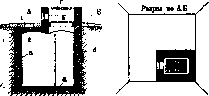
Figure 1. A brick pit measuring 2.13 m x 2.13 m for 70 people. The walls and bottom (a) are one brick thick, with a layer of clay on the outside (b); the inside of the walls and bottom are plastered with cement mortar. The pit is covered on top by a grate (c). The above-ground part is closed by a lid (d) with a hatch, the construction of which is visible in Fig. 2; 1—the space between the walls along the arches, filled with concrete; 2—arch.
damp refuse on the grate leads to the icing of the latter and the clogging of the openings, as a result of which new portions of slops spill over the surface of the yard without penetrating into the pit. It is also impossible to recommend the construction of a slop pit as a common receptacle with a privy cesspool. With such an arrangement, a particularly large amount of foul-smelling gases is formed due to the intensification of the processes of putrefactive decomposition of excrement. In view of the sanitary danger that slops present (harmful foul-smelling gases are formed during their decomposition, pathogenic microbes can remain viable in them, and flies multiply), the requirements for the construction of a slop pit should not be lower than those imposed on the construction of cesspools (see). The construction of the underground part of a slop pit in the form of absorption wells or with liquid drainage into open bodies of water without purification must
the construction of cesspools. Slop pits must be located at least 4 m away from the walls of residential buildings. Fig. 2 hatch. Their underground part should not be deeper than 3 m, and the above-ground part higher than 0.75–1.0 m. The material for the walls and bottom can be wood, brick, concrete, reinforced concrete, iron, cast iron, or ceramic tiles. Wooden and brick walls and the bottom are lined with a layer of well-compacted fat clay, 0.35 m thick. Wood is used in the form of well-tarred logs or planks; brick is plastered from the inside with cement mortar. The above-ground part of the slop pit is constructed in the form of a wooden box or made of brick and must be covered with a lid. The cleaning of such a slop pit occurs either through a special opening (hatch) or after removing the grate. In the latter case, it is convenient to make the entire above-ground part of the slop pit removable. The dimensions of the slop pit are determined by the amount of slops produced by one resident, the number of the latter, and the cleaning intervals. The amount of slops can be assumed, depending on the volume of water consumption, the cultural level of the population, etc., to be from 15 to 25 liters per person per day. Cleaning intervals are set for the liquid part at once a month; solid parts from the grate must be removed at intervals adopted for refuse removal, but no less than once a week. When calculating the dimensions of the pit, it is necessary to provide a reserve of at least 30%.
Related articles
Mentioned in
Cite this page
“Slop Pit.” Soviet Medical Encyclopedia. English translation of Bolshaya Meditsinskaya Entsiklopediya, 1st ed. (Moscow, 1928–1936), ed. N. A. Semashko. https://sovietmedicalencyclopedia.pages.dev/article/slop-pit/