India
Historical document, translated for reference. It reflects medical knowledge of the 1920s–30s and is not medical advice.
Summary
A 1930s overview of India's demographic and public health situation, highlighting extreme overpopulation, widespread famine, and the prevalence of infectious diseases like plague, cholera, and malaria. It details the high infant mortality rates and the lack of reliable medical statistics in rural areas during the British colonial period.
Encyclopedia article (1928–1936)
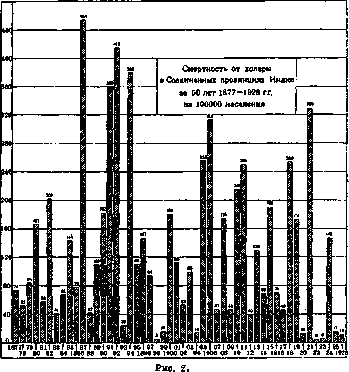
INDIA. Area. Properly British India, including native states under British protectorate - 2,834,237 km2 and Indian so-called independent states - 1,841,573 km2. Total population - 318,942,480 people according to the 1921 census, of which the population of British territory is 247,003,293 people, the population of independent states is 71,939,187 people. The population of India is far from homogeneous. There are about 100 languages and dialects in constant use. The most important of them is the Sanskrit dialect (the language of the Hindus). Administratively, India is divided into 15 British provinces and a large number of scattered and small semi-independent Indian states. The main mass of the population (about 90%) lives in villages, and only 32 million people (about 10%) live in cities, of which there are more than 2,000 in India. About 230 million of the population (70%) are engaged in agriculture, about 33 million are employed in industry, over 18 million in trade. Despite periodic famine, epidemics of malaria, plague, cholera, and influenza, the population of India is still increasing, by approximately 7% per decade. In 1872, the population of British India was only 180,508,677 people. In 1901-11, it increased by almost 21 million, i.e., by 7.1%; from 1911 to 1921 - only by 1.2%. The population density is very high, on average 68 people per 1 km2, reaching 234 people in the fertile Bengal valley and not dropping below 22 people per 1 km2 in the province of Burma - in the jungles. At present, the population of India must be considered close to the maximum. Overpopulated to the extreme, India can with difficulty feed 319 million people, and even a small decrease in the level of precipitation compared to the average is enough to entail a more or less widespread famine. In 1769-70, 1/3 of the population of the Bengal province died of famine. In modern history, great famine has been noted more than once in one part of India or another. In 1896-97, an area of 502,460 km2 of British India and 212,380 km2 of Indian states with a population of 45 and 7 million people was affected by famine. In 1899-1900, about 55 million people were starving, in 1907-08 - about 30 million. Famine was noted in 1919 and 1920-1921. As a result - an increased number of all kinds of diseases in general and epidemic ones in particular. Further increase in the population of India will inevitably lead, under its current social structure, to chronic malnutrition and cruel epidemics. Demography. Data concerning the natural movement of the population are very approximate, especially on the question of the causes of death. 'More than 90% of the population is not served at all by any qualified medical personnel. Only a very small percentage of the dying see a doctor possessing any medical qualification during their last illness. Statistics in almost all of rural India are in the hands of people who are only slightly literate. Under these conditions, one has to draw larger conclusions than the available data allow' (from the report of the Medical Commissioner to the Government of India, 1919). Only in large cities is there any good record-keeping. In rural areas, this is done by the village headman, who, after a certain interval of time, gives his records to the nearest police station. Birth rate and mortality (per 1,000 inhabitants). India in 1926. Birth rate averages 35.0, and mortality - 25.0 per 1,000. Infant mortality in India is exceptionally high. The highest figure for 1926 is given by the city of Poona - 611 deaths per 1,000 births, then Cawnpore - 484.3, Allahabad - 244.06, Benares - 313.55, Lucknow - 286.63. In other places, mortality is significantly lower, yet on average for India - 180 per 1,000 births. The main reasons for such an exorbitantly high infant mortality are the following: according to Hindu concepts, a woman in labor is considered unclean, one cannot touch or even approach her, and therefore the woman giving birth is driven into the most remote, unnecessary, dirty room. Usually, a midwife, 'dai', armed with a kitchen knife, kerosene for lighting and for lubricating hands during vaginal examination, and dirty rags, assists. As a result - thousands of women are victims of prejudice. Mohammedan women, especially from the middle and upper classes, locked up all their lives within four walls, suffer more often than others from tuberculosis, the onset of which usually coincides with the first birth. With such a way of life, women die from tuberculosis twice as often as men. According to the beliefs of Hindus, the woman who dies during her first birth is happy. Too early marriages and too early motherhood lead precisely to such 'happiness', and are also the cause of the non-viability of children. Finally, according to the customs of Hindus, newborn children are not fed at all for the first three days. A child who becomes restless under these conditions is given opium. The main causes of infant mortality by age are visible from the following data for the city of Bombay for 1926 (in %). Morbidity in India. In the United Provinces of India in 1918-19, about 2 million people died from plague, cholera, and influenza alone. The population of these United Provinces decreased over 10 years as a result of famine, malaria, plague, and cholera by approximately 3 people per 1,000, which is visible from the following figures: in 1901 there were 47,313,339 people; in 1911 - 46,807,490 people; in 1921 - 45,375,787 people. Plague in India is generally considered to have appeared since 1896, however, already in the book Bhagavata Purana (between the 5th and 10th centuries AD) there is advice to abandon houses when 'rats jump from the ceiling, stagger like drunks, and die. One can be sure that there is plague here.' Solbank (Joseph Solbank; 1619) indicates that the plague was in Agra for three months and up to 1,000 people died daily. Emperor Jahangir in his autobiography also provides information about the plague. Undoubtedly, there are many grounds to consider India the cradle of endemic plague. The movement of the plague only in British India, excluding the Indian states, about which there is no data, is visible from the following table (and fig. 1). Infectious morbidity in India is enormous; the figures are colossal, as nowhere else in the world, yielding in this perhaps only to China. To illustrate, it is enough to say that the malaria epidemic of 1908 in the northern part of India carried 1/4 million people to the grave in 3 months; the influenza epidemic in 1918 caused more than 6 million deaths by a conservative estimate. Plague over the twenty-year period 1898-1918 was the cause of death of more than 10 million people; cholera in 1924 caused 1/4 million deaths, smallpox in 1925 - about 86,000 deaths, malaria in 1924 - more than 1 million deaths. To this must be added about 500,000 completely blind as a result of smallpox and about 1 million lepers (Muir). If one adds to this the huge unrecorded morbidity and insufficient mortality statistics, one can form a vivid idea of the exceptionally large scale of infectious morbidity. Of the 9 provinces of British India, the United Provinces are the most affected by the plague. Recent years show a significant decrease in plague diseases in India, and yet British India is the most powerful focus of endemic plague in the whole world. Cholera in India was known even 600 years before Christ and to this day does not leave it, giving annual typical endemic outbreaks, often timed to religious holidays, causing a large gathering of Hindus at the 'sacred' Ganges (fig. 2). In 1873, more than 20,000 pilgrims died of cholera in less than 8 days. In 1831 and 1855, pandemics were noted, which then spread to Europe through the Punjab, Afghanistan, and Russia. Low-lying fertile and most populated provinces are most affected by cholera. Annual cholera morbidity fluctuates extremely. Likewise, the geographical distribution of cholera within the endemic area is very uneven. Malaria in India is one of the main forms of morbidity, accounting for 19.09% of all hospital visits - a percentage higher than for any other disease, sometimes reaching 30.23 and only once in the last 40 years dropping to 10.81 (1913).
Of the 18 species of Anopheles registered in the United Provinces of India, 9 have been found infected with malaria plasmodia in nature and play a major role in the spread of malaria. Tuberculosis accounts for 19% of all deaths in India (Sousa). Every 4th visitor to a practicing physician is ill with tuberculosis, and all diseases of the respiratory tract account for slightly less than 1/2 of all deaths. There are about 1 million lepers (Muir) in India; 2/3 of newborns are not vaccinated, and as a result of this, there are at least 500,000 completely blind people in India. Leishmaniasis, relapsing fever, helminthic invasions, mainly ancylostomiasis, venereal diseases, and a number of other diseases are of lesser importance but are still very widespread in India. Control of infectious diseases. Practicing physicians are required to report the first cases of plague, cholera, smallpox, etc., in cities, and the village headman in villages. A monetary reward is given for reporting within the first 48 hours. The primary unit for combating infectious diseases is mobile hospitals and dispensaries, of which there is approximately one in each district (about 1 million population), and in addition, 1-2 sanitary physicians residing in the district capital. "If a physician wanted to visit all the villages in his district only once, then, working 12 hours a day, he would be able to do this in a time from 1 to 3 years" (from the report of the Medical Commissioner to the Government of India). With the almost complete absence of medical services for the population, the center of gravity in the fight against infectious diseases is shifted to the promotion of preventive measures, mainly vaccinations. Smallpox detritus is prepared in sufficient quantities by 8 institutes in India; the Haffkine Institute in Bombay manufactured 10 million cm3 of plague vaccine in 1926; the institute in Kasauli prepares all other vaccines and virus fixe in large quantities; however, vaccinations are not popular among the population.
Health organization. Of the 7 members of the Government of India under the Viceroy, one is in charge of public health. Under him are the Commissioner of Public Hygiene and the Director-General of Medical and Treatment Institutions. In each province, one of the 2 or 3 ministers is also in charge of public health affairs. Under him are: 1) a Director of Public Hygiene with 6 assistants, of whom 3 are in charge of separate branches of sanitary work: 1-sanitary-bacteriological institutes, 1-health education, 1-malaria, and 3 assistants without specific specialization, and 2) an Inspector-General of Hospitals. In each district (there are 30-40 of these in each province) there must be 1 sanitary physician, 1 assistant physician, and 4 sanitary inspectors who are not physicians with 2 years of education in a medical school; each sanitary inspector has about 6 unqualified sanitary assistants. In addition, there is the district medical officer with 2 assistants. Medical aid to the population of India is provided by more than 5,000 civil hospitals, dispensaries, tuberculosis, leper, and other institutions with 75,000 beds. All these institutions admit about 43,000,000 patients per year. In addition, there are more than 600 private hospitals in India with 8,000 beds and an admission of about 5,000,000 patients. Military units and institutions are served by a special organization—the Royal Army Medical Corps (R.A.M.C.), a significant part of whose physicians are seconded for civil service. The sanitary organization in 1925 had 8 directors of public hygiene (in 11 provinces) with 33 assistants and auxiliary staff. Under their jurisdiction were 10 sanitary-bacteriological institutes and 8 smallpox calf stations with a production of more than 10 million doses of detritus, and in addition, 10 research institutes—anti-rabies, Pasteur, radium, etc. More than 30,000 people received anti-rabies treatment in 1925. Finally, it is completely impossible to account for the followers of the Indian system of medicine who are engaged in medical practice. According to the 1921 census, 24,898 people engaged in medical practice were registered in the United Provinces; of these, only 3,000 possess any medical qualification, the rest practice according to the Indian system, which apparently has nothing in common with scientific medicine, being pure quackery. Maternity and infant welfare is carried out mainly by charitable organizations and institutions, for example, the All-India Lady Chelmsford League for Maternity and Child Welfare, etc., at the expense of which and with the help of the state, special institutions (hospitals, maternity homes, milk kitchens) are organized, the possibility of medical education for Hindu women is facilitated, dai-midwives are trained, etc. Infant mortality in the United Provinces of India has shown a downward trend in recent years. Urban improvement. Only in relatively few cities in India is there a sewage system; in most Hindu cities, open drains are practiced, which eventually end up in rivers and pollute them. Most cities in India have water pipes, although as recently as 1899 this was a relatively great rarity; water supply from rivers was carried out by special water carriers. In rural areas, water supply is primitive—from rivers or public wells not protected from contamination. In elevated areas, pits are made to collect rainwater, from where the water is used for all household needs.
Housing. The nature of housing in India depends on the one hand on the climate, which changes sharply from the Himalayas to Ceylon, and on the other—on the mores and customs of the population. In the northern half of India, clay or adobe dugouts with a clay roof predominate in villages. The floor is smeared with clay mixed with cow dung. There is no ventilation, lighting is very weak. Smoke from the kitchen fills all the rooms. In the southern half of India, the structures are lighter, usually covered with palm leaves, with open verandas. In cities, the Hindu dwelling loses its individuality, approaching the usual type of housing, and only the incredible crowding of both houses and residents distinguishes the Hindu dwelling from the spacious detached cottages of Europeans, which are usually grouped in a separate, European part of the Hindu city. Nutrition. According to the beliefs of Hindus, the cow is a sacred animal, and its meat is not eaten; Mohammedans do not eat pork; Brahmins are vegetarians. Fruits, vegetables, rice, vegetable oil, and rarely milk are the main food items of the population. There are enough carbohydrates in the food, vegetable proteins are in insufficient quantity, and there is a lack of salt. In normal schools for girls, dietetics and culinary arts are a compulsory subject. Supervision of the main food products is carried out almost exclusively through administrative channels (Food Adulteration Act); the sale of surrogates and fakes is mainly prosecuted. Special regulations prescribe systematic observation of the sale of meat, etc. Food analysis is in its infancy. State labor protection. A special act of 1911 prescribes sanitary supervision of factories having 10 or more workers or producing dangerous or unhealthy products. No one under the age of 12 can be accepted for factory work. The maximum working day for adolescents of both sexes is 11 hours, including 1 hour for rest. Children younger than 15 years can work no more than 6 hours a day and no more than 4 hours continuously. Women and children are prohibited from working between 7 p.m. and 5:30 a.m. The working day for men should not exceed 12 hours and for women—11 hours. Women and children are not allowed to work where there is a danger of injury from moving mechanisms. One day a week is mandatory rest. The working week should not have more than 60 hours. There is no special regulation for the protection of pregnant women and women in labor. Sanitary rules provide for 14 to 19 m3 (500-700 cubic feet) of air for each worker in a factory premise, sufficient lighting, and ventilation. In production with 500 or more workers, there must be a first-aid station with the necessary equipment, and in large enterprises—a physician for free medical aid. In case of accidents, by court decision, the owner is obliged to pay a fine for the benefit of the victim or his family. Medical education in India in 1925 was carried out by 8 state medical colleges and 23 state medical schools with 8,899 students. In addition, in 1916, one women's medical college and 4 women's medical schools were opened with 392 female students. 244 female students were trained in 5 mixed colleges and in 7 mixed medical schools. The term of study is from 4 to 7 years.
S. Nikanorov. INDOLE, C8H7N, by its structure represents a benzene ring condensed with a pyrrole ring. In the animal organism, it is formed from the amino acid tryptophan (α-amino-β-indole-propionic acid), along with β-methyl-indole, or skatole. It crystallizes in the form of shiny plates; melting point 52°. Indole and skatole are formed in the intestine as a result of the decomposition and putrefaction of protein substances and impart a characteristic fecal odor to the intestinal contents. Both substances are distilled with water vapor and are easily soluble in alcohol. An alcohol solution of indole acidified with HCl colors a pine splinter red; with sodium nitroprusside and alkali, indole gives a dark red-violet color, which turns to pure blue upon acidification. With skatole, an alkaline reaction produces a yellow color, which turns violet upon boiling with acetic acid. With a few drops of formalin in the presence of concentrated H2SO4, indole gives a violet color, and skatole gives a yellow-brown color. Indole, absorbed from the intestine, is oxidized in the organism into indoxyl; the latter enters into a compound with H2SO4, forming so-called indican. A portion of the indole also combines with glucuronic acid.
Indican (indoxyl-sulfuric acid). Indican easily decomposes back into its constituent parts, and the resulting indoxyl can be converted into blue indigo by the action of oxidizing agents; methods for determining indican are based on this.
Indole, Indoxyl, Indigo.
Related articles
Mentioned in
Cite this page
“India.” Soviet Medical Encyclopedia. English translation of Bolshaya Meditsinskaya Entsiklopediya, 1st ed. (Moscow, 1928–1936), ed. N. A. Semashko. https://sovietmedicalencyclopedia.pages.dev/article/india/