Night Shelters
Historical document, translated for reference. It reflects medical knowledge of the 1920s–30s and is not medical advice.
Summary
This article from the 1928–1936 Soviet medical encyclopedia details the history, social function, and sanitary conditions of night shelters (flophouses) in Russia. It describes their evolution from private, exploitative commercial enterprises to municipal institutions, highlighting their role as centers of disease, crime, and poverty, and their subsequent transformation in the post-revolutionary period.
Encyclopedia article (1928–1936)
NIGHT SHELTERS, institutions for the overnight stay of people deprived of permanent housing. The first information about night shelters dates back to 1361 (Maison de St. Esprit en Preve), although as early as the 5th century in Byzantium there existed charitable night shelters for pilgrims traveling to Palestine. In Russia, night shelters first appeared in the 1860s–70s. Initially, night shelters existed at police stations and were of a commercial, entrepreneurial nature; they were replaced by charitable houses or those arising through public initiative; municipal night shelters were the last to develop. In Moscow in 1864, the police proposed that the city duma take over the maintenance of night shelters due to their 'lack of hygiene.' However, the city duma, only 15 years later in connection with the Vetlyanka plague, found it possible to organize its first night shelter for 510 people in addition to the free charitable night shelter of the Lyapin brothers, opened in the 1870s. The social significance of night shelters and the need for them grew with the development of industry, the influx of large masses of people from the countryside, the aggravation of housing needs, and the emergence of crises and unemployment. The need for night shelters was felt especially acutely in large industrial centers, where, due to the nature of the capitalist economy, a homeless population, completely deprived of shelter, grew extremely rapidly. The number of the latter was estimated in pre-war times in Moscow, for example, at over 10,000 people. It was estimated in the tens of thousands in St. Petersburg and other industrial centers of Russia. Over the course of a decade (1883–93), 2,219,836 people (visits) found shelter in 4 night shelters of the 'St. Petersburg Society of Night Shelters.' In Moscow, the movement of night shelter residents in six Moscow night shelters (excluding private ones) by year was as follows: 1909—1,322,878; 1910—1,735,847; 1911—1,809,865; 1912—1,810,202; 1913—1,866,304; 1914—1,488,034. At the same time, for 1913, for example, there were 58,875 registered cases of refusal of admission to night shelters. All these homeless people, consisting of day laborers, the unemployed, and various declassed elements of the 'urban bottom,' wandering around the city during the day in search of casual earnings, found shelter at night in the flophouses of Khitrov Market (Moscow), the slums of Sennaya (St. Petersburg), Moldavanka (Odessa), etc. These flophouses were the subject of exploitation by private entrepreneurs who conducted their night shelter business with great commercial profit. Thus, an examination of night shelters in 1899 in Moscow established that in 155 apartments of Khitrov Market, night shelter residents paid landlords on average 16.5 kopecks per month for 1 m3 of space, i.e., significantly more expensive than for space in a well-appointed apartment. Night shelters always had great social-hygienic significance not only from the point of view of protecting the health of their population, but (which is the main thing) from the point of view of the interests of the city as a whole, since night shelters were always considered as permanent foci of infectious diseases, posing a formidable danger to the entire city. During periods of epidemics, night shelters were often the gates through which the epidemic penetrated the city and spread further. The incidence of infectious diseases in the 3rd district of the Myasnitskaya part in Moscow, in which the famous Khitrov Market with its night shelters was located, was 5–6 times higher in 1894–96 than in the other two districts of the same part; mortality was 2 times higher. Over 5 years (1903–07), the 3rd Myasnitsky district accounted for almost one-third of all cases of infectious diseases in Moscow during this period. The number of infectious diseases in some night shelters of Khitrov Market in Moscow amounted to 44–45% of the entire population of these houses. The role of night shelters in the spread of cholera and parasitic typhus was especially dangerous and significant. The cholera epidemic of 1909 in Moscow developed mainly among the inhabitants of Khitrov Market. About 1/5 of those who fell ill with relapsing fever in 1908 in St. Petersburg fell to the share of night shelter residents and the homeless. Similar data are registered in relation to night shelters in a number of other cities. In addition, night shelters were permanent foci of alcoholism and other types of narcotism, venereal diseases, and crime. An examination of night shelters in Kharkov showed that all those examined (220 people) consumed alcohol; the overwhelming majority of women engaged in prostitution; 21.8% of those examined suffered from venereal diseases; of the latter, 25% became infected after moving into night shelters. Similar results were given by a similar examination in Saratov, where 17.6% of men, 22% of women, and 3% of adolescents were found to be venereal patients. The strong spread of narcotism and the extreme fluidity of the inhabitants of night shelters created favorable conditions in them for the spread and development of crime. These circumstances were aggravated by the composition of the population of night shelters, which was always very mixed. Along with the genuine inhabitants of the bottom: tramps, beggars, criminals, and prostitutes, a large number of day laborers and working women, seasonal workers, the unemployed, and other proletarians and semi-proletarians were encountered in night shelters. Already in the last pre-war years, the composition of the population of night shelters began to change towards the predominance of the latter categories. This was caused by the ever-increasing cost of living and housing needs. A census of night shelters conducted in St. Petersburg in 1910 showed that only about 1/3 of the number of registered night shelter residents were casual, and not permanent visitors to night shelters. Thus, already at that time, it was possible to treat night shelters in a significant part as a peculiar type of cheap housing for the poorest population of large centers. In the first post-revolutionary years, the contingent of night shelters changed even more sharply in the indicated direction. A special census in Moscow in 1924, covering 2,727 night shelter residents (85% men and 15% women), showed that by social status, the vast majority of night shelter residents fall on workers (49.8%) and peasants (22%). Similar results were given by an examination of night shelters in Kharkov, Saratov, and other cities. A very significant place among the inhabitants of night shelters is also occupied by day seasonal workers, as well as those who have permanent earnings. Now, as socialist industry grows, as both men and women are involved in it, and as unemployment is liquidated, the type of homeless tramp, the 'Khitrovets,' is gradually beginning to disappear from night shelters altogether. Some remnants of this population still exist in the form of former, now grown-up homeless children, but their specific weight and social significance are negligible. By age, the majority of night shelter residents usually fall into the working-age group. The Moscow examination gives 35.5% in the group from 20 to 30 years old, 22.6% from 30 to 40 years old; in Saratov, the predominant group is 20–30 years old; in Kharkov, the group 20–40 years old accounts for 83.7%. At the same time, a younger age is also encountered among night shelter residents, which naturally represents a greater social danger. Thus, the Moscow census of night shelter residents in 1924 gives 17.2% for the group aged 10–20 years, with significantly more women in this age group than men. This group is recruited mainly from homeless children. The sanitary condition of night shelters in the pre-revolutionary era was extremely poor and to a large extent predetermined the role of night shelters as breeding grounds for infections. Despite the existence of mandatory regulations governing the issues of the organization and maintenance of night shelters, the latter 'far from corresponded to even the minimum of these requirements. Due to extreme crowding and overcrowding, there was an insufficient volume of air in night shelters. The 'air cube' as a rule did not reach the minimum of 10 m3, fluctuating within the limits of 5–7.5 m3 and lower. It was often noted that the entire area of the night shelter was occupied in two tiers: on bunks and under them. As a result, there was sharp air pollution. During its chemical examination (for example, in Leningrad), the pollution indicator (the presence of CO2) sometimes gave figures 4–5 and even 7 times higher than what is allowed by the norm. This condition was aggravated by the absence or extreme insufficiency of ventilation and airing. Furthermore, insects (bedbugs, lice) and dirt were common for night shelters. Often there was no separation of men and women, which contributed to the spread of prostitution and venereal diseases. After the revolution, a significant improvement in the sanitary condition of night shelters is noted, with the transformation of some of them into a type of publicly accessible cheap hotels. The regime in night shelters varied depending on their nature and the system of exploitation: private or municipal, paid or free, etc. Despite the high fee in private night shelters (from 7 to 35 kopecks in Leningrad), overcrowding in them was greater than in free ones, in which, for the most part, overcrowding was not allowed. Usually, admission to night shelters began at 6–7 p.m. Without any questioning, night shelter residents anonymously passed through the cash register (in case of payment), left their belongings for storage in the night shelter's storeroom, and went either to the wards or to the buffet (where it was set up). There, one could get tea and bread; after the revolution, large buffets were maintained at large night shelters by cooperative organizations; before the revolution, large night shelters had reception rooms; after the revolution, outpatient clinics. Until 12 o'clock at night, the night shelter was open, and those spending the night could leave for a club or reading room; after 12 o'clock, leaving the house was stopped, as was walking along the corridor.
In the morning, until 9 o'clock, the house was gradually cleared of visitors. At 9 o'clock, cleaning and sanitary treatment of the house began. Such was the regime of one of the best Night Shelters in Moscow (the former Yermakovsky). A Night Shelter is usually an important object of sanitary supervision (duty shifts of sanitary doctors at the Night Shelter, general mass examinations of inhabitants with the detection of those with fever and sending them to hospitals, organization of reception wards, and in large houses, outpatient clinics). The outpatient clinic of the former Yermakovsky Night Shelter in Moscow consisted of a large reception room, a dressing room, a doctor's office, a room for the on-duty medical assistant, and a bathroom with a toilet. Medical aid and medicines are free. Patients are received from 7 to 12 o'clock at night by a doctor and a medical assistant. At night, a medical assistant and a nurse were on duty. The number of visits reached up to 150 people per evening in 1924-1925. At the same time, sanitary supervision was the initiator of streamlining the night shelter business in general: transferring this business into the hands of the city, increasing the number of Night Shelters, correctly distributing the network of Night Shelters throughout the city, and improving and rationalizing their organization and maintenance. Sanitary supervision drew up mandatory resolutions, rules, and instructions for the organization and maintenance of Night Shelters. After the revolution, there is a special position of sanitary doctor for Night Shelters in Moscow. Sanitary supervision participates in the construction of new Soviet Night Shelters, giving its conclusions on the choice of site, on the project and plan of the houses, etc. A subject of special concern on the part of sanitary supervision was usually the fight against ectoparasites (disinsection). At first, the fight was conducted with blowtorches, then Night Shelters were additionally equipped with disinsection installations, and finally, in many of them, baths were equipped, or general baths were used for washing the night shelter residents. In recent years, Night Shelters have been equipped with shower installations and pass-through type baths. Sanitary supervision must pay special attention to the sanitary treatment of Night Shelters. The latter in Moscow Night Shelters is carried out under the guidance of a disinfector and consists of the following. Cots are washed every day or two with hot water with soap and lye, and the floors in the wards are washed at the same time. On other days, dry cleaning is performed, i.e., the wards are swept, and the cots are wiped with a damp cloth. Floors in corridors, the reception room, and stairs are washed daily; toilets are additionally disinfected; monthly wet disinfection of the entire house is performed; in case the outpatient clinic identifies a contagious or suspicious patient, their cot is taken out into the yard, and the disinfector is notified. In addition, it is necessary to resort to blowtorches from time to time. Abroad, Night Shelters exist in all large centers. Their number is far from corresponding to the need, especially in years of crises and unemployment. In most cases, they are maintained by charitable societies and municipal authorities. It is characteristic that their maintenance is often the business of the police (Germany), which gives them a certain peculiar character. Although they are significantly higher than our pre-revolutionary Night Shelters in sanitary terms, the moral atmosphere in them is extremely burdensome and has a depressing effect on the clientele. For example, in the internal regulations of the Berlin municipal Night Shelter, in § 17, we read: 'in case of violation of the internal regulations of the institution, the manager has the right to remove the violator. In addition, the latter may, at discretion, be subjected to one of the following disciplinary measures: a) prohibition of visits; b) prohibition of staying in the courtyard of the institution; c) reduction of food and d) isolation from other inhabitants of the house (punishment cell).' Such rules, also characteristic of English Night Shelters, turn them into institutions with a prison regime and explain why the homeless prefer sleeping under the open sky to them. The Berlin municipal night shelter provides families deprived of an apartment with accommodation and food for a period of no more than 5 days, and for the homeless and single people, a night's lodging with hot soup in the morning and evening. English Night Shelters are famous for their harsh police regime and complete lack of respect for their inhabitants. In sanitary terms, they are different: along with hygienically furnished Night Shelters with separate cells (rooms), with showers and baths, one still encounters Night Shelters today that resemble the former Khitrovka in Moscow. In the USSR, in particular in Moscow, Night Shelters have now undergone an evolution reflecting the economic and cultural development of the country after the revolution and that different attitude towards the inhabitants of Night Shelters, which distinguishes a socialist country from a capitalist one. The predatory Khitrovka was decisively and quickly liquidated. Moscow's Khitrovka is now a square surrounded by new housing cooperative buildings. Along with this, completely destroyed old Night Shelters were restored and newly equipped. The contingent of Night Shelter inhabitants has also gradually changed. The 'Khitrovka dweller' is disappearing, and the predominant type is becoming the seasonal worker, the manual laborer, and temporary workers who do not have permanent housing. Night Shelters are thus turning into a kind of cheap, publicly accessible dormitories. Night Shelters are now usually operated on the principles of economic accountability. A buffet, a canteen, and cultural institutions are being set up, and cultural work is being conducted. At some Night Shelters, clubs, well-equipped stages, and radio receivers with loudspeakers have been set up among the night shelter residents in Moscow; separate rooms have been set aside for reading rooms; cultural work is conducted by the cultural commission of the night shelter staff. At the Sadovnichesky night shelter in Moscow, there are special nurseries. At the same time, for other groups of the population, such as collective farmers, their own 'collective farmer houses' (formerly 'peasant houses') are now being organized, where cultural work is also deployed, etc. Night shelters of the old bourgeois type are thus disappearing in the USSR and are being replaced by other institutions of a targeted nature. Sanitary requirements that are imposed on modern houses were taken into account during the construction of new Night Shelters. As an example, we provide a description of the first Night Shelter in Moscow on Sushchevsky Val, built specifically as a Night Shelter according to the project of architect A. S. Fufaev (see drawing). The Night Shelter consists of 3 departments: 1) family, with separate rooms, a place for their own clothes, a smoking room, washrooms equipped with bathtubs for washing feet with cold and hot water. From the washroom, there is an entrance to toilets with floor-mounted bowls (Turkish style). At the house on the 6th floor, there is a large club with an auditorium Plan of the night shelter: 1-wards for single people; 2-wards for families; 3-smoking room; 4-linen distribution; 5-drying room; 6-disinfection chamber; 7-shower room; 8-reception room; 9-undressing room; 10-barbershop; 11-apartments for service personnel.
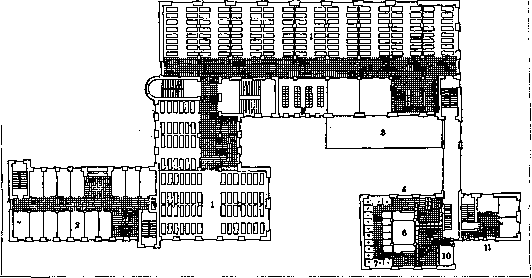
hotel-type rooms (separate building), 2) departments for single men and women, 3) general-purpose service premises (canteen, club, outpatient clinic, etc.). The building is oriented so that no living quarters face north. In front of the main entrance, there is an asphalt-paved area serving for visitors waiting to be admitted to the Night Shelter. Through the main vestibule, the visitor enters the lobby, sized at a rate of 0.5 m2 per person. In the lobby, there are barriers for the queue waiting at the ticket office. From the lobby, the visitor enters the Hall, where the controller indicates the floor, room number, etc. In a separate building, there is a pass-through shower room with a disinfection chamber and a laundry with a dryer, from where there is a direct connection to the wards on one side, and to the outpatient clinic on the other. In the semi-basement, where the main staircase from the Hall leads, there is a warehouse for belongings with places for receiving and issuing them. This warehouse is divided into 2 rooms so that they can be disinfected in turns. There are also the commandant's premises and a room for the water boiler. The Night Shelter has a large canteen, the dining hall of which is designed for 328 people dining at one time (at a rate of 1.30 m2 of area per person), with a buffet, bread slicer, dishwashing area, kitchen, and other premises. The kitchen has a separate exit. On the 2nd, 3rd, 4th, and 5th floors, there are wards for overnight stays: on the 2nd floor, women, in the others, men, with a separate entrance for the former. The area per visitor in the wards is 3 1/2 m2 with a height of 3 1/2 m. On each floor, there is a drying room equipped with two-tier lockers for a total of 896 places, where visitors hand over their belongings to the attendant through a window
for 400 people and a stage, with a reading room, foyer, cinema, and club rooms. In the family building, there is a common room for children's games, where the latter can be left for the entire duration of club activities. In the women's washrooms, special sinks for children's diapers have been installed. The house is equipped with central heating with central supply and exhaust ventilation.
Related articles
Cite this page
“Night Shelters.” Soviet Medical Encyclopedia. English translation of Bolshaya Meditsinskaya Entsiklopediya, 1st ed. (Moscow, 1928–1936), ed. N. A. Semashko. https://sovietmedicalencyclopedia.pages.dev/article/night-shelters/