Alcoholism
Historical document, translated for reference. It reflects medical knowledge of the 1920s–30s and is not medical advice.
Summary
This article from the 1928–1936 Soviet Great Medical Encyclopedia defines alcoholism, explores its biological, social, and economic causes, and discusses its historical roots and proliferation among the working class.
Encyclopedia article (1928–1936)
ALCOHOLISM — a term first established by the prominent Swedish temperance advocate Magnus Huss (1852), who understood it to mean all pathological changes in the organism developing under the influence of alcohol consumption. Over time, this term in the works of various authors received a broader interpretation, including harmful consequences to society arising from mass habitual consumption of alcoholic beverages. In this regard, alcoholism in the broad sense of the word combines the totality of all those influences on health, daily life, labor, and the well-being of both the individual and society as a whole, which arise in connection with the production, distribution, and consumption of alcohol-containing beverages. The section of social hygiene that deals with the issues of alcoholism identifies the causes contributing to the development of the consumption of alcoholic beverages, as well as the measures necessary to combat alcoholism. I. Causes of the development of alcoholism. In the development of humanity's consumption of alcoholic beverages, a whole range of factors plays a role: a) endogenous and b) exogenous. The former include the drive for euphoria inherent in human nature, sometimes the lack of self-control and restraint, and pathological predisposition. The latter include the desire to compensate for quantitative and qualitative food insufficiency, the desire to alleviate tiring working conditions, the desire for entertainment in the absence of higher interests or organized opportunities for reasonable recreation, the lack of favorable housing conditions for home rest, temptation, seduction, etc. All these factors represent a rather intertwined tangle with roots in biological, everyday, and socio-economic conditions. The primary and simplest cause lies, obviously, in the fact that man's need for euphoria found its first and most accessible source in alcohol. Even in small doses, alcohol causes a feeling of heightened self-satisfaction in most individuals. With the administration of a larger dose, a so-called elevated mood appears, expressed in the fact that the subject reacts with greater liveliness than normal and becomes more uninhibited in behavior; even in usually very shy subjects, talkativeness appears; it seems to the person that they can easily overcome all difficulties and all life's adversities. This state usually serves as the strongest subjective incentive for alcohol consumption. The narcotic properties of alcohol make it the "great deceiver" and give rise to all those popular misconceptions about its supposedly beneficial properties as a warming, strengthening, and cheering beverage, which further contribute to the development of alcohol consumption. — The production and distribution of alcohol therefore became one of the oldest types of industry and trade. In successive historical development, no ruling class stood aside from the exploitation of man's need for euphoria and its satisfaction with alcohol. Pagan religions, resp. the priesthood, widely introduced the rituals of wine use into their ritualism (bacchanalia, saturnalia), on the one hand, with the aim of more easily influencing the stupefied masses, and on the other, to extract large revenues. From here come the still-surviving "drinking customs" associated with religious rites, holidays, family celebrations proceeding under the blessing of religion (weddings, christenings, wakes, etc.). Commanders and the military estate found in alcohol a mighty means to throw enraged, stupefied, unthinking hordes into battle. Hence the traditions of drunken debauchery and drunken daring, accumulated over centuries and still not extinct among the officer cadres of capitalist armies. Commercial capital in the early stages of its development owes much of the success of its predatory accumulation to the trade in alcoholic beverages (it is interesting that the Latin word caupo, consonant with the words Kaufmann, merchant, means wine seller). The inhabitants of New England, i.e., the first generations of Americans, made huge fortunes thanks to the trade in Negroes, whom they bought for a barrel of rum. In our country, fur buyers in the pre-revolutionary era, by making Samoyeds and other northern nationalities drunk, acquired large batches of furs for a pittance, making huge profits. Finally, taxes, duties, and excises on alcoholic beverages are one of the oldest indirect taxes introduced by the state. In Russia, strong drinks have been a subject of taxation from the most ancient times. Information about "honey tribute" is found already in the 10th century, about "brew duty" — from the 12th century. In the 16th century, in addition to duties, the system of selling alcoholic beverages by the treasury was introduced, the development of "tsar's taverns"; in subsequent centuries the system of tax-farming arose, and further, in the 19th century, the excise system, replaced at the end of the 19th century by the treasury sale of liquors. Thus grew and strengthened the channels of alcohol penetration into the population. Poetry, literature, and even science of all times and peoples, serving the interests of the ruling classes, sang laudatory hymns to the beneficial properties of alcohol. "Wein, Weib und Gesang" — these were the slogans that educated the youth of these classes; the tavern song, however, poisoned the youth of the exploited masses of the population from an early age. Medicine until the middle of the 19th century widely preached the use of alcohol; popular books in Russia at the beginning of the 19th century still zealously recommended the use of vodka for a particular disease or accident. Coal miners, loaders, ditchdiggers.... Chimney sweeps, carters....... Bakers .... Sawyers, carpenters. . . Masons .... Thus drinking customs and prejudices took root in society. The development of capitalist relations further widens the field of activity for the spread of alcoholic beverages. A huge army of consumers grows, no longer sporadic, but unable to do without alcohol. The causes of the spread of alcoholism among the proletariat are indicated in the shocking pages of Engels's book "The Condition of the Working Class in England." Severe housing conditions, inadequate and monotonous nutrition, the absence and inaccessibility of cultural entertainment, the lack of a need for cultural leisure due to a low level of development, and the hopelessness of the situation create that vicious circle of mutual causes and consequences that drives the proletarian to the tavern and makes him see the sole friend in alcohol. Workers, especially in branches of labor that are tiring, demanding physical effort and less skilled labor, consume alcohol in large quantities. Thus, the French factory inspector Humbert 20 years ago compiled the following table depicting the spread of the consumption of alcoholic beverages (in %) in various professions: 100
Besides the proletariat, alcohol finds its constant consumers in other strata of capitalist society. The frantic pace of urban life, constant nervous tension, and instability of position drive the middle bourgeoisie, the salaried intelligentsia, and members of the liberal professions toward alcohol—although a deceptive, temporary, yet artificially invigorating means that helps them forget and escape from reality. It must be particularly noted as a sad fact that the feeble-willed intelligentsia, especially in epochs of stagnation and reaction, takes to drinking in the provinces, in remote corners, having despaired of finding an application for its forces. The upper strata of bourgeois society, well-fed and idle, satiated with life, in search of new irritants to break the monotony and uniformity of each day, are drawn to alcohol. In a word, the contradictions of the capitalist system, which are born and grow every day and break through at every step, serve as that rich soil on which the consumption of alcoholic beverages, supplied by the improving technology of alcohol production and the ramified "alcoholic" capital, develops widely. Like an avalanche of taverns, pubs, bars, liqueur houses, and secluded drinking corners, "alcoholic" capital sows new temptations and sets traps for the already doomed victims of alcohol. All these countless drinking establishments are closely intertwined with prostitution—secret and overt—and with the trade in the female body. The disharmony of sexual life in capitalist society opens an extra source of the alcohol wave. Alcohol is a procuress, an accomplice in the seduction of the naive girl; the youth's path to a prostitute often lies through alcohol. The old school, with its rod regime, dry rote learning, and lifeless teaching, without giving children a reasonable upbringing that develops independent activity, also made them easy victims of imitating the alcoholism of their elders. Finally, there is yet another powerful impetus to the development of alcohol consumption: the imperialist policy of wine-producing countries in Europe, such as France, Italy, and Spain. Under the pressure of governments dependent on domestic "alcoholic" capital, weaker capitalist states that have embarked on the path of combating alcoholism are forced by trade treaties to import huge quotas of alcoholic beverages. Such was the case with Iceland, Norway, and Finland; under the Treaty of Versailles, Germany undertook to import French wines. Under the influence of all these causes, the production and consumption of alcoholic beverages reached enormous proportions, to which a temporary blow was dealt by forced anti-alcohol measures during the imperialist war.
Czechoslovakia. . . . 9.0 Great Britain. . 37.8
Czechoslovakia . . .
0.3 Vodka production in Europe by 1925 was significantly less than pre-war production. Comparative data on the production of vodka (50°) in various countries in pre-war times and in recent years (collected from various sources) are as follows (in million liters): Countries Recent years France (1922). . . . ; Germany (1925) . . .! USSR (1925-26) . . . I I Czechoslovakia (1921) | England (average annual consumption for 1919-26) Netherlands (1922) Spain (1923) Belgium .... Romania (1922) Sweden (1923) Denmark..... 346 327 202 81.0 61.3 54.2 43.7 33.0 21.1 10.0 Before the war 483 (1911) ; 693 1,130 (1909) (Russian Empire); 212 (1910) 70 (1910) 71.0 (1910) 41 (1911) 31
» 694
2.6
1.00 [ 18, The destruction of foodstuffs and their conversion into harmful alcoholic beverages, thanks to such enormous production, has truly grandiose proportions. In 1913 in Russia, there was expended on the manufacture of alcoholic beverages: Potatoes,. . . .
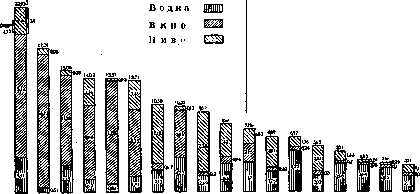
42,476 » According to Vogel's calculations, over 30 months (from January 1920 to July 1922), various products were received from the Quakers in America to feed starving German children, the caloric content of which amounted to 122,966,284,200 calories; during the same time, 1,547,821 tons of foodstuffs containing 5,103,426,504,500 calories were expended in Germany on the manufacture of beer, i.e., foodstuffs were spent on beer 41 times more than were brought from America for children. The consumption of alcoholic beverages is characterized by calculating the quantity of various alcoholic beverages and absolute alcohol in liters per capita per year. The table on pages 407-410 shows the trend of this consumption for the period from 1851 to 1922. The trend of development in the consumption of alcoholic beverages in pre-war times was as follows: vodka consumption grew in Russia, France, and partly in America. A more or less noticeable decrease in it is found in Denmark, Belgium, and England. In all other countries, an insignificant decrease in per capita vodka consumption is also noted. Per capita wine consumption shows an increase in France and Italy, and a drop in Switzerland and Germany. In other countries, it remains at the same level with small fluctuations in the size of per capita consumption. Beer consumption increased sharply in the United States of North America, Spain, and Switzerland; it decreased significantly in the Netherlands and England. Per capita consumption of absolute alcohol showed an upward trend in France, Italy, the United States of North America, and Russia. A certain decrease is noticeable in Switzerland, Germany, England, Belgium, and the Netherlands; a significant decrease is in Denmark. As for the post-war period, during which alcohol consumption cannot be considered finally stabilized (probably the "recovery" process will continue in the coming years), the data available for 1919-1922 allow us to note the following: total per capita consumption of absolute alcohol decreased in all countries, with the exception of Spain, which showed an increase. First place in per capita alcohol consumption remained after the war with France. Spain took 2nd place, and Italy 3rd (these two countries exchanged places with what they occupied before the war). The decrease in per capita alcohol consumption in 1919-1922 depended, mainly, on a sharp decrease in vodka consumption (in most countries 2-3 times less than before the war). An increase in per capita vodka consumption took place in three of the countries listed above—Spain, Switzerland, and Italy; an increase in per capita wine consumption—in Spain, Norway, England, and Sweden; an increase in per capita beer consumption—in Denmark, Norway, Sweden, and Italy. The diagram placed below, compiled by Gabrielson, shows the place occupied in 1906-1910 by one or another country in terms of the level of per capita consumption of absolute alcohol, and the prevailing types of beverages in it (see Diagram 1). Statistics on the consumption of alcoholic beverages cannot take into account small-scale production not subject to excise taxes and alcohol surrogates. In France, for example, alcoholic beverages exempt from excise duty that are produced for home consumption are not taken into account
rubles, or 2.5 billion rubles; the population of the USSR—about 850 million rubles. Calculated per capita, expenditures on alcoholic beverages in recent years were:
England (1923)........ 70 r. New Zealand (1923). . . . 60 » Germany (1926)....... 35 » Denmark (1923)......... 34 » Norway (1923)....... 21 » USSR (1926) ........ 6 » E. Deichman. III. Alcohol and Health. Alcohol has since ancient times been considered one of the important causes of many individual sufferings well-known in pathology. Alcohol and the Nervous System. Among the diseases developing as a result of alcohol intoxication, some of the most severe are diseases of the nervous system. They can bear the character of general functional or persistent organic disorders of both the central and peripheral nervous system. Manifestations n Diagram 1. Consumption of pure alcohol in 1906-1910 (in liters per person). by a huge number of peasants—from fruit, wine, and other products produced on the farm of the distillers themselves. According to Ichok, such distillers in France were: 1880..... 69,162
g..
» .
» .
» . . . . 679.347 In the USSR, statistics do not cover the production of local alcoholic beverages (araka, brashka, kumyshka, etc.) and illicit home-brewed liquor (samogon, see), which became widespread after the prohibition of the sale of vodka. Data obtained through budget surveys and questionnaires provide tentative information on the scale of samogon production. According to the most complete questionnaire by Gosspirt (1923), the consumption of samogon by the rural population was approximately 298,875,800 liters with an average strength of 25°, or 186,950,900 liters in terms of 40°. The primitive method of preparing samogon leads to an extra waste of 655,200 tons of grain compared to the factory method of manufacturing vodka. The fusel oil content in samogon (averaging 0.4%) is 4 times higher than the average content in vodka (0.1%). Population expenditures on alcoholic beverages amount to huge sums of money every year; some figures are as follows: the population of England spent 315 million pounds sterling on alcoholic beverages in 1923, or over 3 billion rubles; the population of Germany spent 41/2 billion marks— chronic alcohol poisoning in the form of functional disorders, as well as epilepsy, are encountered quite often. Among epileptics, about 30% are alcoholics (Oppenheim). Alcoholic epilepsy differs clinically from genuine epilepsy in that the seizures cease together with the cessation of alcohol. Delirium tremens is often accompanied by epileptic seizures. Status hemiepilepticus frequently develops, characterized by insomnia, fears, restlessness, tremor (tremor alcoholicus) not only of the outstretched hands, but also of the lips and tongue, especially in the mornings, increased tendon reflexes, vasomotor disorders, convulsive attacks, and decreased potency. Among more persistent organic alcoholic nervous disorders, polyneuritis alcoholica (multiple neuritis) is the most complete disease form in symptomatological and etiological terms. Sometimes, besides alcohol, causative side factors can be chilling and febrile illnesses. Middle age is most frequently affected. Polyneuritis is encountered not only in those who drink alcohol, but also as a result of inhaling alcohol vapors during the manufacture of essences, varnishes, etc. (as an occupational disease). The onset of alcoholic polyneuritis is acute or subacute. After the stage in which sensory disorders predominate—paresthesias, pain, and tenderness of the nerve trunks—paralysis develops; the favored sites of paralysis are the region of the peroneal and radial nerves. The upper extremities suffer less and more rarely than the lower ones. The distribution of paralysis is symmetrical, predominantly in the peripheral parts; the character of the paralysis is degenerative (atrophy with the reaction of degeneration). The most frequent form of alcoholic polyneuritis is ataxic; hyperesthetic and amyotrophic forms are less frequent. Among vasomotor-trophic symptoms, increased sweating and sometimes edema are noted. Of the cranial nerves, the nerves of the eye muscles are affected (gaze paralysis). In optic neuritis, a central scotoma is observed; difference in pupils is rare. In polyneuritis, psychoses can sometimes be observed—delirium tremens and Korsakoff's psychosis. If paralysis develops, the disease can drag on for many months. The prognosis is not always favorable. Recovery with some defects is possible. Adverse consequences, up to fatal outcome, are observed if the vagus and phrenic nerves are involved in the process. Relapses of the disease are possible, especially with continued alcohol abuse. Treatment follows the general rules for treating polyneuritis, with absolute abstinence from alcohol.—Another important form of alcoholic intoxication of the nervous system with signs of organic disease is alcoholic polioencephalitis in the form of polioencephalitis acuta haemorrhagica superior, characterized by paralysis of the eye muscles; at its base lies a disease of the gray matter of the floor of the third ventricle of the brain and the cerebral aqueduct; sometimes the process captures the fourth ventricle and even the gray matter of the spinal cord (polioencephalomyelitis). To the fore come not inflammatory proper, but parenchymatous changes in the cells and small hemorrhagic foci in the indicated areas. The picture of alcoholic polioencephalitis generally does not differ from the classical picture described by Wernicke (see Polioencephalitis). Alcoholic polioencephalitis usually develops directly from symptoms of alcohol poisoning: headache, dizziness, vomiting, sometimes clouding of consciousness in the form of a delirious state or simple drowsiness with some general restlessness. In addition to alcoholic polyneuritis and polioencephalitis, there is also known alcoholic hemorrhagic pachymeningitis (pachymeningitis haemorrhagica interna); in it, hemorrhages are observed on the inner surface of the vascular-rich dura mater. This disease is characterized by symptoms of a cerebral nature: coma, hemiplegia, convulsions (for details see Pachymeningitis).
Alcohol and mental disorders. Alcohol plays a very significant role in the etiology of mental diseases, incomparably more important than any other exogenous intoxication. The influence of alcohol on the psyche has been studied through numerous laboratory investigations, mainly by Kraepelin and his pupils. Experimental studies of the effect of small doses (25.0–60.0) have shown that the action of alcohol on mental activity consists in hindering the assimilation, fixation, and processing of external impressions and in centrally facilitating the transition of volitional impulses into action. The processes of perception and recognition of complex sensory stimuli are slowed and hindered. The speed of the associative process falls, and as the action of alcohol continues, "external" associations begin to predominate to the detriment of combinations based on internal, logical meaning. In calculation and learning by heart, irregularity of work, its slowdown, an increase in errors, and the like are noted. The realization of motor impulses is facilitated, but the choice of movements is hasty, often erroneous. Even the smallest quantities of alcohol noticeably lower the capacity for higher mental and creative work, which is masked by a subjective feeling of relief and increased work capacity. Clinic of alcoholic psychoses. Alcoholic intoxication, acute alcohol poisoning, familiar from everyday life, is, strictly speaking, an acute mental disorder, although practically it is not usually considered as such. Depending on individual conditions, the picture and course of intoxication vary significantly. In some cases, intoxication deviates so much from the ordinary type, taking on a character so morbid and abnormal, that it receives the name of "pathological intoxication." Pathological intoxication, "complicated intoxication," according to Ziehen and Kraepelin, develops on the basis of either a congenital (psychopathy, oligophrenia, epilepsy) or acquired (arteriosclerosis, chronic alcoholism, trauma, neuroses) predisposition, or as a result of accidental debilitating factors—menses, pregnancy, post-infectious states, psychic shocks, and the like. Sometimes in the picture of pathological intoxication, affects of fear and melancholy predominate with delusional ideas and suicide attempts. An essential sign is considered to be a disorder of consciousness, loss of the ability to orient oneself, with frequent illusions and hallucinations, most often visual. In the majority of cases, however, pathological intoxication is accompanied by motor excitation, impulsive acts expressed in senseless rage and attacks. Such states of excitation and aggressiveness most frequently develop in epileptics, sometimes under the influence of extremely insignificant quantities of wine, as an expression of their intolerance to alcohol. The duration of pathological intoxication is short, not exceeding several hours. It usually ends in sleep with subsequent amnesia or an extremely vague memory. Being frequently a source of criminal acts, pathological intoxication is of great importance in forensic medical respects. Mental disorders developing on the basis of chronic poisoning include: a) Chronic alcoholism. Prolonged abuse of alcohol continuing for years causes a series of persistent changes in the physical and mental state, together giving a typical picture of chronic alcoholism. The clinical picture of chronic alcoholism, varying significantly in degree and details, is composed of mental and physical symptoms. Disorders of the mental sphere, in pronounced cases, manifest themselves in a change of the entire personality of the alcoholic with the character of decline and degradation in all areas of mental life, which gives the right to speak of alcoholic degeneration (degeneratio alcoholica). In the emotional sphere, a drop in moral feeling and generally higher sentiments and interests is stated. Along with this, coarseness, irritability, egoism, suspicion, a superficial, frivolous attitude to one's situation, and a peculiar humor ("alcoholic humor") develop. Intellectual changes, outside of intoxication, are very close to the above-mentioned results of laboratory research on the influence of alcohol on the healthy, but are more persistent and sharp: difficulty in assimilating perceptions; weakening of memorization, concentration, combination; slowing of the associative process with a tendency to stereotypy, rhyming, and habitual speech productions; superficiality of thinking, rapid fatigue, absent-mindedness, decrease in mental activity. The weakening of will is manifested in the inability to resist the craving for wine, reluctance to work, lack of endurance, and a decrease in work capacity. The course of the disease, depending on the degree of individual stability and the kind of beverages consumed, is not identical, but in general very prolonged and gradual. With far-advanced changes, more frequently, apparently, in connection with developing arteriosclerosis, the phenomena of mental decline reach such a great degree that one has to speak of alcoholic dementia (dementia alcoholica). b) The drunkards' delusion of jealousy does not represent an independent disease, but is merely a variety, a complication of chronic alcoholism. Delusional ideas of jealousy, generally easily arising in alcoholism, sometimes occupy such a dominant position in the disease picture that they give grounds for isolation into a special form. The disease develops slowly and gradually, usually in elderly alcoholics, and is rooted, presumably, in the irritability and suspicion of the alcoholic on the one hand, and in the awareness of his own inferiority, including sexual, on the other—which is often favored by sensory deceptions. The husband suspects his wife of infidelity, everywhere sees her imaginary lovers, in everything perceives evidence of her guilt, follows her, locks her up, reports to the police, and the like, over time expressing increasingly fantastic assertions. The delusion of jealousy can be a source not only of gross insults, torture, violence, but sometimes also of murder. c) Delirium tremens (delirium tremens) represents the most frequent and well-known disease of a specifically alcoholic character. The onset of the disease is usually sudden, often after a long period of prodromal signs (poor sleep, nightmares, anxiety, night sweats), sometimes following an epileptic seizure. Disorders of assimilation, lack of comprehension, illusory nature of perceptions, loss of orientation, and false memories rapidly develop. Especially characteristic are sensory deceptions, mainly visual, reaching unusual sensory vividness and usually distinguished by their multiplicity and mobility (a multitude of constantly moving small animals: rats, mice, cats, dogs, fantastic beasts, birds, insects, little devils, human figures, threads, wires, coins, cinematographically changing pictures, and the like). In second place are tactile (tickling, biting, crawling on the body) and auditory (noise, ringing, shooting, shouting, words, and whole phrases) hallucinations. Consciousness is filled with a series of rapidly changing dream-like, bizarre, alternately terrifying and amusing experiences, in which habitual occupations often figure ("delirium of occupations"). The mood fluctuates between fear and humorous carelessness. Behavior is determined by hallucinatory and delusional experiences; at night—with an intensification of hallucinations and fear (restlessness, urge to run, suicide attempts, less frequently aggressiveness). Personality consciousness is preserved, but orientation in time and surroundings is impaired. Among physical symptoms, first of all, general tremor (hence the name of the disease), sweating, unsteadiness of gait and awkwardness of movements, insomnia, increased pulse rate, elevated temperature (usually around 38°), increased blood pressure (up to 200 mm and higher), and leukopenia strike the eye. The duration of the disease is 2–4 days. Recovery is mostly sudden, after a critical sleep. Mortality according to Kraepelin is 3–4%, according to Bonhoeffer 9%, in the presence of brain irritation phenomena or cardiac weakness. Abortive forms with short duration and mildly expressed symptoms are frequent. d) Alcoholic hallucinatory insanity (acute alcoholic hallucinosis of Wernicke, hallucinatory insanity of drunkards of Kraepelin) is closely related to delirium tremens and corresponds to the "alcoholic paranoia" of earlier authors. In the clinical picture, the central place is occupied by abundant auditory hallucinations, mostly of an unpleasant content (insults, threats, conversations, sometimes very coherent, by third persons), and acutely or subacutely developing delusional ideas of persecution on the basis of the aforementioned auditory deceptions. It seems to the patient that he is being watched, is about to be killed, conspiracies are afoot to arrest him, subject him to torture, execute him, burn him, mutilate him, quarter him, and the like. Orientation is preserved, and the patient, despite delusional notions, is sufficiently conscious. Deceptions in the area of other senses (most often visual) occupy a secondary place. In the affective sphere, fear dominates. Behavior is generally determined by the content of delusions and hallucinations and can sometimes present a danger to the patient and those around him.
Physical symptoms are insignificant; in severe cases, where delirium tremens-like phenomena are mixed in, tremor, sweating, weight loss, and insomnia are observed. The course of the disease, in more than half of the cases, is acute: from a few days to 2-3 weeks, but acute cases also include those lasting 2-3 months. Often the disease ends, similarly to delirium tremens, critically, after sleep; in cases of longer duration, recovery is gradual. Prolonged cases and cases of chronic course lasting for years are observed; more rarely, in the absence of an acute period, the disease immediately takes on a chronic course. To this group of initial states in alcoholists, grouped by Kraepelin under the name "hallucinatory dementia of drunkards," belongs: d) protracted alcoholic delirium (delirium alcoholicum protractum), developing most often after repeatedly suffered delirium tremens and characterized, mainly, by auditory hallucinations, usually monotonous and unpleasant in content, with clear consciousness, correct behavior, but with phenomena of general mental decline. The course of the disease is very prolonged. - e) Korsakoff's psychosis (psychosis Korsakowi, psychosis polineuritica alcoholica), described by Prof. S. S. Korsakoff in 1887, has a enormous literature, exhausting the list of which, even regarding the most important works, does not seem possible. Although the picture described by Korsakoff can arise under the influence of various causes, most often and in the most severe form it develops on the basis of severe alcoholism, at an older age compared to delirium tremens. The disease frequently (according to Kraepelin, in 1/4 of cases) debuts with delirium tremens; an acute onset following an epileptiform seizure is possible; but for the most part the onset of the disease is gradual. The peculiarity of the disease picture is caused by a memory disorder in the form of a loss of the ability to memorize. There is an almost immediate forgetting of all current events, of everything that the patient has just experienced. A significant gap of the recent past (up to several years) can drop out entirely. Memory for individual events is better preserved. Memory gaps are filled with numerous, constantly changing false memories (confabulations), which either arise spontaneously or can easily be provoked by corresponding questions and prompting. These memory illusions strike with their detail and subjective sense of certainty. The memory disorder causes prolonged disorientation in time and surroundings and the inability to figure out complex impressions. Hallucinations, delusions, and delirious states can sometimes arise episodically. Comprehension is slowed. Active attention is satisfactory, passive is reduced. Mood is unstable: sometimes alcohol-euphoric, sometimes anxious, sometimes indifferent. In 1/6 of cases, the disease has a progressive course and a fatal outcome; in other cases, the disease acquires a stationary character or slowly, over months, subsides. - f) Dipsomania (dipsomania), or periodically appearing irresistible urge for drunkenness, in typical cases begins with a prodromal phase in the form of melancholy, irritability, restlessness, physical malaise. Under the influence of the arising irresistible urge for wine, the patient begins to drink, drinks uncontrollably, impulsively abandoning work, locking themselves at home or wandering through drinking establishments. Towards the end of the attack (from several days to several weeks), satiation with alcohol sets in, general weakness, poor sleep, trembling, vomiting; sometimes the attack ends with a delirium tremens-like state. In the intervals between attacks, the urge for wine is absent or even replaced by aversion. Most often dipsomania develops from chronic alcoholism, sometimes occurs in psychopaths in connection with a mood disorder, more rarely in the depressive or manic phase of circular psychosis. The Kraepelin school sees in dipsomania one of the manifestations of psycho-epilepsy. The etiology of chronic alcoholism and alcoholic psychoses is very complex: social factors come first: in particular, the influence of the environment, the power of drinking customs and prejudices, lack of culture, deprivation, hard labor, profession, etc. Among personal moments - innate predisposition, heredity (direct alcoholic heredity 37-66%), trauma, mental anomalies, etc. Regarding individual alcoholic psychoses, long-term alcohol abuse, age (earlier for delirium tremens, later for hallucinosis and Korsakoff's psychosis), sex (Korsakoff's psychosis is more common in women), time of year (delirium tremens, predominantly in the warm season), infections (especially pneumonia for delirium tremens), trauma, and the like are of importance. Sudden deprivation of alcohol, which was attached importance to in the development of delirium tremens, apparently does not play a role. - Pathological-anatomical changes in the nervous system in chronic alcoholism are partly degenerative, partly inflammatory in nature (leptomeningitis, pachymeningitis, hyperemia, edema, thinning of convolutions in the central and frontal lobes). Microscopically: degenerative changes in ganglion cells and tangential cells, thickening of vessel walls and fatty degeneration of the intima with loss of cells and fibers in the vicinity of the vascular lesion. Pathological-anatomical data in delirium tremens are difficult to distinguish from those in chronic alcoholism and represent their exacerbation and intensification (chromatolysis, swelling, granular degeneration of nerve cells and degenerative changes of the fibers of the radial layer). In Korsakoff's psychosis, the most characteristic are the swelling and decay of the protoplasm of the cells of the 2nd and 3rd layer and the degeneration of tangential fibers, which is most constant for this disease. - Pathogenesis. The former view that alcoholic psychoses are an "exacerbation" of the process of alcohol poisoning has been abandoned. It is assumed that at the heart of delirium tremens, hallucinosis, Korsakoff's psychosis lies not direct poisoning, but a pathogenic principle arising secondarily as a result of prolonged alcoholic poisoning, on the basis of personal predisposition, under the condition of various harmful moments, which makes it necessary to consider them "meta-alcoholic" diseases. Diagnosis in pronounced cases is not difficult, except for those where alcoholism is a symptom of another mental illness (manic-depressive psychosis, schizophrenia - Graether). Regarding alcoholic hallucinosis - clarity of consciousness, the predominance of auditory illusions, coherent delusions, the absence of elevated temperature distinguish it from delirium tremens. In Korsakoff's psychosis, one must keep in mind progressive paralysis, arteriosclerosis, lues, brain tumors, presbyophrenia, which give similar symptom complexes in the sense of memory disorder. - Prophylaxis comes down, mainly, to measures of state struggle against alcohol. In the field of personal prophylaxis, proper upbringing and the example of those around are important. - Treatment in all cases presupposes complete deprivation of alcohol and long-term, up to a year, treatment - either inpatient in special institutions with a medical-labor regime, psychotherapy, physiotherapy, or outpatient (hypnosis). In delirium tremens, bed rest, supervision, nutrition, maintenance of heart activity, and sleeping pills are necessary. In Korsakoff's psychosis, systematic memory exercises are also appropriate subsequently.
Alcoholism introduced. Morphological and functional changes in other tissues and organs in chronic alcoholics vary depending on many intervening circumstances. In cases where alcohol consumption is accompanied by gluttony, the picture of pathological changes is generally much richer than in cases of the reverse order. When analyzing pathological changes in alcoholics, it is also important to take into account that death from alcoholism as such is generally rare; one usually deals with a deceased person either from acute poisoning or from various intervening diseases, in particular infectious ones, which put their stamp on the changes in alcoholism proper. The study of patho-anatomical changes in alcoholism leads to the conclusion that 1) there are no strictly specific processes in the organism of alcoholics; 2) there is no parallelism between the degree and duration of alcoholism and the degree of organ changes; 3) habituation to alcohol, as to other poisons, can occur, thanks to which its huge doses are tolerated "without visible changes" on the part of the organism; 4) into the widespread views on the direct connection of alcoholism with many chronic diseases of the liver, heart, kidneys, vessels, etc., it is necessary to introduce certain corrections based on some studies of patho-anatomists. While clinicians, especially French ones, attribute the onset of a number of diseases to the consumption of alcoholic beverages, pathologists are more restrained in attributing to alcohol the sole and paramount importance in the etiology of the same diseases. On the part of the cardiovascular system, even in non-obese alcoholics, epicardial obesity is often found; the cavities of the ventricles of the heart, especially in individuals who abused large quantities of wine or beer, are noticeably dilated. Arteriosclerosis in alcoholism is observed in any case no more often than in abstainers; very often in completely ruined, and moreover elderly subjects who have abused alcohol and its surrogates for decades, one has to see a clean aorta on the dissection table. Arteriosclerosis is much more often observed in obese alcoholics who abuse food, especially fatty food; apparently, the lipemia developing in this case favors the development of vascular atheromatosis, similar to well-known experiments with feeding rabbits with cholesterol (see Arteriosclerosis); however, lipemia in alcoholism is generally a frequent phenomenon. On the part of the gastrointestinal tract, catarrhal changes of the mucous membranes are usual; in the esophagus, pharynx, and mouth, diffuse and island-like thickenings of the epithelium, acquiring a whitish appearance (leukoplakia, see), are not uncommon; catarrhs of the stomach are well known; true, their degree and form are subject to strong fluctuations; hypertrophic catarrh is more often observed, often with the formation of polypous outgrowths. There are no indications of specific changes in the intestine; only the influence of alcoholism on fermentation processes in the intestine, processes of protein and fat breakdown is known, which, however, is not unimportant. A major question in the pathology of alcoholism is its relation to liver diseases. Among liver cirrhoses, it is customary to associate with alcoholism the so-called atrophic or Laennec's cirrhosis, even called alcoholic. Eppinger and others stated an alcoholic history in 3/4 of cases of atrophic cirrhosis; but, on the other hand, among women with liver cirrhosis, there were only 19% heavy drinkers and 58% who never drank. Taking into account that among the cirrhotics there are quite a few alcoholics, and among the latter, taken in a huge mass, only an insignificant percentage of cirrhotics (according to Kaiser-1888, 16% out of 155 cases of alcoholics, according to Fahr-1911, only 3.7% out of 343 cases), it must be concluded that alcoholism is not the sole cause of liver cirrhoses; it is necessary to take into account other causes and among them especially one—the violation by alcohol of gastrointestinal processes of digestion and absorption with the very probable formation of decay products in the process, with which it was possible in an experimental order (Lissauer) to obtain cirrhotic changes in the liver. That the matter here is not only in alcohol as such is proved by whole series of unsuccessful experiments with its direct effect on the liver (in more successful experiments by Kulbin, the best results were obtained with the combined effect of alcohol and fusel oils). At present, in the question of the effect on the liver of these or other poisons (e.g., alcohol, chloroform), great importance is attached to the state of the organ itself at the moment of such an effect in the sense of its richness in glycogen, fats, not to mention hereditary predisposition and abiotrophic factors put forward by many authors. According to Bergmann's data, in alcoholism, a significant prolongation of the time of bilirubin excretion by the liver (into the intestine) is observed when it is introduced into the blood; this symptom was very well expressed both in cirrhotics and during acute alcohol excesses. In the pancreas, obesity of its parenchyma, sometimes chronic inflammatory changes, and cirrhoses are described; there are separate indications of a connection between alcoholism and bronze diabetes (hemochromatosis). On the part of the reproductive system, progressive obesity and desolation of the testicular parenchyma with subsequent azoospermia are indicated (Simmonds, Bertholet); changes in the ovaries are similar. A definite and direct connection of alcoholism with kidney diseases has apparently not been established; Kaiser found a contracted kidney in 13% of cases at 120 autopsies, Fahr found it in only 2.6% of cases at 143 autopsies. There are isolated observations on the thyroid gland in alcoholism: epithelial degeneration, atrophy, sometimes organ sclerosis. The blood in alcoholism may not present special changes, or symptoms of ordinary (secondary) anemia are observed. Finally, among the morphological pictures in alcoholism, the frequent fact of incorrect distribution of masses of fatty tissue attracts attention; the latter accumulates especially in the mesentery, omentum, around the renal pelves, in the epi- and pericardium; this phenomenon is also observed in non-obese (upon external inspection) subjects. The negative influence of alcoholism on the course of already developed infectious diseases is well known: alcoholism aggravates their course both in the sense of changes in their pace, involution (e.g., protracted, migrating forms of pneumonia ending in carnification, suppuration, gangrene) and in the sense of special symptomatology (e.g., the addition of acute alcoholic psychoses). Regarding the influence of alcoholism on tuberculosis, there is no uniformity of views. According to some authors, alcohol contributes to the development of tuberculosis, according to others (Orth's data), alcohol supposedly reduces morbidity, and according to others—it has no effect (neither negative nor positive). The study of the connection of tuberculosis with alcohol consumption can be conducted only on the basis of an analysis of combined nutritional, housing, occupational, and everyday conditions, and not of alcoholism alone. Finally, in the immuno-biological respect, it is important that the children of alcoholics, along with phenomena of general physical weakness and a decrease in the rate of their development, are especially predisposed to various diseases; in particular, the production of immune bodies in them is insufficient.
I. Davydovsky.
IV. Statistics of morbidity and mortality from alcoholism. Existing statistical data regarding the direct influence of alcohol on the development of certain somatic diseases are contradictory and require further study and clarification. On the other hand, sufficient data have accumulated that leave no doubt regarding the dependence of certain mental diseases on alcohol. Thus, for example, there is a sharp drop in the number of cases of alcoholic psychoses during the prohibition of the sale of alcoholic beverages in various countries, during the imperialist war, and a subsequent rapid increase in them after the lifting of restrictions. In the European part of the USSR, the number of patients with alcoholic psychoses in psychiatric hospitals changed by years as follows: [Table data omitted in translation for continuous prose flow].
A constant, year-by-year absolute and relative increase in the number of patients with alcoholic psychoses prior to the war is replaced by a sharp drop from 1914 to 1922; from 1923 an increase begins again. In Moscow, the absolute number of patients with alcoholic psychoses and chronic alcoholism admitted to psychiatric hospitals rose from 25 in 1921 to 1,279 in 1926. The percentage of patients on the basis of alcoholism in relation to all those admitted to psychiatric hospitals increases by years as follows: 1921: 2.2%, 1922: 2.4%, 1923: 4.6%, 1924: 6.0%, 1925: 9.9%, 1926: 25.0%. A similar phenomenon is observed in almost all countries. In Prussia, the admission to psychiatric hospitals of patients whose illness is associated with the abuse of alcoholic beverages is as follows: [Data on the movement of patients in psychiatric hospitals throughout Prussia]. Here, a drop is observed from 1914 to 1918 and an increase from 1919, from which time the production of alcoholic beverages and the strength of beer began to increase. Coope in his article "Alcool et maladies mentales" presents interesting data on the percentage of male patients with alcoholic psychoses in relation to the total number of insane male patients admitted to medical institutions in some countries (see Diagram 2). In Switzerland, Belgium, and Munich, there is a sharp drop in alcoholic psychoses during the years of the imperialist war and the prohibition of the sale of strong alcoholic beverages, and an increase after the end of the war, with the beginning of the free sale of strong beverages. In Sweden and Norway, however, there is yet no rise in the curve by 1923-1924, since the restrictions on sale in the former and the prohibition of the sale of strong alcoholic beverages in the latter remain in force by this time. Another disease whose dependence on alcohol is beyond doubt is chronic alcoholism. Statistical data on the number of chronic alcoholics for the entire USSR and on the change in this number in recent years are, unfortunately, not available (except for Moscow). In the narcological dispensaries of Moscow, the number of newly registered alcoholic patients was: in 1924: 2,162; in 1925: 5,352; in 1926: 8,971. Over three years, in Moscow alone, 16,000 chronic alcoholics were registered. In Germany, according to the calculation of sanitary physician Lazarus, there are about 300,000 alcoholics. An increase in the number of the latter in German cities has been observed in recent years. The number of registered chronic alcoholics in dispensaries was: [Hamburg, Königsberg, Nuremberg figures]. There is also an increase in the number of people applying for emergency assistance and detained on the streets on the occasion of acute intoxication. In Berlin, the number of people who applied to the emergency station on the occasion of acute intoxication was: 1923: 1,306; 1924: 1,992; 1925: 2,324; 1926: 3,075. In Leningrad, the number of people detained in a drunken state on the streets by years increased as follows: 1923: 2,088; 1924: 11,000; 1925: 21,000; 1926: 95,000. In Moscow for 1926, the police department drew up 50 thousand protocols for persons detained in a drunken state; this number corresponds approximately to half the number of those detained, since a protocol is drawn up only for those who are in a state to pay a fine. In pre-war times, Leningrad (then Petersburg) surpassed the capitals of other countries in the number of people detained in a drunken state. Thus, one detainee (per year) occurred: in Petersburg: per 25 residents; in Berlin: per 369 residents; in Vienna: per 1,220 residents; in Paris: per 17,000 residents.
Mortality. Precise quantitative determination of the role of alcoholic beverages in increasing the mortality of a particular population group is extremely difficult due to the necessity of isolating the role of alcohol in mortality from various causes (for example, in mortality from tuberculosis, liver diseases, kidney diseases, and other ailments). Statistical data on mortality in connection with alcohol consumption require a critical attitude. The data on the number of deaths from intoxication are beyond any doubt. According to the annual reports of the chief medical inspector on the state of public health in Russia, forensic medical doctors examined dead bodies with regard to alcohol poisoning by years: 1910: 1,703; 1911: 2,209; 1912: 2,624; 1913: 2,880; [and 1915: 1,155]. According to the most modest calculations of various authors, no less than 6,000 people died annually in Russia from intoxication before the war. In Petersburg alone, the number of deaths from alcoholic intoxication averaged 715 annually during the years 1911-1913, which amounts to 351 cases per 1 million inhabitants. Despite the fact that in terms of per capita alcohol consumption compared to other countries Russia occupied one of the last places, in terms of mortality from intoxication it stood significantly higher than other countries. Thus, in pre-war years, the number of deaths from alcoholism calculated per 1 million inhabitants was: France: 11.5; Prussia: 12.5; Russia: 55.2. According to the same data of the chief medical inspector, in pre-war times in the former Russian Empire, the maximum number of poisonings fell on alcohol poisoning. Thus, in 1913, poisonings were registered: alcohol: 2,880; arsenic: 380; other inorganic poisons: 1,155; carbon monoxide: 1,100; other organic poisons.
The period of prohibition of the sale of alcoholic beverages was accompanied by a drop in mortality from alcohol poisoning and, conversely, the abolition of prohibition and the introduction of free sale resulted in an increase in the number of deaths. This can be seen from the following data on the number of deaths from intoxication in recent years for Leningrad and Moscow. [Statistical tables for Leningrad and Moscow from 1911 to 1926].
Of considerable interest are the data of some large life insurance companies in America and England, which for a long period have kept mortality records in the teetotalers' department and the general department. According to new data published by a major life insurance company in London, the "United Kingdom Temperance and General Provident Institution," actual mortality compared to expected mortality was (in %): [Table of comparative mortality rates between abstainers and the general public from 1866 to 1923]. Over the course of 60 years, there has thus been a constant difference in mortality in the two departments; moreover, in the abstainers' department, the expected mortality is always lower than in the general department. But even these data, which deserve attention and further study, suffer from certain defects, as Princing points out in his book "Methods of Sanitary Statistics": "These societies collect information only at the time of the member's admission, and all his subsequent life remains outside the sphere of observations. Moreover, non-drinkers represent a selected group of persons who have a tendency to an orderly lifestyle and to concerns for maintaining their health." When comparing the mortality of drinkers and abstainers, it is essential to take into account the influence of social, professional, and cultural-living conditions of both groups.
E. Deichman.
V. Alcoholic occupations. More detailed data are available from the study of morbidity and mortality among persons in alcoholic occupations. Alcoholic occupations are understood to be those in which workers, due to the nature of their work, deal with alcohol. These include: grape growers, wine warehouse employees, tasters, distillers, denaturers of alcohol, workers of alcohol-distilling, alcohol-refining, brewing, liqueur, and beer-brewing plants, sellers of alcoholic beverages, employees of beer halls, taverns, restaurants, and various places of entertainment, etc. Finally, alcoholic occupations can also be considered those associated with the constant use of ethyl alcohol in production processes (factories of gunpowder, artificial silk, felt hats, some enterprises using alcohol as a solvent for varnishes—such as airplane dope—and paints). Sometimes, although rarely, occupational poisonings with alcohol occur due to the inhalation of alcohol vapors, and the poisoning can be both chronic and acute (the latter is especially predisposed to by the crampedness of the workspace and insufficient ventilation). More often, of course, alcoholic occupations are distinguished by the regular consumption of alcoholic beverages or simply ethyl alcohol. According to André, restaurateurs, brewers, and hotel keepers insured in the Gotha Insurance Company showed a mortality rate exceeding the average by 31-62%. According to Ogle (late last century), in England the mortality of brewers exceeded the mortality of the clergy by 2.45 times; the corresponding coefficients were equal to 2.74 for publicans and wine merchants, and 3.97 for hotel employees. According to Bertillon (1895), mortality in Paris among wine and liqueur merchants aged 30-39 was 21.2 per 1,000 versus 14.9 among the entire population. Statistics of later years yield the same data. Thus, according to data from Austrian sick funds (1891-1910), the mortality of workers in brewing and distilling plants was 133% of the average, fluctuating across individual age groups from 113.5 to 171%. In Switzerland, according to sick fund data, the mortality of those working in restaurants was 42.59 per 1,000 with an average of 25.8 per 1,000. In Paris, according to Jacquet, the corresponding figures are 46.9 versus 36.1. The mortality and morbidity of alcoholic occupations are distinguished by several characteristic features associated with the specific properties of alcohol's effect on the organism. However, when evaluating all cited data, one cannot lose sight of the fact that a certain selection plays a role in the formation of individual occupational groups. Among waiters and other tavern staff, asthenic subjects are often encountered; in addition, the waiter's labor has a number of hazards (lack of sleep, length of the working day, etc.), and among tavern keepers, people with special psychological qualities are not uncommon. According to English statistics for 1900-1902, the following table of comparative mortality of various alcoholic occupations compared to the average mortality of the entire population, taken as 100, was compiled: Occupation ... [table data unrecoverable in parts]
According to Dutch statistics for 1908-1911, the following small table was compiled (standard values are given): Brewers, Hotel employees, All professions; Pulmonary tuberculosis ..., 120; Respiratory organ diseases ..., 92; Cardiovascular apparatus diseases ..., 63; Nervous system diseases ..., 95, 52.6.
There are also some indications of a particular prevalence of gout and cancer among alcoholic occupations. Thus, according to the well-known statistics of the Leipzig Sick Fund, waiters show a morbidity rate from gout 2.5 times higher than average (see also the English figures given above). Kolb (1910) points out that in Bavaria, tavern keepers show a mortality from cancer diseases 3.5 times greater than average, with the digestive organs being particularly affected, primarily the esophagus, and in female tavern keepers, uterine cancer was also noted 2 times more often than average. According to English statistics for 1900-1902, mortality from cancer among brewers aged 45-65 was 2 times, and at an age older than 65, 1 1/2 times higher than average.
S. Kaplun. VI. The influence of alcoholism on labor productivity, accidents, and criminality. Alcoholism and labor productivity. In addition to the pathological consequences described above, alcoholism is also manifested by a whole series of negative phenomena in social life. Mention was made above of the unproductive waste of a huge amount of food products. But that is not all; with the growth in the consumption of alcoholic beverages, labor productivity falls, absenteeism grows, accidents and crime increase, etc. Experiments conducted by Hellsten, who studied work using an ergograph, showed that a dose of alcohol of 0.86 g per kg of the subject's weight, on average, lowers work productivity by 16-17%. Approximately the same results were obtained in studying the effect of alcohol on climbing work after alcohol intake. The amount of work produced per unit of time fell by 17%. Translating these data into working days, we find on average that work which normally can be completed in an 8-hour workday will take 9 hours under the influence of alcohol. Aschaffenburg examined the effect of alcohol on the labor productivity of typesetters in a printing house. A dose of 3 g of alcohol lowered the typesetting norm, on average, by 15%. When threading a needle, according to Totterman's experiments, after an evening intake of 25 g of alcohol, a drop in productivity of 10% was noted. Analogous experiments by Kraepelin proved that the depressing effect of alcohol on labor productivity is more sharply manifested in those types of work that require more intense intellectual and coordinative brain activity. Kapel cites information (1909) that lapidary production in Yekaterinburg began to fall due to the rampant drunkenness of handicraft lapidaries and wage laborers employed by larger entrepreneurs. The work of a cutter of precious and semiprecious stones requires a keen eye and a steady hand. Meanwhile, alcohol kills the eye, causes hand tremors, and under these conditions, it is impossible to grind stones. However, the effect of identical doses of alcohol on labor productivity varies individually. On the labor productivity of the entire collective, alcohol undoubtedly acts negatively, contributing, in particular, to the growth of absenteeism on post-holiday days, after payday, etc. A large survey conducted by the Free Economic Society, covering 172 enterprises with 214,615 workers, established that as a result of the ban on the sale of alcoholic beverages in our country in 1914, workers' absenteeism decreased from 4.9% to 2.4%, while the labor productivity of male textile workers increased by 3.6%, of metalworkers by 11.4%, and of all workers by 0.89%. Modern special studies and individual observations in our country show an increase in the number of absenteeism cases on post-holiday days in factories and plants by 2-4 times compared to normal. The influence of alcoholism on accidents. Accidents are also due to alcohol to a certain extent; according to the Wiener Rettungsgesellschaft, 8.3% of all accidents attended to by the society were due to alcohol. In Wiesbaden at breweries, the number of accidents decreased from 18.2 per 100 workers in 1902 to 12.7 in 1904 after the abolition of the free distribution of beer to workers. According to the Leipzig Insurance Fund, there are 82 accidents per year per 1,000 insured persons, and 269 per 1,000 insured alcoholics. Monday almost everywhere yields the maximum number of accidents. To a certain extent, this phenomenon is explained by a decrease in adaptability to work after the Sunday break. Partly, however, this phenomenon undoubtedly depends on Sunday drinking and the subsequent hangover. This is indirectly confirmed by the following table. If the average number of accidents per day of the week is taken as 100, the accidents are distributed: Monday, Tuesday, Wednesday, Thursday, Friday, Saturday, Sunday. In Germany (1897): 117, 110, 110, 106, 105, 119, 75. In Norway (1900–1903): 116.6, 126.5, 112.5, 110.4, 117.4, 109.0, 64.2. In Norway, the maximum falls on Tuesday, obviously in connection with the ban on the sale of alcoholic beverages on Sunday. Alcoholism and criminality. Crime, being mainly a consequence of the socio-economic dislocation of modern society, to some extent undoubtedly also depends on alcohol. The distribution of certain crimes by days of the week is given by Wlassak in the following table: The highest percentage of crimes falls on Sunday days. An exception is formed by the cities of Norway, where the sale of vodka is prohibited starting from one o'clock in the afternoon on Saturday until Monday morning and where the maximum of crime falls on Monday. The connection between hooliganism and alcohol is established by the statistics of Leningrad: Years, Number of convicts for hooliganism, As % of total number of convicts, % of hooliganism in a state of intoxication (1923: 541, 2.3, 32.9; 1924: 1,664, 4.9, 54.0; 1925: 2,343, 16.6, 66.5; 1926: 6,264, 23.1, --).
E. Denzhman. VII. The significance of alcoholism in forensic psychopathology. The dependence of crime on alcoholism is very clearly evident from the following table (Sullivan), which gives information on the movement of crime in England from 1912 to 1921 (per 100,000 population), i.e., in a period encompassing the imperialist war, when the D'Aberton Act restricting the sale of alcoholic beverages was introduced in that country. ...the curve of suicide attempts. Already the incorrectly called "normal" intoxication with the intensification of motor impulses and the weakening of higher controlling and regulating instances leads to a whole series of offenses. The first stage of intoxication, associated with excitation, is, of course, criminogenically higher than the second—paralysis with clouding of consciousness. The resolution of the question of the nature of intoxication is possible only in each specific case and depends on determining not only the state of consciousness, its volume and clarity, but also the interaction of all psychisms operating during the commission of the crime. Formally correct behavior during intoxication (the ability to speak coherently, answer, perform complex actions, etc.) does not contradict the presence of a morbid change in consciousness: daily experience constantly confirms this. Purposeful actions by no means indicate the presence of consciousness. One must not identify the words "consciously" and "voluntarily". The question of the criminal responsibility of drunk persons is extremely complex. The note to Article 11 of the Criminal Code, 1926 edition, states: "The effect of this article does not extend to persons who committed a crime in a state of intoxication." Cases of "normal" intoxication are provided for here, i.e., a state in which a person can account for his actions and direct them and is therefore criminally responsible. A person who has committed a crime in a state of intoxication cannot be considered irresponsible, since one misdemeanor cannot be justified by another. This proposition is correct only in relation to those cases where alcoholism (resp. intoxication) has an arbitrary character, i.e., where, according to the terminology of the note to Article 17 of the Criminal Code, 1922 edition (an article analogous to Article 11 of the Criminal Code, 1926 edition), they "brought themselves into a state of intoxication to commit a crime." Of course, it would be wrong to consider mentally ill persons who committed a crime in a state of intoxication criminally responsible, as well as those who under the influence of alcohol were in a state of "temporary... 1912, 1913, 1914, 1915, 1916, 1917, 1918, 1919, 1920, 1921. Crimes associated with...
j violence............; 5,79i 5,43; 4,68 3,87 3,53; 3,06 3,11 Crimes against morality . Attempts at suicide Crimes against property ........... 6,4 21 6,921 6,27; 5,17| 4,77! 3,57 3,65 4,12 4,11 3,69 4,94 6,54; 6,71} 6,74! 4,79 256,35 242,331220,62,202,93 3,64! 2,86; 2,53; 3,63 6,04 4,66 219,66J251,21 249,71 226,23:249,61 5,92 3,64 255,38 The reduction in the consumption of alcoholic beverages led to a significant decrease, as can be seen from the table, precisely in those categories of crimes that are most closely associated with alcoholism, as well as to a sharp drop in the disturbance of mental activity or in another pathological state in the sense of Art. 11 of the Criminal Code. States of pathological intoxication accompanied by significant changes in consciousness are one of the most frequent causes of criminality. It is important to remember that pathological intoxication may occur depending on the constellation in anyone and that the reactions and picture of states in it can be very diverse. The following criminal-pathological forms of pathological intoxication are distinguished: the first, with signs analogous to epilepsy (see), (fear, delusional ideas of relation and persecution, hallucinations, motor discharges); the second, psychogenic, in which the state of excitement is caused by psychic moments, and the third—with psychomotor discharges under the influence of motives that already existed in a sober state (for example, jealousy). Characteristic crimes in pathological intoxication are a violent act of cruelty, a aimless desire for destruction, disorderly conduct, etc. In recognizing pathological intoxication, one must follow the same direction as in diagnosing pathological affect. Along with the determination of clinical phenomena (disorder of consciousness, memory, delusional ideas, rushes of blood to the head, involuntary and impetuous actions, etc.), a careful study of the makeup of the personality on the basis of which the pathological reaction to alcoholic poisoning arose is necessary. Usually there are (though not always can they be established) predisposing moments, constant or accidental. Among the former are alcoholic personality changes (as a result of chronic alcoholism) and a psychopathic soil (especially epileptics, schizophrenics, traumatics), among the latter—everything that weakens the organism (exhaustion, insomnia, overwork, affective state, sexual arousal, etc.). In the presence of predisposing conditions, pathological intoxication can develop under the influence of an insignificant amount of alcohol. A great help in evidence are objectively established in the anamnesis pathological shifts in the state of alcoholic intoxication. One circumstance has extremely great judicial significance: very often the subject remembers absolutely nothing, for example, about his state the day before during intoxication, but then when prompted (by way of reproduction, recognition) the picture of what happened is gradually (and sometimes immediately) restored. In such cases, of course, it would be a big mistake to regard this state, subsequently so reproduced by him, as one of which normal (resp. continuous) memory has been preserved. Undoubtedly, there was a morbid memory disorder here. In addition, amnesia is often incomplete, or it develops later, sometimes during the following day, sometimes even after the patient has already confessed to the crime. Therefore, whenever the question of intoxication is raised, it is necessary to carefully study the conditions and nature of the very first conversations and interrogation of the accused. Among alcoholic psychoses, acute alcoholic hallucinosis has great criminal significance. In recognition, one should always keep in mind abortive cases, sometimes proceeding in the form of transient mental disorders. In all cases of pathological intoxication, delirium tremens, and acute hallucinosis, criminal responsibility is eliminated. In cases where there is chronic alcoholism and a tendency, in general, to pathological breakdowns with aggressive tendencies, the stamp "socially dangerous" and compulsory treatment with isolation in psychiatric institutions are indicated.—The criminal-psychopathological significance of dipsomania is determined by that mood disorder which is associated with an irresistible urge to drink. In forensic-medical terms, it is important to uncover that basic affliction, that psychopathic predisposition, against the background of which these attacks of the disease develop. One must not forget that some chronic alcoholics at the same time also suffer from dipsomania. Since a drinking bout is an attack of mental disorder, those who committed a crime in such a state fall under the operation of Art. 11 of the Criminal Code. The majority of chronic alcoholics possess reduced resistance and a tendency to pathological alcohol reactions, because they are predominantly recruited from psychopathic personalities who, thanks to their instability, hypersensitivity, and tendency to mood disorders, possess a special propensity for alcohol and other intoxicants. Murder of wives and cohabitants is the most typical and frequent crime of chronic alcoholics with delusions of jealousy, which is especially frequent in alcoholics suffering from latent schizophrenia, arteriosclerosis, etc. Chronic alcoholism not only causes the action itself, but also gives it a definite sexual direction. The latter probably stands in intimate connection with those atrophic processes in the testes that are found on the autopsy table in chronic alcoholics, as well as in general with that general degeneration in connection with chronic alcoholism, which in many respects clinically resembles the degeneration of the age of involution. Most often, delusional ideas appear in chronic alcoholics only in a state of intoxication, which they often either do not remember at all or remember very vaguely; it is characteristic that many of them then, despite some memories from the period relating to intoxication, categorically deny the jealousy that existed in the state of intoxication. Delusions of marital infidelity can persist quite stubbornly and independently of alcohol intake. Thus, the murder can be committed quite deliberately and consciously, but under the influence of delusional ideas, which moreover are often very carefully hidden by patients or expressed in a very veiled form, under the guise of psychologically understandable motives supposedly arising from the objective situation nurturing jealousy. On the question of the criminal responsibility of chronic alcoholics, everything depends on the degree of structural changes in the personality. In sharply pronounced cases (for example, in delusions of jealousy), although criminal responsibility disappears completely, the necessity of social protection measures of a medical nature, carried out compulsorily, with isolation in medical institutions, is not excluded. In cases that are relatively mild, but not associated with pathological reactions, the recognition of criminal responsibility from both social and medical points of view is fully indicated. Hospitals are useless for these patients, and they are harmful to the hospitals. In penitentiary institutions regarding them, an individual approach, a purposeful labor regime, and firm discipline are necessary. N. Brukhansky. VIII. The fight against alcoholism. The oldest measures directed against the consumption of alcoholic beverages, predominantly immoderate, boiled down to legislative punishments, at times extremely severe. Thus, 2286 years before Christ in China, an edict was issued forbidding under pain of punishment the immoderate consumption of alcoholic beverages. Chinese sages and legislators—Confucius and Mencius, who lived one in the 5th century, the other in the 3rd century before Christ—made great efforts to suppress drunkenness. In ancient Egypt, drunkards were subjected to humiliating punishments and ridicule. In ancient Greece, Solon issued laws against tavern keepers who sold wine undiluted with water. Lycurgus forbade the use of wine in Sparta, especially on the wedding day, under pain of severe punishment. Among the ancient Romans, in the era of the development of their power, there were prohibitions against drinking wine (by one edict, for example, for people younger than 30 years). In 186 BC, the Roman Senate banned the cult of Bacchanalia both in the metropolis and in the provinces. Analogous legislation against excessive drunkenness is encountered among other peoples at almost all times.—The fight against alcoholism in modern times, starting from the end of the 18th century to the present day, developed as a, on the one hand, study of the influence of alcohol on the individual and society, and on the other hand, clarification of the causes of the spread of alcoholism. At the present time, the fight against alcoholism is conceived only through a combination of general measures capable of undermining the roots of alcoholism in modern society, with a number of specially antialcohol measures contributing to the restriction of the spread of alcoholic beverages, predominantly strong ones. These latter measures can be reduced into three groups directed to the fight: a) against the consumption of alcohol, b) against the distribution of alcoholic beverages, and c) the most radical—against the production of alcoholic beverages. The former include, first of all, attempts—arising from the first quarter of the 19th century, by means of persuasion, passionate preaching depicting all the horrors of drunkenness—to recruit at first the ranks of moderately drinking people, and then absolute teetotalers (see Abstinence).
Ardent preachers have more than once appeared in this field (e.g., Father Mathew in Ireland), captivating hundreds of thousands of followers with their words. But in the last quarter of the 19th century, the abstinent movement increasingly leaned toward the conviction that the most appropriate form of sobriety preaching is the dissemination among youth of information about the nature and harm of alcoholic beverages, primarily through school. At present, anti-alcohol education is most fully and systematically implemented in Sweden and the United States of America. The desire to restrict the circle of persons consuming alcoholic beverages, as well as to reduce consumption itself, is reflected in such elements of anti-alcohol legislation as the prohibition to dispense alcoholic beverages to minors and underage persons (up to 16 years in some countries, up to 18 years in others), the prohibition of the sale of alcoholic beverages on certain days (holidays, market days, paydays, military draft days, etc.), the restriction of the hours of sale of alcoholic beverages, and the establishment of a limit on the sale to one person of no more than a certain quantity of alcoholic beverages. These latter measures also partially serve as a means of combating the spread of alcohol, as they restrict and limit the profits of tavern keepers. The fight against immoderate consumption, which also aims to reduce the harm from the consumption of alcoholic beverages, is most fully reflected in the Gothenburg system (see), under which the sale of alcoholic beverages is permitted only in limited quantities and only on the condition of the simultaneous intake of hot food. The owner of the tavern establishment is thus interested precisely in the sale of the latter, since from the income of the sale of alcoholic beverages he receives only 6%. The remaining income goes to the disposal of the communities and the treasury specifically for the development of anti-alcohol measures. A further modification of the Gothenburg system along the paths of restricting the consumption of alcoholic beverages is the Bratt system, existing in Sweden since 1919 and introducing a peculiar alcohol ration (the sale of a limited amount of alcohol per month to a family and its adult member). Only on particularly solemn occasions (weddings and other family celebrations) is the sale of a larger amount of alcoholic beverages permitted. Measures aimed at restricting the spread of alcoholic beverages also include those restrictive conditions with which the opening of drinking establishments is surrounded. This includes the limitation of their number, particularly heightened requirements regarding maintenance, conditions of hiring service personnel, high patent fees, the brevity of the term for which the permit is issued, and conditions of distance from certain buildings (schools, churches, medical institutions, etc.). A further stage in the development of these measures is the establishment by legislation of the right of the population itself to decide either on the extension of the patent term of an already existing drinking establishment or on its closure before the expiration of the patent term, and finally, in a more general form, on the permission to open new places of sale. Thus arises the so-called Gemeinde-bestimmungsrecht (local veto), the right of communities to introduce local prohibition. Such a right has been implemented in Norway, Finland, the United States of America, Denmark, Holland, and partly in Germany and Switzerland; its main purpose is the fight against alcohol capital, especially engaged in the tavern trade, and the expulsion of private interest from the sphere of the sale of alcoholic beverages. The latter is achieved in some countries by the introduction of a state monopoly. The legislation of various countries differs from each other regarding the establishment of the minimum number of citizens upon whose initiative the question of applying the right of local prohibition can be raised, then the establishment of the qualified majority necessary for the implementation of this measure, and finally, the very term of validity of the local prohibition. Experience shows that Gemeindebestimmungsrecht has predominantly purely agitational significance and serves anti-alcohol propaganda. The prohibition of the sale of alcoholic beverages only in a small district, in the presence of neighboring districts where their production and sale are permitted, is of little significance in the sense of sobering the population. Therefore, a natural continuation of Gemeindebestimmungsrecht becomes the legislation on the prohibition of the production of alcoholic beverages as well, and moreover on the scale of large regions and even the entire state. Thus prohibitionist alcohol laws arose. Prohibition is divided into: a) partial and b) full. In turn, they can be temporary and permanent. Partial prohibition concerns the production and sale of individual alcoholic beverages, e.g., absinthe (in Belgium, in France), or beverages above a certain strength (in Sweden, Norway). Full but temporary prohibitions, i.e., concerning the production and sale of all alcoholic beverages, usually arise in connection with extraordinary circumstances (war, mobilization, crop failure, etc.). Particularly numerous prohibitions arose during the imperialist war, in connection with the shortage of food supplies discovered in almost all European countries (both belligerent and neutral). The most complete was the temporary wartime prohibition in tsarist Russia, introduced in August 1914 out of fear of unrest among the mobilized. Permanent prohibition, but partial—regarding only strong alcoholic beverages—was first implemented in the United States of America in the middle of the 19th century (1851-1856), when a whole wave of prohibition laws swept through 16 states (out of 31). This full prohibition, owing its origin solely to the wide propaganda of abstinence societies that saw whiskey and vodka as the source of all troubles and disorders, but not yet having sufficient support in the cultural and economic development of the country, could not hold out for long. Prohibition soon had to be repealed in direct connection with the economic difficulties caused by the Civil War. True, as a result of even the short-lived existence of this prohibition, the consumption of strong alcoholic beverages did not return to its former level; instead, beer consumption increased. The first full and permanent prohibition was implemented in Iceland (1912), but repealed under pressure from Spain in 1923, then in the United States of America (1919) and in Finland (1919) as the completion of the temporary wartime prohibition. The Finnish Sejm had already approved the prohibition law in 1907, but it was not approved by the tsarist government largely under pressure from France. The prohibition law of the United States of America enters as the 18th Amendment to the Constitution of the States and prohibits the production, transport, and sale of beverages containing more than 1/2% alcohol. It owes its appearance not only to the systematic, planned propaganda of the organized abstinence movement for over 100 years, but also to the corresponding cultural and economic preparedness of the country. Almost all major industries, especially transport, electrical, metallurgical, and machine-building, starting already from the 1990s of the 19th century, continuously demanded from their workers and employees the renunciation of the use of alcoholic beverages. Wartime circumstances made it particularly easy and profitable to transfer those branches of agriculture that worked for the distilling and brewing industries onto the rails of the food and flavoring industry, which began to work not only for the domestic market, but also for the external one—to supply belligerent and neutral countries. The prolonged cessation of the influx of immigrants from European countries (Germany, Italy), who supplied the main contingent of wine and beer consumers, and skillfully raised agitation against the Germans, who were the main representatives of large brewing capital, were also factors that contributed to the rapid and unanimous implementation of prohibition. Its beneficial effect on the reduction of alcoholic psychoses, on the decrease in absenteeism (from 10% to 3%), criminality, the growth of prosperity (in some states the number of deposits doubled in 5 years), and the improvement of nutrition was especially sharply manifested in the first years after prohibition. Then the situation began to change for the worse. The mortality rate from alcoholism by years was as follows (per 100,000 population): 1916...
5.8
5.2
2.7
1.6
1.0
1925 ».....3,6 In recent years, an increasing amount of information has been spreading (especially in the Western European press) about the failures of prohibition, the growing secret alcoholism growing year by year, the increase in crime, etc., and the developing campaign for the repeal of prohibition. The yearbook of the American Anti-Saloon League summarizes the following results of the development of secret distilling in the USA over five years (see table on the following page). These data do not yet allow us to speak of a colossal growth in the consumption of alcoholic beverages. In the development of smuggling, the efforts of world and, first of all, English alcohol capital to break through the "dry" system of the USA are undoubtedly to blame. In this respect, the figures for the import of alcoholic beverages to the Bahama Islands are indicative...
457,67
3.
On the other hand, the growing influx of immigrants every year creates, especially in the eastern states, a cadre of consumers of alcoholic beverages dissatisfied with prohibition. Finally (and this is probably the most important thing), the newly sharpening capitalist contradictions, somewhat muffled, or rather suppressed by the fist of wartime circumstances, present little favorable soil for the strengthening of a sober regime. However, the very idea of prohibition, which has not yet been repealed either in the USA (whereby it must be emphasized that repealing an article of the constitution in the USA is not so easy) nor in Finland (although there is information about growing rural moonshining in Finland, threatening the city as well), cannot be considered discredited. Prohibition in the USSR was broken by a wave of moonshine from the countryside, which thus found for itself the most profitable way of exchanging its agricultural products for industrial goods. The scale of the enormous growth of moonshining is evidenced by the following figures: Moonshining cases detected
Moonshines confiscated
The failure of prohibition in the USSR, in particular, only shows that a bare prohibition, like other purely anti-alcohol measures, does not solve the problem of the fight against alcoholism. The experience of prohibition over the last decade in various countries has once again emphasized the need for deep preparation of prohibition on the basis of combining special anti-alcohol measures with general measures that could cut off the endogenous and exogenous roots of alcohol consumption. In this latter direction, the fight against alcoholism can be successfully completed only when the cultural and social development of the country makes it possible to close those gaps that may arise when alcohol is banned, both in the field of satisfying a person's individual need for euphoria and in the field of the industrial structure of the national economy, on the one hand, and in the field of the state's financial resources, on the other. From this follow the following methods of work in the fight against alcoholism in the broad sense. First of all, to give the broad masses sources of euphoria that are healthier than alcohol, to eradicate those causes that make people seek oblivion and escape from grim reality. Naturally, in first place, therefore, will be measures to improve the housing conditions of the proletariat and the middle and small peasantry, especially the development of workers' housing construction, further - the fight against exhausting working conditions (short working day, labor protection, supervision of sanitary conditions and rationalization of labor processes, mechanization of agricultural work), concerns for the quantitative and qualitative improvement of the nutrition of the broad masses (in particular, the development of accessible, cheap, and hygienic public catering). This expanded program aimed at destroying the exogenous factors of alcoholic beverage consumption is possible only in a state that sets as its task the care of the majority of the population, i.e., the working people. Hand in hand with this must go measures ensuring the delivery of joyful, interesting, and pleasant entertainment. For a long time, the demand for the development of amateur people's choral, musical, dramatic, and sports circles, the development of excursions and tourism, has been put forward in this direction. All this is of particular importance for preventing the development of alcohol consumption among youth. Recently, cinema and radio, as well as measures to facilitate and cheapen access to theaters and concerts, have been becoming especially valuable sources of euphoria. Prohibition in the United States of America was accompanied by a stormy and unprecedented boom in the cinema business, the flooding of cities with movie theaters that replaced former tavern establishments. However, it is not enough just to facilitate access to reasonable cultural entertainment; it is necessary to instill a taste for them, to arouse the need for them among the usually uncultured, dark mass bogged down in grandfatherly drinking prejudices and customs, and sometimes also among the intelligentsia, who have often not freed themselves from the power of alcoholic traditions. In this regard, measures aimed at the broad organization of general educational work (the growth of the network of extracurricular education, workers' clubs, people's houses, reading huts), the correct organization of club work (the inclusion of an entertaining element), the development of a healthy newspaper press, cheap, accessible, and entertaining illustrated magazines and books come to the fore. Furthermore, in order to create an anti-alcohol public opinion and cultivate an aversion to alcoholic beverages, anti-alcohol education must be introduced in schools, not in the form of isolated sobriety propaganda, but in connection with the system of upbringing of a versatile, harmoniously developed child, active and independent. Finally, no small role in the planting of sober manners is played by the development of tea rooms, non-alcoholic dining rooms, confectioneries, coffee houses, places selling soft drinks (kvass, mineral waters), the sale of fruits, sweets, and pastries. All of them are sources of gustatory euphoria and powerful competitors of alcohol in the fight for a place in the workers' budget, especially among youth. The corresponding tax policy should stimulate the development of these branches of the food and flavoring industry as opposed to the alcohol industry. The development and strengthening of all such needs give a powerful impetus to the growth of that light industry which replaces and provides profitable sales for agricultural products, instead of brewing, distilling, and winemaking. The huge vineyards of California, for example, did not suffer at all from prohibition, thanks to timely measures taken to market their products in the canning and confectionery industries. Significant benefits for agriculture, especially animal husbandry, from the by-products of distillation cannot suffer provided that the consumption of alcohol for technical needs is developed in the country (in particular, in the USA, a huge consumer of technical alcohol is the motion picture industry). The development of such industries as electrical, machine-building, and mechanical transport is important in that it increases the demand for absolute sobriety of the workers employed in them. The rationalization of work processes (time compression, conveyor) in other industries as well requires clarity of consciousness and attention on the part of workers, which is disrupted by alcohol. Without the fight against alcohol, labor productivity drops, and the rejection of goods grows. Naturally, the resolution of all these tasks requires planning and a single guiding principle in the economy, which cannot exist in a capitalist economy that seeks a way out only in the imperialist struggle for markets and in militarism. In the conditions of a capitalist economy, the attempts of certain states by means of a vodka monopoly to help reduce the consumption of vodka and banish the interest of private capital in the sale of alcoholic beverages fail, because the government's dependence on the private economic interests of large and middle agrarians and even on powerful kulak peasant farms, suppliers of raw materials for the alcohol industry, who force the government to expand vodka production, remains anyway. This was the case, for example, in tsarist Russia, and the same is partly observed now in Germany. On the other hand, it cannot be denied that the tsarist government managed to carry out the wartime alcohol prohibition of 1914 only thanks to the existence of the monopoly. The state drinking monopoly in the conditions of the Soviet state is, first of all, an important factor in the sense of regulating the production and sale of alcoholic beverages, maneuvering with respect to directing them to certain regions, especially those most threatened by the development of illicit moonshine (a drink that is more harmful and predatory, exhausting the most valuable grain products, e.g., wheat). Most important of all is that the monopolistic alcohol industry, being a link in the general planned economy, as the conditions favoring the sobering of the population develop further, can be gradually curtailed and, ultimately, finally reduced, leaving only the production of alcohol for technical needs. Only the Soviet state will be in a position to press the most important levers of the fight against alcoholism, provided the country's economic and financial strengthening is gradual. An important measure in this direction is the propaganda and development of mutual credit and savings operations, various types of insurance, and internal loans that mobilize and interest the free funds of the population for a long time. In order to make the best use of the inevitable (for a certain period of time) alcohol revenue of the state, in almost all European countries a certain percentage deduction (in Switzerland, for example, up to 10%) has been introduced for needs associated with the fight against alcoholism. The economy and budget of the Soviet state are built in such a way that not only alcohol revenues, but all others go to improve the material and cultural situation of the broad masses of working people. Thus, the opportunity is created to move toward the stabilization of alcohol revenues, and in the near future to their gradual curtailment, but the necessary prerequisite for this is the development of a public anti-alcohol opinion. The fight against alcoholism in the USSR is primarily concentrated on measures of a general social and cultural character. But at the same time, special anti-alcohol measures have been outlined in the legislative acts of the government (September 1926 and March 1927): anti-alcohol education in schools, as well as through the network of extracurricular education, then a number of restrictions on the sale of alcoholic beverages, and finally, the right of local prohibition. The latter has so far been declared in general terms and needs more detailed formulations of the conditions and order of application. The development of public initiative, in particular the powerful Pioneer and Komsomol movement, the strengthening and growing ranks of women delegates in the city and countryside create cadres of supporters of the sobriety movement. Finally, in our conditions, the proletarian "Society for the Fight Against Alcoholism" (the first was created in Moscow in 1927) can also find a place, contributing to the propaganda of anti-alcohol measures and helping in their implementation.
Alongside these broad preventive measures of great political significance, requiring lengthy preparation and time, measures to combat alcoholism also include the establishment of institutions for therapeutic and therapeutic-prophylactic aid to the victims of alcohol. These include sobering-up stations for intoxicated individuals picked up on the street (these stations must be under the jurisdiction of public health authorities), as well as shelters and colonies for chronic alcoholics. Recently, the task of creating open-type institutions, the so-called narcological dispensaries, has been put forward. Their task is, apart from treating the alcoholic, to draw him into the social struggle for temperance and to prevent the development of alcoholism among family members. By a decree of April 7, 1927, compulsory treatment of alcoholics was introduced in our country. I. Strashun. International anti-alcohol organizations: 1) Bureau international contre l'alcoolisme, Lausanne; organized in 1907. 2) Fédération Internationale de la Croix-Bleu, Geneva; organized in 1886. 3) International Order of Good Templars (I. O. G. T.), Glasgow. 4) Internationaler Eisenbahn Alkoholgegner-Verband, Zurich; organized in 1907. 5) Fédération Internationale des socialistes abstinents, Vienna.
Related articles
Mentioned in
- Abstinence (a3123)
- Antenatal Protection of Infancy
- Braga
- Brain (551 General diagnostics of brain diseases)
- Bunge
- BUTSNE
- Childhood Hypotrophy
- Childhood Paralysis
- Club
- Cognac
- Combined Psychoses
- Combined Sclerosis
- Contusion
- Degeneration (a588)
- Delirium
- Dembo
- Dercum Disease
- Dipsomania
- Exudative Diathesis
- Family Registration
Cite this page
“Alcoholism.” Soviet Medical Encyclopedia. English translation of Bolshaya Meditsinskaya Entsiklopediya, 1st ed. (Moscow, 1928–1936), ed. N. A. Semashko. https://sovietmedicalencyclopedia.pages.dev/article/alcoholism/