Anatomical Theaters
Historical document, translated for reference. It reflects medical knowledge of the 1920s–30s and is not medical advice.
Summary
Anatomical theaters are specially equipped rooms for dissecting corpses in scientific and educational institutions. This article traces their historical development from medieval times to modern Soviet-era facilities, detailing their evolution from public spectacles to sophisticated research institutes.
Encyclopedia article (1928–1936)
ANATOMICAL THEATERS, specially equipped rooms for dissecting corpses in scientific and educational institutions. Religious views of the ancients and prejudices made almost impossible the dissection of human corpses. In the Middle Ages, the laws of almost all European countries prohibited dissections; one had to be content with dogs and pigs; "Anatomia porci" by Cofon (11th century) consisted of only 27.5 pages. The study of anatomy was devoted in medical schools to no more than 4-5 lectures. Emperor Frederick II, who founded the University of Naples, issued a decree that public dissections of human corpses (executed criminals) should be performed once every five years (without being present at them, the title of surgeon was not granted). The first to write a guide to anatomy,
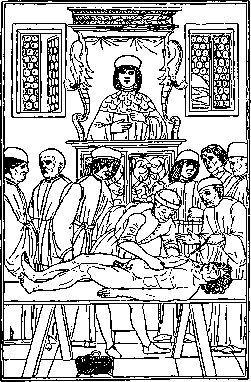
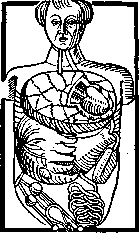
Illustration from Fasciculus medicinae (J. de Ketham, 1493).
based on the examination of two corpses (in 1316), was Raimondo deLiucci (Mundinus), professor at the University of Bologna. The dissections, which took the form of public spectacles and lasted for several days, were attended, besides those studying medicine, by prominent persons of the city and simply the "curious". Professor anatomiae primarius sat on the rostrum and taught, while the dismemberment of human and animal corpses was performed by the prosector, sometimes a tonsor (barber); dissection was not given great importance, since "Galen has already said everything". Therefore, they delved into disputes about matters unrelated to dissection; sometimes such spectacles ended with music. Hence the name-theatrum anatomicum, anatomical theater. Vesalius, the great reformer of anatomy (1514-1564), greatly elevated the importance of dissections, beginning to perform them personally himself. One of the earliest old anatomical theaters was arranged in Padua in 1490 (the anatomical theater of Benedetti). To the anatomical theater, as a place for such spectacles and disputes (auditoriums), with the increase in the number of corpses dissected and the accumulation of material, cabinets and museums of anatomical prepa
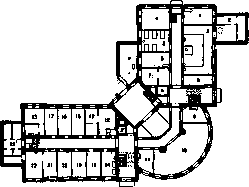
New anatomical institute of 1st Moscow State University. Plan of the ground floor: 1-reception for corpses; 2-morgue; 3-storage of corpses; 4-embalming room; 5-room with tanks; 6-injection room; 7-crematorium; 8-freezing; 9-maceration room; 10-public museum; 11-kitchen; 12-laundry; 13-ironing room and storage for linen; 14-baths and showers; 15, 16, 17-storage rooms for preparations, chemicals and utensils; 18-plaster; 19-modeling; 20-metalworking; 21-assembly; 22, 23-apartments for attendants; 231-firewood, ice cellars.
rations, first very modest; thus, the Basel anatomical theater, for example, until the beginning of the 19th century had only two skeletons. In 1788, Salzmann in Strasbourg introduced practical anatomy classes for students, during which preparatory dissection halls arose. How difficult it was to obtain human corpses can be judged by the fact that in England, for example,
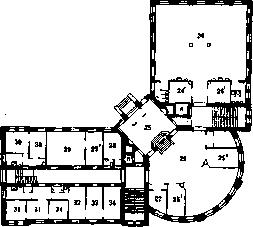
Plan of the first floor: 24-dissection hall; 241-storage of corpses; 25-vestibule; 251-storage of clothing and robes; 26-concierge; 27-attendants' duty room; 28, 29-anthropometric office; 30, 31-apartments; 32-director's reception; 33-steward; 34-office; 35-elevator.
there still existed in the first quarter of the 19th century a special profession of "resurrectionists", who dug up corpses for sale to anatomists. Official permission to deliver corpses from hospitals to anatomical theaters was granted only in 1828 after the execution of Burke, who had strangled 16 people and sold their corpses to Dr. Cox.-As anatomy developed, anatomical theaters turned into anatomical institutes, more extensive and equipped with means for research work. One of such exemplary institutes is the one opened in Munich in 1908 and described in detail by Rücker. There is also a tendency to move medical faculties outside the city; new anatomical institutes, for better ventilation and lighting, are surrounded by sufficient area with grass cover. Institutes have spare rooms; dissection halls and all places for storage and processing of corpse material are isolated as much as possible from audito
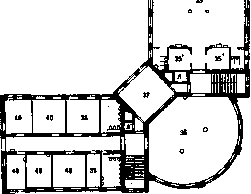
New anatomical institute of 1st Moscow State University. Plan of the 2nd floor: 35-dissection hall; 351-storage of corpses; 36-student museum; 37-small auditorium; 38-student library; 39-student room; 40-seminars; 41-elevator.
ries and rooms for scientific work. Attention is paid to the acoustic conditions in auditoriums, their supply with projection equipment, and the arrangement and equipment of scientific, educational, student and public museums. The institute should have: means and devices for accumulating and long-term preservation of corpses, maceration rooms, refrigerators with freezing appar
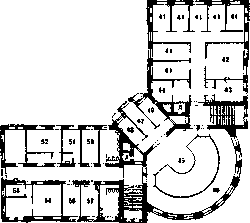
Plan of the 3rd floor: 41, 43-offices for scientific workers; 42-histological; 44-storage of corpses; 45-auditorium; 46-demonstration room; 47-projection apparatus; 48-lecturer's room; 49-preparation room; 50-prosector's office; 51-microphotography; 52-radiological; 53-histological; 54-librarian's office, reference library and reading room; 55-director's office; 56-chemical; 571-elevator.
ratus, crematory furnaces for burning soft parts, X-ray and photographic apparatus. A modern equipped laundry, baths and showers for personnel (especially for attendants) are extremely necessary for an anatomical institute in view of the peculiarities of work in it. New anatomical institute of 1st Moscow State University. As an example of a properly arranged and equipped anatomical theater ready for opening, one can give a description of the new anatomical theater of 1st Moscow State University, built already during Soviet power (1926-28). Initially, the anatomical theater was built in 1765 (10 years after the founding of the university); in 1820, the "Loderovsky" theater was built in its place; the anatomical theater that existed until recently was opened in 1877. The project
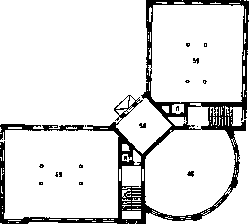
Plan of the 4th floor: 45-upper part of the auditorium; 58, 59-fundamental museum; 601-elevator.
for the new building was developed in the first half of 1926 by architect Greypert according to the specifications of the anatomists of 1st Moscow State University headed by P. Karuzin. The basis was laid as complete isolation as possible of the rooms for working on corpses from the rest of the clean part of the building, scientific from the educational part of the institute and the availability of spare rooms. The area of the five-story building, consisting of a central part and two wings (southern and western), is 1,411.18 sq. m, volume-3,500 cubic m,

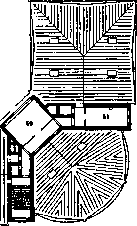
Plan of attics and roofs: 60-photographic studio; 61-for reconstruction.
useful area in all floors (for scientific-educational work)-4,017 sq. m. Heating is water-based with independent ventilation from it, separate for three parts of the building; gas and electricity (for lighting and motors). In the ground floor of the western wing there is a series of rooms for receiving corpses, embalming them, long-term storage in preserving liquids and vapors, injection with cold and hot masses, cremation of soft parts, for a refrigerating machine and freezing, maceration, degreasing and bleaching. An elevator for delivering corpses and moving institute personnel passes through the upper four floors. At the dissection halls-two rooms for cleaning and storing corpses and preparations. In the 3rd floor there is a special dissection hall for scientific workers, a preparation room and a room for storing corpses. In the ground floor-museum for excursionists; in the 1st floor-vestibule with cloakroom; in the 2nd-student museum and small auditorium; in the 3rd and 4th-large auditorium for 350 people with a demonstration room, lecturer's room and preparation room for lectures. In the ground floor of the southern wing there are rooms for storing linen, dishes and chemicalia, workshops, laundry, baths and showers, apartments for attendants, underground cellar; in the 1st floor-anthropometric office, attendants' duty room, office, offices of the economic assistant and director of the institute, his apartment; in the 2nd floor-student library-reading room, Lenin corner and five rooms for laboratory-group work on all departments of anatomy; in the 3rd floor-offices of the professor and prosector, institute library, histological, radiological, photographic and chemical laboratories; in the 4th floor-fundamental museum and next to it the museum of tables and drawings. In the attic-photographic studio and room for reconstruction. In size and abundance of laboratories, the new anatomical institute can occupy one of the first places in the world. Construction-A. S. Grebenshchikov; completion of construction of the new anatomical institute is scheduled for September 1928.
Albinus (1749), 'Vasorum lymphaticorum corporis humani historia' by Mascagni (1787), 'Anatomia corporum humanorum' by Cowper (1739), 'Planches anatomiques du corps humain' by Antommarchi (1824) - drawings in natural size (the entire atlas weighs 16 kg). All these valuable and rare editions are available in the Institute of Normal Anatomy of 1st Moscow State University. It should also be mentioned about 'Anatomie du gladiateur combattant' by Salvat (1812, in the Central Library of 1st Moscow State University), which is of great interest not only for the artist but also for the anatomist, and about the famous 'Anatomia topographica sectionibus per corpus humanum congelatum triplici directione ductis illustrata' by Pirogov (1849). Without dwelling on many atlases and wall charts that were still common in relatively recent times (Langenbeck, Bourgerie, Bonamy, Bock, Heitzmann, etc.), it should be noted the classic 'Icones nervorum capitis' by F. Arnold (2nd edition, 1860), 'Atlas des peripherischen Nervensystems des menschlichen Korpers' (1862) by Rüttinger, and two anatomical guides, richly illustrated, allowing them to be used without an atlas: 'Lehrbuch und Atlas der Anatomie des Menschen', 1923, by Rauber-Kopsch (also available in Russian translation) and 'Anatomie des Menschen' by Braus (1924). An excellent (still unfinished, 1908-1923) multi-volume guide of the same type - Quain's 'Elements of Anatomy'. Among those translated from German and necessary for students to perform practical work, the most common atlases in our country are by Sobotta, Toldt, and Spalteholz (Sobotta, 'Atlas der descriptiven Anatomie des Menschen'; Toldt, 'Anatomischer Atlas für Studierende und Ärzte'; Spalteholz, 'Handatlas der Anatomie des Menschen'); the latter is available in several Russian editions. There are stereoscopic atlases: 'Stereoscopic atlas of preparations by Kenningham' in 10 parts (250 plates), translated from English by Dyakonov; 'Anatomischer Atlas in stereoskopischen Röntgenbildern' by Sommer; N. S. Ogrin, 'The X-Ray Atlas of the systemic arteries of the body', New York, etc. The number of such atlases is increasing with the development of radiography and the growing interest in anatomy of the living. Among the more recent ones, we can mention: Hasselwander A., 'Atlas der Anatomie des menschlichen Körpers im Röntgenbild', with 199 illustrations on 72 plates, 1926.
Related articles
Mentioned in
Cite this page
“Anatomical Theaters.” Soviet Medical Encyclopedia. English translation of Bolshaya Meditsinskaya Entsiklopediya, 1st ed. (Moscow, 1928–1936), ed. N. A. Semashko. https://sovietmedicalencyclopedia.pages.dev/article/anatomical-theaters/