Zona
Historical document, translated for reference. It reflects medical knowledge of the 1920s–30s and is not medical advice.
Summary
This article defines the term 'zona' as a layer or small area of tissue characterized by a common histological structure, innervation, or function. It provides specific examples of such zones in the adrenal gland, the ovary, and the central nervous system, including the zona incerta and the zona spongiosa of the spinal cord.
Encyclopedia article (1928–1936)
ZONA (Latin zona - belt), a layer or small area of some tissue, distinguished by a common histological structure (homogeneous cells, their arrangement, direction of fibers, their origin or termination), a common innervation (see Head's zones), or finally, a common function. This term is encountered especially often in histology when describing the structure of various organs. Thus, in the adrenal gland, the cortical layer is divided into 3 areas, or layers, based on the arrangement of cells: zona glomerulosa, zona fasciculata, zona reticularis. When describing the structure of the ovary, mention is made of the zona radiata—a layer of cylindrical cells surrounding the egg cell, and the zona pellucida—a very resistant, dense membrane covering the egg cell. This term is also very commonly used in the anatomy of the central nervous system.
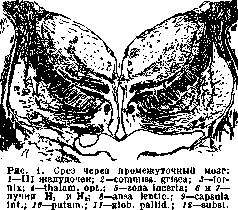
perfor. ant. (According to Marburg.) Zona incerta—a small area of nerve tissue located in the regio subthalamica, directly below the external nucleus of the thalami optici, from which it is separated by the H1 bundle or Forel's field H1 (Fig. 1); medially, the zona incerta transitions into the gray matter of the III ventricle, and inferiorly, the H2 bundle separates it from the corpus Luysii. The zona incerta is formed by a small number of cells of medium
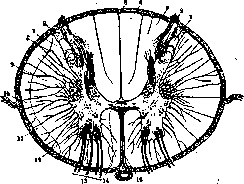
Figure 2. Cross-section of the spinal cord with pia mater and lig. denticulatum (schematically): 1—zona spongiosa; 2—radix post.; 3—fasc. cuneatus (Burdach's); 4—fasc. gracilis (Goll's); 5—sulc. median. post.; 6—zona terminalis; 7—subst. gelatinosa (Rolandi); 8—columna post.; 9—fasc. cerebro-spinal. lat.; 10—fasc. cerebello-spin.; 11—fasc. antero-later. superf. (Gowers's); 12—columna ant.; 13—radix ant.; 14—fasc. cerebro-spin. ant.; 15—fissura mediana ant. (According to Rauber.)
size, polygonal and triangular; their protoplasm has a diffuse stain, and in adults, it contains lipochrome; Nissl bodies are poorly differentiated; this zone is very rich in myelin fibers running in all directions; the neuroglia is very well developed. The connections of the Z. incertae, besides the thalamus opticus and nucl. lenticularis, have not yet been sufficiently studied. Its physiology is also unknown, as is the clinical picture caused by its disease. — Zona spongiosa — a small layer of gray matter located at the apex of the posterior horn of the spinal cord (Fig. 2). — Zona terminalis, or Lissauer's zone, is located at the periphery of the spinal cord, at the outer parts of the posterior column, separating the posterior horn from the periphery. Furthermore, in the posterior column, in its anterior parts, there is a zona ventralis, consisting of endogenous fibers (see Spinal Cord).
Related articles
Mentioned in
Cite this page
“Zona.” Soviet Medical Encyclopedia. English translation of Bolshaya Meditsinskaya Entsiklopediya, 1st ed. (Moscow, 1928–1936), ed. N. A. Semashko. https://sovietmedicalencyclopedia.pages.dev/article/zona/