Kyphosis (or round)
Historical document, translated for reference. It reflects medical knowledge of the 1920s–30s and is not medical advice.
Summary
This article from the 1928–1936 Soviet medical encyclopedia defines kyphosis, a condition characterized by a uniform curvature of the spine, and discusses its causes, types, and treatment.
Encyclopedia article (1928–1936)
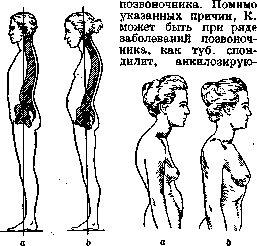
KYPHOSIS, or round back (kyphosis, dorsum rotundum), is characterized by a uniform curvature, usually of the thoracic spine, with a convexity to the back and a slight compensatory lumbar lordosis (Fig. 1 and 2). Anterior-posterior curvature (kyphosis) in its pure form occurs less frequently than lateral curvature. Haglund, in his study of 1,599 children in Stockholm, found kyphosis in 170 cases. Grönberg, in his study of 8,250 children, established spinal curvature in the anterior-posterior direction 715 times, of which actual kyphosis was established in 66.9%, kypho-lordosis in 20.8%, and lordosis in 12.3%. In the etiology and pathogenesis of kyphosis, one should consider the congenital peculiarity of the structure of the spine; weakness of the muscles of the whole body, and in particular the back muscles; prolonged bent position of the spine, conditioned by profession (e.g., among slaughterhouse workers) or by the school environment in a growing organism. Jones points to a possible etiological factor expressed in the overloading of the shoulders by inappropriate clothing. Rickets, which lies at the basis of a number of spinal deformations, can be a cause of kyphosis. Rickets kyphosis in children is well expressed in the lower thoracic and lumbar parts of the spine. Such kyphosis is characterized by a uniform curvature of the spine, easily disappearing in the prone position, or in more severe cases - upon stretching.
Figure 1.
Figure 2.
Figure 1. a - physiological kyphosis in normal standing; b - kyphosis in round back. Figure 2. Round back: a - before treatment; b - after treatment.
Spinal tuberculosis (see Spinal Tuberculosis) - spondylosis rhizomelica; in traumatic injuries of the spine - osteitis deformans; in paralysis of the back muscles, as residua of ant. poliomyelitis (see Childhood Paralysis); in rarer cases - in muscular dystrophy. Also noted are hysterical kyphoses. Brightly expressed forms of kyphosis of the upper thoracic part are observed in the so-called hypertrophic emphysema of the lungs. Finally, kyphosis of the thoracic spine can be combined with a tuberculous process in the lungs, primarily with the cirrhotic form. Special mention should be made of senile kyphosis. It represents, to a certain extent, a physiological phenomenon and is conditioned by senile degeneration and shrinkage of the intervertebral cartilages, as well as loss of muscular tone. Due to the loss of elasticity of the intervertebral cartilages, the bodies of the vertebrae come into close contact, which disrupts the functional curves of the spine characteristic of young age. There are finally reliable data on genetic kyphosis, and it should be noted that there is an amazing similarity in the form of spinal deformation within the same family. Thus, Aschner and Engelmann observed a pair of identical 9-year-old twins with a completely identical form of kyphosis. From the genealogies described in the literature, one should mention the case of Paulsen, where kyphosis was noted in 5 generations as a clearly expressed dominant trait. The same occurred in the case of Levy (3 generations, Fig. 3). The clinical picture of kyphosis is quite characteristic. In addition to the anterior-posterior curvature of the spine, primarily in the thoracic region, there is a simultaneous flattening of the thoracic cage, displacement of both shoulders forward of the frontal plane; compensatory lordosis in the lower part of the spine, abdomen in the shape of a pear with relaxed walls, ptosis. It should be noted, however, that although ptosis sometimes combines with round back, it does not always manifest as any painful signs.
Incorrect position of the body, kyphosis (woman) conditioned by kyphosis and compensatory lordosis, does not remain without influence on the internal organs of the thoracic cage, on the general condition of the growing organism. General weakness of musculature, sunken chest, insufficient ventilation of the lungs, protruding abdomen characterize juvenile kyphosis. The etiology, mechanism of formation, and therapy of kypho-scolioses have much in common with scolioses (see). In the treatment of true kyphoses of non-inflammatory origin, primarily in children and young people, one should distinguish 1) mobile kyphoses, 2) fixed kyphoses. If kyphosis easily submits to passive correction, satisfactory results can be achieved by systematic gymnastics, massage of the back muscles, and training the patient's will in the direction of a correct body position. Gymnastic exercises should be directed at developing the back and abdominal muscles. At the same time, other harmful moments (inappropriate clothing, unfavorable school conditions, etc.) must be eliminated. Fixed forms of kyphosis must first be converted into mobile ones by careful and skillful gymnastic exercises. Active corrective exercises with a roller placed under the kyphotic area are good for this purpose. The Lorenz apparatus ("Lorenzsches Wolm") is also very convenient for corrective gymnastics. In fixed kyphoses, especially of the thoracic region, tuberculosis must be carefully excluded before resorting to mobilization. After good correction has been achieved, in individual cases the wearing of corsets-directors, built on the type of the Nyrop director, is indicated. If simultaneously there is a pear-shaped hanging abdomen with stretched abdominal walls, a corset covering the abdominal walls is indicated. Therapy of other types of kyphosis should be applied depending on the main affliction (see Spinal Tuberculosis).
Related articles
Mentioned in
Cite this page
“Kyphosis (or round).” Soviet Medical Encyclopedia. English translation of Bolshaya Meditsinskaya Entsiklopediya, 1st ed. (Moscow, 1928–1936), ed. N. A. Semashko. https://sovietmedicalencyclopedia.pages.dev/article/kyphosis/