Lumbago
Historical document, translated for reference. It reflects medical knowledge of the 1920s–30s and is not medical advice.
Summary
Lumbago is a clinical symptom characterized by shooting pains in the lumbar region. The article discusses its classification as either muscular or neuralgic, causes, symptoms, and diagnostic considerations from a 1930s Soviet medical perspective.
Encyclopedia article (1928–1936)
LUMBAGO, lumbago (lumbalgia, "shooting pain"), clinical symptom manifested by shooting pains in the lumbar region. Usually this symptom was associated with muscle disease, but clinical study of L. shows that this symptom is also observed in diseases of the nerves (primary neuralgias) and vertebrae (secondary neuralgias). To determine in each individual case of L. whether there is myalgia or neuralgia often presents a difficult, and sometimes futile, task, and at present L. is considered as a collective concept for pains in the soft parts of the lumbar region (Alexander), which, along with other symptoms and etiological factors, determine the nature and location of the lesion. Muscular L., myalgia of the lumbar muscles (myalgia lumbalis), is observed in diseases of the erectores dorsi (mm. quadratus lumborum, iliopsoas, sacro-lumbalis) and fascia lumbodorsalis. The disease most often affects persons engaged in heavy physical labor, and persons working and living in poor sanitary conditions (dampness, cold). Among men, the disease is observed more often than among women. In the etiology of muscular L., several basic factors can be noted: trauma, muscular tension, cooling, and infection. Along with severe trauma leading to muscle tears, tears and avulsions of tendons, and stretching of joints, daily heavy work involving overexertion of the musculature can also be a cause of muscular L. Among infections, muscular L. is most often associated with the so-called rheumatic infection, especially with its chronic forms. In recent times, an important role in the development of muscular L. has been noted for chronic purulent processes, such as carious teeth, tonsillitis (Passler), maxillary sinusitis, sinusitis. The cold often noted by patients preceding the illness should be considered as a predisposing factor facilitating the action of toxins and infections. However, the possibility is not excluded that excessive cooling of the muscles, by disrupting their blood circulation and metabolism, can cause muscle pains. To differentiate traumatic muscular L. from infectious L., which usually manifests after cooling, is not always easy, all the more so since heavy physical labor and cooling often follow one another. Zollinger gives the following guiding points in this direction: in traumatic muscular L., there is a clear trauma or physical overexertion and pain immediately after trauma; the disease occurs in all ages; pains are spontaneous and on pressure are limited; smaller muscles are more often affected; recurrences are rare; in infectious L. (rheumatic), there is a connection of the disease with the season of the year, rheumatic lesions in other places (joints); the disease rarely occurs before the age of twenty; it does not develop immediately; pains are diffuse, varying in intensity, often passing into sciatica; superficial muscles are more often affected; recurrences are frequent. The diagnosis of constitutional muscular L. should be made with great caution and only in the absence of other etiological factors and in the presence of patients with clearly expressed phenomena of metabolic disorders (e.g., gout, etc.). Symptomatology of muscular L. The disease sometimes develops acutely; immediately after trauma or physical exertion; or soon after cooling, an acute, tearing, shooting pain in the lower back appears immediately (hence the name "shooting pain"); sometimes at first a dull, aching pain is felt in the lower back, which over several days increases to the degree of acute pain. At rest, the pains weaken or disappear altogether, but arise in an acute degree with the slightest movements and strains (coughing, sneezing, straining at stool). Pains are more often localized on one side (traumatic muscular lumbago), but can spread to both sides (infectious muscular L.). The position of the patient is forced: the trunk is in a bent forward position; with unilateral involvement, scoliosis with convexity to the healthy side is usually observed. The cause of the scoliosis lies in the contracture of the
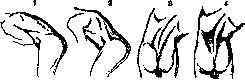
Figure 1. Bending forward in a healthy person. Figure 2. The same in lumbago. Figure 3. Bending to the side in a healthy person. Figure 4. The same in lumbago.
of the muscles. According to Plate, scoliosis is caused by a lesion of the m. psoas on one side, while according to Stein, it is caused by a secondary lesion of the branches of the second sacral nerve passing between spina iiii post and symphy-sis sacro-iliaca (Schudel's point). The patient's movements are limited, and when bending forward, the lordosis does not completely disappear (figs. 1 and 2); when bending to the side, the lower part of the line of spinous processes remains immobile; only the upper part curves, so that the line of spinous processes appears broken (figs. 3 and 4). Rising from a lying position is difficult and is accompanied by a series of characteristic movements (see Sciatica, fig. 4). When the m. ilio-psoas is affected, backward bending is sharply limited. On pressure, tenderness (hyperaesthesia muscularis) is found on the sides of the spinous processes; in traumatic muscular lumbago, the area of tenderness is limited, while in rheumatic lumbago it is diffuse. When the m. ilio-psoas is affected, so-called Gar's point is found (pain on deep pressure below the navel near the midline); in some cases, neighboring bones are tender on pressure. The tone of the affected musculature is sharply increased, often up to rigidity and contractures. These contractures are caused by a pathologically increased reaction of the diseased muscle (MiPeg). Along with hypertonicity to, hardening of the muscle and its bulging in the form of a cushion are usually observed. Sometimes individual dense and painful nodules can be palpated in the muscle, which are foci of muscle tissue altered in its colloidal nature (under the influence of cooling, toxins) (Schade). No histological changes were found in such nodules. - The duration of muscular lumbago varies. Acute pains usually disappear after a few days, while weak pains and pains on movement last from 1 to 3 weeks. It should be said that infectious muscular lumbago is always more protracted compared to traumatic lumbago. The treatment of traumatic muscular lumbago in the acute stage is rest and counter-irritants in the form of cups, mustard plasters, heat in various forms, rubbing with ointments; after the acute stage has passed, massage. The same is recommended for infectious (resp. toxic) muscular lumbago, where causal therapy, medicinal (salicylates, methenamine) or non-specific in the form of vaccine and protein therapy, is also applied. In chronic and frequently recurrent cases, spa treatment with mud and sulfur baths is indicated. In constitutional muscular lumbago, it is necessary to fight against the corresponding diatheses and general strengthening treatment. - For the prevention of traumatic muscular lumbago, it is recommended to avoid physical overexertion; in cases of a tendency to relapses, depending on the work, a change of profession is indicated. In infectious muscular lumbago, all factors facilitating the penetration and action of infection should be avoided: cooling, work in damp and cold rooms, intoxications; hardening of the body is necessary (gymnastics, fresh air, water procedures throughout the year). Lumbago associated with diseases of the nerves supplying the lumbar region (neuralgic lumbago) is clinically very difficult to distinguish from muscular lumbago. It is not always possible to differentiate both diseases etiologically. Thus, sciatica begins with lumbar pains in almost 50% of cases. However, the appearance of sciatic symptoms does not always help in recognizing muscular lumbago, since the spread of myalgias to the gluteal muscles and thigh muscles can simulate sciatica (pseudo-ischias myalgica). It should also be noted that the process that caused the myalgia can spread to the nerves and cause neuralgia. Apparently, such simultaneous involvement of muscles and nerves occurs very often, especially with an infectious nature of the lesion. Schmidt even considers that in all cases of lumbago, it is a matter of neuralgia. Various changes in the lumbar-sacral vertebrae have particularly important significance in the origin of lumbar pains. Erben, who studied 200 cases of lumbago, found changes in the vertebrae in almost all cases, and for this reason he generally denies the possibility of muscular lumbago. Such a view should be considered extreme; however, the frequent association of vertebral changes with the development of lumbar pains is beyond any doubt. In such cases, there is almost always a lesion of the nerve roots, i.e., secondary neuralgia. Among the changes in the spine causing lumbago, one can note both congenital (e.g., spina bifida occulta, sacralization of L5, lumbarization of S1 and spondylolisthesis) and acquired (infectious spondylitis, spondylitis deformans, spondylarthrosis, tumors of the vertebrae, traumatic injuries). In congenital changes of the vertebrae, the occurrence of pains is usually associated with trauma or heavy physical work, and the pains are particularly prone to relapse with any physical exertion, sometimes even slight. Pains usually appear suddenly; but in the anamnesis of patients, it is almost always possible to establish the presence of mild transient pains in the lumbar region. In the clinical picture, in addition to the signs characteristic of muscular lumbago, signs of nerve root lesions can be noted: straight and crossed Lasègue's sign, then the head flexion sign (Neri-Lindner's) (pain in the lumbar region, buttock, sometimes in the legs on forced passive bending of the head to the chest) and motor signs (Shambov's) [forced passive bending of the head is accompanied by flexion of the affected leg (or both) at the knee and hip joints; the same phenomenon is observed in the affected leg when the healthy leg, which has been raised, is extended at the knee joint]. Tenderness on pressure is also found in the vertebrae (L5 and S1). The configuration of the spine is changed: scoliosis, kyphosis, kyphoscoliosis, marked lordosis (in spondylolistheses) are observed. Movements of the spine are limited forward and backward (spina bifida occulta), to the sides (sacralization and lumbarization); inability to bend forward is characteristic of spondylolisthesis. Descending stairs and jumping on the heels intensifies or causes pain (sacralization, lumbarization, spondylolisthesis). Often the pains spread to one or both extremities; then all the signs of root sciatica (lumbo-ischiatic syndrome) are present. An X-ray in doubtful cases determines the true nature of lumbago, which is why every case of lumbago should as a rule be subjected to radiography. As for treatment and prevention in lumbago associated with congenital changes of the spine, it is necessary to resort to the same measures as in traumatic muscular lumbago. In treatment with rest, simultaneous traction on an inclined plane is recommended; after the disappearance of pains, wearing a removable corset. In persistent and frequently recurrent cases, surgical intervention is indicated: release of adhesions, fat inclusions, etc. in spina bifida occulta, resection of the transverse processes in sacralization, fixation according to Gibbs in spondylolisthesis. Lumbar pains are sometimes found in diseases of the spinal cord (tumors, tabes dorsalis, etc.). The presence or acute addition of symptoms from the spinal cord easily determines the cause of the pains in these cases. Diffuse pains in the lumbar region can be observed in kidney diseases, pleurisy, gynecological diseases. In diseases of abdominal organs, pains can be limited and found on pressure (Ged's zones). In such pains, a number of myalgic and neuralgic signs are absent, such as rigidity of the musculature, intensification of pains on pressure, change in mobility and configuration of the spine. In such cases, the pains are not strictly localized, they migrate, and their occurrence is not connected with the external factors mentioned above. Along with these signs, examination of internal organs helps to determine the cause of these pains. It should be noted that in neurasthenics, anemic, weakened subjects, and asthenics, lumbar pains can be observed. The occurrence of these pains is more often connected with psychogenic factors and fatigue. In such cases, the pains are usually without a precisely defined localization, they change in intensity, migrate, radiate along the spine; often the nature of the pains is different: burning, smarting. At the same time, the presence of other neurasthenic signs is always found.
Related articles
Mentioned in
Cite this page
“Lumbago.” Soviet Medical Encyclopedia. English translation of Bolshaya Meditsinskaya Entsiklopediya, 1st ed. (Moscow, 1928–1936), ed. N. A. Semashko. https://sovietmedicalencyclopedia.pages.dev/article/lumbago/