Radicotomy
Historical document, translated for reference. It reflects medical knowledge of the 1920s–30s and is not medical advice.
Summary
Radicotomy is the surgical section of spinal nerve roots, differentiated into posterior (sensory) and anterior (motor) sections. Initially used for severe neuralgias, particularly from cancer metastases, its application was later expanded for tabetic crises and spastic paralysis, though with limited success due to high mortality rates and unsatisfactory results.
Encyclopedia article (1928–1936)
RADICOTOMY, rhizotomy (radicotomia, rhi-zotomia), the operation of sectioning the roots of the spinal cord. The following types are distinguished: radicotomy posterior - section of the posterior (sensory) roots, and radicotomy anterior - section of the anterior (motor) roots. For the first time, R. (posterior) was performed in 1888 by Bennett (W. H. Bennett, England) for a severe form of sciatica. In the same year, Abbe (Abbe, America) independently performed the same operation successfully in one case of severe neuralgia of the brachial plexus on the basis of a former gunshot wound. Subsequently, R. was repeated by numerous authors (Jones, Groves, Horsley, Chipault and De-moulin and others). The main indication for its use was severe neuralgias, mainly due to cancer metastases to the spine. R. gained wider acceptance after Foerster (1908) proposed sectioning the posterior roots in tabetic crises, as well as in spastic paralysis, particularly in Little's disease (fig. 1). However, clinical observations showed that a complete therapeutic effect from this operation is achieved in only a small percentage of cases; in addition, a rather high percentage of operative mortality was noted. Ruvertoni, in 44 cases of section of the posterior roots for neuralgia, obtained good results in only 8 patients, while in 13 cases there was a fatal outcome (6 times directly after the operation and 7 times in the immediate period following it). Similar figures are also given in the collective statistics of Frazier: out of 50 cases of radicotomy, recovery occurred in 7, significant improvement in 7, and some improvement in 5; 10 cases showed no improvement, and in 21 a fatal outcome occurred: 8 of them directly after the operation and 13 at later dates. The unsatisfactory results obtained after section of the posterior (sensory) roots for various types of pain led some researchers to assume the presence of additional pain-conducting pathways in the anterior (motor) roots. Accordingly, to enhance the therapeutic effect of posterior R., it was proposed to also section the corresponding anterior roots (Foerster, Heymann, Kilvington, Thorburn and others). However, even such expanded application of root section proved to be ineffective in combating pain, while the exclusion of the anterior roots was accompanied by paralysis of the corresponding muscle groups. All this forced a drastic narrowing of the application of this modification of R. Most surgeons abandoned it altogether. The indications for radicotomy posterior at present are: 1) neuralgic pains not responsive to other methods of treatment (physiotherapy, alcoholization, neurectomy), 2) tabetic crises (in severe form), and 3) spastic paralyses. Technique of R. The operation begins with the typical opening of the spinal canal (see Laminectomy) at the appropriate level. The dura mater is incised throughout the length of the operative wound and its edges are taken on ligatures. By pulling on the latter, the corresponding edge of the membrane outward, while simultaneously pushing the spinal cord (or cauda equina) in the opposite direction with a blunt spatula, the roots become well visible, which can easily be isolated from each other. For orientation when counting roots, the following indications are useful. For the cervical region: the spinous process of C7 corresponds to the exit point of the C8 root from the dura mater; in addition, the 7th cervical root is thicker than the other cervical roots and C8. For the lumbar region: the spinous process of L5 corresponds to the exit point of the S1 root from the dura mater. As for distinguishing anterior and posterior roots, in the cervical and thoracic regions of the spinal cord this presents no difficulties, as they are sufficiently distant from each other. The matter is somewhat more difficult in the region of the conus medullaris and cauda equinae; here, when differentiating the roots, it must be remembered that the posterior root is wider, flatter, and lies posteriorly and laterally, while the anterior root is thinner and rounder; in doubtful cases, it is useful to use an electrode. By successively isolating the found roots on a special hook, they are sectioned with a sharp scalpel (but not scissors). Bleeding that sometimes occurs during this is stopped with light tamponade; ligatures should be avoided as much as possible. For greater radicalism, some authors recommend not limiting oneself to just sectioning the root, but to excise a whole segment of it, i.e., to perform rhizectomy. The operation ends with the application of layered sutures to the dura mater (continuous), soft tissues, and skin.
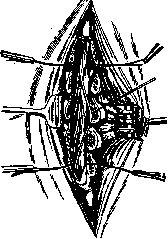
Figure 1. Section of the posterior roots of the spinal cord in the lumbar region of the vertebral canal (radicotomy posterior).
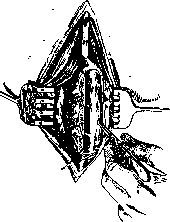
Operation of Guleke - extradural section of the roots. In order to avoid opening the dura mater sac and the associated possible trauma to the spinal cord, introduction of infection, subsequent leakage of cerebrospinal fluid, etc., Guleke proposed to section the posterior roots (as well as the anterior roots) extradurally (outside the membrane sac) (fig. 2). However, this method has not yet gained wide acceptance.-Operation of Moltokov - extraganglionic section of the posterior roots of the spinal cord (radicotomy post, extra-ganglionaris). Proceeding from the special significance of the intervertebral nodes in the origin of vasomotor, trophic, and pain disorders, as well as the ineffectiveness of other operative interventions on the nervous system for these diseases, Moltokov at the 20th Congress of Russian Surgeons (1928) proposed to section the posterior (sensory) root immediately distal to the ganglion, where this root has not yet entered the composition of the mixed nerve. Positive results of this operation were noted by the author in 8 cases, but have not yet been confirmed by other surgeons.
Operation of Guleke - extradural section of the roots. In order to avoid opening the dura mater sac and the associated possible trauma to the spinal cord, introduction of infection, subsequent leakage of cerebrospinal fluid, etc., Guleke proposed to section the posterior roots (as well as the anterior roots) extradurally (outside the membrane sac) (fig. 2). However, this method has not yet gained wide acceptance.-Operation of Moltokov - extraganglionic section of the posterior roots of the spinal cord (radicotomy post, extra-ganglionaris). Proceeding from the special significance of the intervertebral nodes in the origin of vasomotor, trophic, and pain disorders, as well as the ineffectiveness of other operative interventions on the nervous system for these diseases, Moltokov at the 20th Congress of Russian Surgeons (1928) proposed to section the posterior (sensory) root immediately distal to the ganglion, where this root has not yet entered the composition of the mixed nerve. Positive results of this operation were noted by the author in 8 cases, but have not yet been confirmed by other surgeons.
Operation of Guleke - extradural section of the roots. In order to avoid opening the dura mater sac and the associated possible trauma to the spinal cord, introduction of infection, subsequent leakage of cerebrospinal fluid, etc., Guleke proposed to section the posterior roots (as well as the anterior roots) extradurally (outside the membrane sac) (fig. 2). However, this method has not yet gained wide acceptance.-Operation of Moltokov - extraganglionic section of the posterior roots of the spinal cord (radicotomy post, extra-ganglionaris). Proceeding from the special significance of the intervertebral nodes in the origin of vasomotor, trophic, and pain disorders, as well as the ineffectiveness of other operative interventions on the nervous system for these diseases, Moltokov at the 20th Congress of Russian Surgeons (1928) proposed to section the posterior (sensory) root immediately distal to the ganglion, where this root has not yet entered the composition of the mixed nerve. Positive results of this operation were noted by the author in 8 cases, but have not yet been confirmed by other surgeons.
Related articles
Mentioned in
Cite this page
“Radicotomy.” Soviet Medical Encyclopedia. English translation of Bolshaya Meditsinskaya Entsiklopediya, 1st ed. (Moscow, 1928–1936), ed. N. A. Semashko. https://sovietmedicalencyclopedia.pages.dev/article/radicotomy/