Torsion Spasm
Historical document, translated for reference. It reflects medical knowledge of the 1920s–30s and is not medical advice.
Summary
Torsion spasm is a chronic progressive disease characterized by changes in muscle tone and distinctive involuntary movements. It typically begins in childhood and has a genetic component with recessive inheritance patterns.
Encyclopedia article (1928–1936)
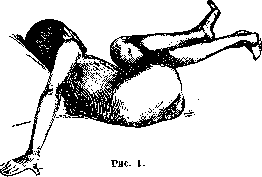
TORSION SPASM (torsion neurosis of Zielen, dystonia musculorum deformans or dysbasia lordotica progressiva Oppenheim, torsion dystonia, progressive torsion spasm of children, pallidum spasmus), a chronic progressive disease, the most characteristic symptoms of which are changes in muscle tone and peculiar involuntary movements. The first description of this disease belongs to Schwabe and Zielen (1908-10), who considered it, as shown by the name they gave 'tonic torsion neurosis', a severe functional disorder. In 1911 Oppenheim first pointed to the organic nature of this disease; in 1919 appeared a comprehensive work by Mendel, including 33 cases of T. s. and summarizing the then knowledge on this subject. Subsequently important works were published by Flatau and Sterling, Bregman, Frankel, Thomalla, Forster, Davidenkov and others. The movements in T. s., according to Mendel, represent a mixture of choreatic, athetoid, tic-like, hemiballistic, parkinsonian-like movements, resembling in part each of these diseases, but not coinciding entirely with any of them. Particularly typical are the rotational movements of the trunk and limbs, to which torticollis-like curvatures of the neck are often added. Into these stretching-rotational, rather monotonously occurring movements suddenly burst out jerking and throwing movements, leading to peculiar, fanciful, affected positions of the body, to abduction of the upper extremities, aimless movements of the trunk, legs, etc. (fig. 1). The forced movements are most strongly expressed in the proximal joints, but the distal ones are not free from them; however, they reach their greatest development in the trunk. At the same time, significant lordosis, scoliosis and displacement of the pelvis may develop, caused by abnormal tension of the muscles, which almost completely disappears at rest. In some muscles at this time there is a tendency to prolonged tonic contractions, while in others hypotonia is often observed, frequently associated with a decrease in tendon reflexes.
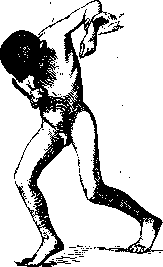
The disease usually begins at the age of 10 to 13 years, sometimes earlier, more rarely in adolescence. The first phenomena are usually observed in one of the lower extremities, sometimes in both, more rarely in the upper extremity or neck muscles. Occasionally at the beginning the crossed upper and lower extremities are affected. Often at the beginning of the disease disorders of gait are observed in the form of awkwardness, in which convulsive states may play a certain role. At rest, as well as during distraction, the forced movements usually weaken or completely disappear. During sleep and in hypnosis they cease. In severe cases, however, convulsive states are also observed at rest, most strongly expressed in the spine in the form of extreme extension, flexion convulsions, etc. The facial muscles are usually not affected, but some authors (Maas, Wartenberg and others) noted forced movements in them as well, others, on the contrary, note amimia. The convulsions in general have an uneven character; they are not the same in different parts of the body, not rhythmic. In many cases patients are able to suppress both the forced movements and the tendency to hypertonia by assuming peculiar, sometimes very fanciful positions, in which they prefer to remain. In some cases movements, usually impossible, are performed quite easily with resistance or under the influence of various irritations (sensory, electrical), with pressure, etc. Pyramidal symptoms, pareses, sensory disorders and pelvic organs, convulsions of an epileptiform character are not observed. The plastic tone is normal. However, paresis of the lower branch of the facial nerve and the Babinski symptom (Davidenkov) were sometimes noted, occasionally nystagmus, dysarthria, dysphagia, attacks of convulsive laughter, tremor, as well as pains. Some authors noted the so-called paradoxical kinesia phenomena, when patients could suddenly, for example, walk backward well or dance, play ball, etc. In some cases a unilateral development of symptoms was observed. The psyche is not affected, sometimes patients even show very high intellectual development. A sharp demarcation of the clinical picture of the disease on the basis of clinical symptoms cannot however be made at present. Rosenthal points out that at the height of its development the disease in individual cases shows significant deviations. According to this author, two types of T. s. can be distinguished. In the first, position anomalies come to the fore, especially of the head and trunk, sharply prominent during walking (fig. 2) and standing. Rosenthal calls this type the dysbatic-dystatic form of T. s. In the second type, general restlessness is mainly observed, with or without involvement of the facial muscles. In view of the closeness of this picture to double athetosis, Rosenthal, on the basis of his recent research, is inclined to consider it an idiopathic form of double athetosis.
Almost all the cases described earlier belonged to Jewish families from Poland, Galicia and western regions of the USSR. In recent years, however, cases of definitely non-Jewish origin have also been encountered. Thus, the disease was observed among French, Germans, Danes, Swedes, Brazilians, both of pure origin and of mixed race, among Argentines and North Americans. There are indications of the high frequency of this condition in North America (Austregesilo). For a long time this disease was not considered hereditary. Mendel in his monograph states that heredity probably plays no role in the etiology of this disease, and in the review by Austregesilo and Marques (1928) nothing is said at all about the heredity of this disease. In reality, however, quite a few cases of familial occurrence of this condition have been described. Besides the cases of Schwabe-Zielen and Bernstein, familial cases were described by Dzerzhinsky, Wexler-Brock, Davidenkov-Zolotova, Mankovsky-Cherny, Regensburg. In most cases it is a disease of children of healthy parents, and heredity thus has a recessive character. The few cases where the form of inheritance was dominant had a clinically atypical character. Thus one has to come to the conclusion that at present the existence of a recessive clinically pure group of cases of T. s. is definitely proven (Davidenkov). Sometimes in healthy relatives various anomalies were noted. Thus, alcoholism, schizophrenia, hemiplegia, migraines, psychopathies were observed. In others, symptoms suspicious of a milder manifestation of the same gene are sometimes encountered, for example, tremor, tics, forced movements, etc. (Davidenkov).
The nature of the disease is unknown. It is undoubtedly an organic disease, most likely in the area of the subcortical ganglia. Ferster assumes the isolated loss of certain inhibitory elements of the striatum for certain muscle groups, due to which the corresponding elements of the pallidum are disinhibited, while others are inhibited. The prognosis quoad vitam is favorable. In general, the disease gradually progresses, but significant remissions are noted. Usually, the disease, after reaching a certain stage of development, stops. Patients can reach a very advanced age, for example, one of Regensburg's patients was 71 years old. Wimmer drew attention to the fact that many cases ended with extrapyramidal immobility with Parkinsonian tremor. The pathological-anatomical picture of T. s. is far from being clarified. The number of autopsies is small and their data have not led to uniform results. In the cases of Tomall (atypical) and Wimmer, cirrhosis of the liver and changes in the striatum, observed in diseases of the Wilson group, were found. Tomall found necrotic phenomena in the striatum, the putamen appeared macroscopically shrunken and softened, the fibers of the corpus Luysii were poor and it was reduced in size. In Wimmer's case, a macroscopically normal brain contained Figure 2. v25 diffusely located Alzheimer's i cells, mostly in the striatum. Other authors also saw changes typical of hepatolenticular degeneration. Richter, however, found changes in the same areas as in Tomall's case, but having the characteristic of chronic progressive chorea (death of striatal cells without predominant damage to small cells with indistinct proliferation of glia with less severe changes in fibers). Intensive cellular changes were also found in the case of Marinescu-Nicol escu. Bels hovsky in the case of Cassirer found phenomena of brain edema, expansion of perivascular lymph spaces, and swelling of myelin. In the ganglion cells - phenomena of disintegration. All changes are equally expressed in the cerebral cortex and in the striatum. Thus, it can be considered established that the anatomical basis of T. s. cases can be different processes, and therefore it must be assumed that there are symptomatic and genuine forms independent of each other, and the external similarity can be so complete that it does not allow them to be separated from each other (Davidenkov). This situation has led to the fact that at present, authors adhere to opposite points of view on this issue. While some (Wimmer) do not recognize T. s. as a disease sui generis, others (Lotmar) consider it a completely independent disease. Sterling considers it necessary to separate the cases of T. s. sui generis from symptomatic forms and proposes the term dystonia for the first, and dystonism for the second. - Diagnosis in general is not difficult. Differential diagnosis must keep in mind chorea, paralysis agitans, Wilson's disease, double athetosis, hysteria, and epidemic encephalitis. Against double athetosis speaks the usual onset in one limb, the peculiar rotational character of the forced movements, the predominant involvement of the trunk, the non-involvement of the face, normal intellect. In the diagnosis, nationality may also be of importance. Against hysteria speaks the uniformity of motor disorders, against other diseases - the characteristic symptoms of the latter. - Therapy is fruitless. Hypnosis sometimes gives transient improvement. Sometimes surgical intervention in the sense of tendon lengthening gives some effect. Regensburg applied daily systematic injections in combination of 0.0003-0.0005 scopolamine and 0.003-0.005 morphia and thereby achieved complete rest and normal gait. Upon cessation of treatment, however, the forced movements reappeared.
I. Prishmin.
Related articles
Mentioned in
Cite this page
“Torsion Spasm.” Soviet Medical Encyclopedia. English translation of Bolshaya Meditsinskaya Entsiklopediya, 1st ed. (Moscow, 1928–1936), ed. N. A. Semashko. https://sovietmedicalencyclopedia.pages.dev/article/torsion-spasm/