Rue
Historical document, translated for reference. It reflects medical knowledge of the 1920s–30s and is not medical advice.
Summary
Rue (Ruta graveolens L.) is a semi-shrub of the rue family, native to Crimea and cultivated in gardens in the southern and western USSR. Its leaves and essential oil were historically used as emmenagogues, antiseptics, and anthelmintics, though they can cause poisoning.
Encyclopedia article (1928–1936)
RUE, Ruta graveolens L., a semi-shrub of the rue family, growing wild in Crimea. It is cultivated in gardens in the southern and western USSR. The leaves and essential oil obtained from them were previously used as emmenagogues, antiseptics, and anthelmintics in doses of up to 0.2 g of leaves or 0.05 g of oil per administration. In folk medicine, rue is still used, despite the fact that it often causes poisoning, the signs of which are: severe salivation, swelling of the tongue, gastrointestinal disorders, decreased body temperature, and convulsions.
Fresh leaves contain, in addition to essential oil, the glycoside rutin, a volatile alkaloid, a resinous substance, a bitter substance, and malic acid. Prolonged contact may cause skin inflammation. Treatment is symptomatic in nature.
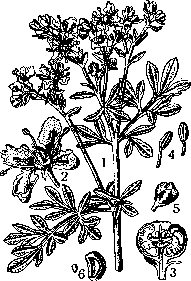
Ruta graveolens: 1-flowering plant; 2-flower; 3-fruit in longitudinal section; 4-tips of stamens; 5-fruit; 6-seed.
Fresh leaves contain, in addition to essential oil, the glycoside rutin, a volatile alkaloid, a resinous substance, a bitter substance, and malic acid. Prolonged contact may cause skin inflammation. Treatment is symptomatic in nature.
Related articles
Mentioned in
Cite this page
“Rue.” Soviet Medical Encyclopedia. English translation of Bolshaya Meditsinskaya Entsiklopediya, 1st ed. (Moscow, 1928–1936), ed. N. A. Semashko. https://sovietmedicalencyclopedia.pages.dev/article/rue/