Salting Out
Historical document, translated for reference. It reflects medical knowledge of the 1920s–30s and is not medical advice.
Summary
Salting out is a method for precipitating dissolved substances by adding large amounts of soluble salt. It's widely used in organic chemistry and for protein separation without denaturation. The article also covers uterine curettage, a surgical procedure for diagnostic or therapeutic purposes.
Encyclopedia article (1928–1936)
SALTING OUT, a method for precipitating dissolved substances from a solution by adding a large amount of some readily soluble salt. In most cases, salting out is apparently based on the fact that the molecules or ions of the salt, having a tendency toward hydration, bind water and thus, as it were, remove the solvent from the substance present in the solution. However, in a number of cases, one must also consider the direct influence of the added salt on the solubility of the substance being precipitated. Salting out is widely used in organic chemistry for the isolation of various products from aqueous solution, both in laboratory practice and in production (for example, the precipitation of soap when common salt is added). Salting out is often used to precipitate proteins from solution and to separate them into individual fractions, since different proteins precipitate at certain salt concentrations. Thus, for example, when the solution is half-saturated with ammonium sulfate, globulins precipitate, and when completely saturated with this salt, all proteins are precipitated. In relation to proteins, salting out is the most delicate method for isolation from solution, as it is not accompanied by denaturation of the proteins, and the precipitate can be easily and completely redissolved without changing its properties. Therefore, salting out is often used for the isolation of unstable or protein-bound substances, such as immune antibodies, enzymes, and toxins. CURETTAGE OF THE UTERUS, an operation whose purpose is the removal of the uterine mucous membrane or the fertilized egg, resp. its remnants (as occurs in pregnancy). The operation of curettage of the uterine mucosa (abrasio mucosae uteri) was proposed in 1846 by Recamier and his student Robert. Recamier also proposed for this operation the curette he had invented. Thanks to the work of Simon, Hegar, and especially Olshausen, curettage began to gain wide spread starting from the 1870s. As a diagnostic method, curettage is used mainly when there is suspicion of cancer of the uterine cavity. Although in the presence of uterine cancer, trial curettage, as some indicate, may lead to further spread of the neoplasm, nevertheless this danger when using proper surgical technique is small, and trial curettage is the best method in all doubtful cases. True, in evaluating the results of microscopic examination of scrapings from the uterine cavity, special care is required (see Uterus). Trial curettage is also used by some (Wyder, Ott) in ectopic pregnancy. Here, in the scraping, unlike in uterine pregnancy, only decidual tissue is found. However, the absence of the latter is not an argument against ectopic pregnancy, since the uterine mucosa may not yet have undergone decidual reaction, or the decidual membrane may have already been shed, expelled, and replaced by indifferent tissue (see Ectopic Pregnancy). Thus, the significance of trial curettage in the diagnosis of ectopic pregnancy is problematic, and moreover the method itself is far from safe, as it may lead to disruption of an unrecognized uterine pregnancy or contribute to rupture of the gestational sac in ectopic pregnancy. Trial curettage of the uterine mucosa is also used for the diagnosis of tuberculosis of the sexual organs. The basis for this is that in the uterine mucosa, the tuberculous process is localized in approximately half of all cases of tuberculosis of the sexual sphere. As observations show, trial curettage can also lead to the spread of the tuberculous process, for which reason it is rejected by many. Based on the latest data on the cyclic changes of the uterine mucosa in connection with ovarian function, examination of the scraping can also provide a key to clarifying the condition of the ovaries (see below). The scraping obtained during trial curettage is examined histologically. The diagnosis is based on the microscopic picture (see also Biopsy). For therapeutic purposes, curettage is most often used in pregnancy, for performing artificial abortion in the first 2-21/2 months of pregnancy, in cases of retention of parts of the fertilized egg due to incomplete abortion, in bleeding on the basis of placental polyp, etc. In cases of retention of parts of the placenta or fetal membranes after childbirth (full-term or premature), curettage is a very dangerous procedure and is performed only in exceptional cases. Curettage of the uterine mucosa is also used in decidual endometritis (endometritis decidualis), observed after abortions, in chronic interstitial endometritis and its polypous form (endometritis interstitialis chronica, endometritis fungosa et polyposa). In these cases, the indication for curettage is uterine bleeding, which usually has the character of menorrhagia (hypermenorrhoea, polymenorrhoea). The question of the use of curettage as a therapeutic method in hyperplastic processes of the uterine mucosa accompanied by uterine bleeding has recently been reconsidered, as the result of the operation often proves to be unstable. The change in views on the therapeutic value of curettage in these processes has been greatly contributed to by modern views based on the work of Hitschmann-Adler, R. Schroder and others on the cyclic changes of the uterine mucosa. According to these new data, hyperplasia of the endometrium is not an independent disease of the mucosa and does not arise on the basis of inflammation (which is also indicated by the change in the term 'glandular endometritis' to 'glandular hyperplasia'), but is merely a product of ovarian hyperfunction, which in turn may be connected with disruption of the functions of other links in the endocrine chain. Nevertheless, even in these cases, curettage has retained some significance: histological examination of the scraping helps to clarify the diagnosis, and removal of the hyperplastic mucosa, being a strong irritant to the uterus, can help stop uterine bleeding. And even if later clinical symptoms return again, menstruation after curettage can for some time take a more or less normal course. In uterine bleeding resulting from ovarian hypofunction, curettage can produce a beneficial effect as a means of stimulating the function of these organs (Stoeckel). In rare cases, curettage is used to treat infertility. In individual cases, curettage is not used as a separate operation, but in connection with other therapeutic measures. Thus, for example, in artificial sterilization by ligation of the Fallopian tubes and in fixations of the uterus that exclude the possibility of natural childbirth, it is useful to first perform curettage of the uterus so that no unrecognized pregnancy due to its early stage (the expected menstrual period has not yet been missed) remains in it. - Contraindications to curettage are, mainly, acute infections, inflammatory processes in the area of external and internal genital organs, submucous fibromyomas, perforation of the uterus, ectopic pregnancy, febrile abortions in cases when the infection has spread beyond the uterus. There is no uniform opinion regarding the indications for curettage in abortions with elevated temperature without localization of infection beyond the uterus. Performing curettage in uterine bleeding, the cause of which lies outside the sexual apparatus, is useless. And in curettage for therapeutic purposes, the scraped material should be subjected to microscopic examination. Technique of curettage. For curettage, a standard surgical setting is required. The preliminary preparation of the patient for the operation must be thorough and complete, since during curettage there may suddenly arise a need to expand the boundaries of the undertaken surgical intervention up to laparotomy, as happens, for example, in case of perforation of the uterus. Preparation of the operative field consists of shaving hair, disinfecting the external genital organs, vagina, and vaginal part of the uterus. In addition to washing, alcohol and tincture of iodine are used. The first stage of the operation is the descent of the cervix. For this, the vaginal part of the uterus, exposed by mirrors, is grasped with bullet forceps at the anterior lip of the uterine os and pulled downward and forward. In the absence of an assistant who would hold the posterior vaginal speculum during the operation, one can grasp with forceps not the anterior, but the posterior lip, pulling it downward and backward; then the speculum will be held in the vagina by the forceps without any outside help. Before curettage, it is necessary to determine the length of the uterine cavity by sounding and to check the position in which the uterus lies; at the same time, one can also determine irregularities and protrusions, if any are inside it. Every curettage must necessarily be preceded by dilation of the cervical canal. Sufficient opening of the latter is the essential condition for performing curettage. Dilation is usually performed using Hegar metal dilators, which are inserted one after another into the cervical canal.
If the introduction of any dilator meets significant resistance, then the previous number is reintroduced, left in the canal for some time, and only then is an attempt made to introduce the next number; the force applied should increase slowly and not exceed known limits, otherwise a rupture of the cervix may occur up to the connective tissue with all the complications that may arise from this. The degree of dilation of the cervical canal depends primarily on the goals pursued in Salting Out. Thus, when performing a 2.5-month abortion, the cervical canal is usually dilated to No. 12, whereas in trial Salting Out in suspected uterine cancer, up to No. 8 Hegar. In general, the wider the cervical canal is dilated, the easier, safer, and more perfect the Salting Out is performed. As instruments for performing Salting Out, spoons and curettes are used. Curettes have the advantage that tissue fragments get caught in the loop of the instrument and are more easily extracted from the uterus (Gubarev). For emptying a pregnant uterus, blunt or semi-sharp curettes are used, while for trial Salting Out, semi-sharp and sharp curettes are used. A curette, like any other instrument, should be introduced into the uterine cavity with a 'soft hand'; feeling resistance, one should not force the advancement of the curette, but carefully determine what the resistance may be caused by. Determining the moment when the curette reaches the bottom of the uterus serves as the most important condition for preventing perforation of the uterus during curettage. Figure 1 shows how the operator should hold the curette in the hand when introducing it into the uterus. The actual scraping of the uterine mucous membrane
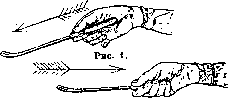
Figure 2.
or placenta is performed when withdrawing the curette from the uterus in the direction of the exit. At this time, the instrument is pressed against the corresponding wall of the uterus, which is how tissue scraping occurs. Figure 2 shows with what force the curette is withdrawn from the uterine cavity. The possibility of uterine perforation during the backward movement of the curette is usually considered unlikely. In Salting Out, one should adhere to a known system: one scraping should lie next to another. First, one wall of the uterus is scraped, for example, the anterior, then the posterior, and finally its lateral surfaces. The uterine cavity is then re-traversed with a curette of a smaller caliber; the bottom of the uterus and both horns are scraped separately. When the mucous membrane has been scraped, the movement of the curette along the muscular layer of the uterus produces a characteristic crunch, which serves as proof that the mucous membrane has been completely scraped in this place. With complete emptying of the pregnant uterus, the latter, contracting, as it were, grasps the instrument. The length of the cavity sharply decreases, and bleeding stops. Washing out the uterus, formerly often used after Salting Out, is now completely abandoned by most. Instead of it, some use smearing the uterine cavity with tincture of iodine. If the case is aseptic and the rules of asepsis were strictly observed during the operation, then this measure is also unnecessary. Some importance may be attached to disinfection of the uterine cavity after Salting Out in the case of feverish miscarriage (see Abortion). Trial curettage, from a technical standpoint, is a simpler operation than Salting Out performed for therapeutic purposes. Nevertheless, trial Salting Out also requires careful, considered, and thorough execution. Salting Out should be performed with particular caution in elderly women, in whom bleeding that appeared after many years of menopause has already lasted for a long time. In such patients, the uterine wall may already be affected by a cancerous process to a considerable depth, as a result of which perforation may occur. Perforation of the uterus is always a dangerous complication in Salting Out; here, however, in the presence of cancerous decay in the uterine cavity, often infected, and sometimes extensive adhesions with the intestine in advanced cases, uterine perforation is fraught with especially serious consequences. However, due to the fear of perforation, one cannot limit oneself to passing a curette once or twice to obtain only a small scraping from one limited area of the uterus. Beginning carcinoma may not be included in the scraping by this method, and histological examination in such cases will give an erroneous result. In case of spread of cancer to the cervix, perforation of the latter may already occur when introducing Hegar dilators. Therefore, Salting Out should be performed after slight dilation with narrow curettes. Postoperative care, if Salting Out was performed correctly, consists of washing the external genital organs and caring for the proper function of the bladder and intestines. Special measures are needed only if any complications arise. After trial Salting Out, the patient usually remains in bed for two to three days; after an abortion, this period should be somewhat extended. In case of any complication, the issue is decided depending on the nature and course of the complication.
Related articles
Mentioned in
Cite this page
“Salting Out.” Soviet Medical Encyclopedia. English translation of Bolshaya Meditsinskaya Entsiklopediya, 1st ed. (Moscow, 1928–1936), ed. N. A. Semashko. https://sovietmedicalencyclopedia.pages.dev/article/salting-out/