Bauhinian Valve
Historical document, translated for reference. It reflects medical knowledge of the 1920s–30s and is not medical advice.
Summary
The Bauhinian valve is a flap located at the junction of the small and large intestines, consisting of all layers of the intestinal wall except the serous layer. It regulates the passage of intestinal contents from the small to the large intestine and plays a role in preventing invagination.
Encyclopedia article (1928–1936)
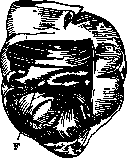
BAUHINIAN VALVE (valvula coli, valvula ileo-coecalis), a valve located at the junction of the small intestine into the large intestine. Being a duplication of the walls, this valve consists of all their layers except the serous (see Figure 1). The mucous membrane in the part facing the cavity of the cecum has the structure characteristic of the latter; from the side of the small intestine it repeats the character of the small intestinal covering. In the muscular layer, circular fibers (m. ileo-colicus) are vigorously developed, but the valve also includes to a significant extent longitudinal bundles that pass into it, according to Toldt's observations, partly from the wall of the ileum. This character of the valve's musculature eliminates its primary causal role in explaining the frequently occurring invaginations here and reduces the participation of the Bauhinian valve to a secondary phenomenon (Blauel). From the cavity of the cecum ris. 2. The cecum has been inflated and dried. It pre-sented the appearance of a window opposite the closed projections above the median surface of the two transverse lip-like folds (see Figure 2). At both ends of the valve, the closing lips continue forward and backward into ordinary transverse folds of the mucous membrane, so-called frenulum anterius et posterius. The narrow slit between the lips periodically opens and allows the contents of the small intestine to pass into the cecum. Reverse movement is prevented by the closure of the valve, which is strengthened with increased pressure from the side of the cecum (Heile). The innervation of the Bauhinian valve is connected with the n. splanchnicus and with the n. vagus. Irritation of the first (according to Elliot) leads to closure, of the second (according to Katz and Winter) to opening of the valve. According to the latest observations on animals, the action of the valve is regulated by psychic influences (Braus). Spasm and insufficiency of the Bauhinian valve are currently attributed a significant role in pathological phenomena of the cecum area and the intestinal tract.
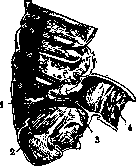
Figure 1. 1- frenulum valv. coli posterius; 2-cecum; 3- Bauhinian valve (upper and lower lip); 4- ileum (according to Braus).
spasms and insufficiency of the Bauhinian valve are currently attributed a significant role in pathological phenomena of the cecum area and the intestinal tract.
Related articles
Mentioned in
Cite this page
“Bauhinian Valve.” Soviet Medical Encyclopedia. English translation of Bolshaya Meditsinskaya Entsiklopediya, 1st ed. (Moscow, 1928–1936), ed. N. A. Semashko. https://sovietmedicalencyclopedia.pages.dev/article/bauhinian-valve/