Drawing
Historical document, translated for reference. It reflects medical knowledge of the 1920s–30s and is not medical advice.
Summary
This article examines the use of drawings as a supplementary method in psychiatry and psychology, analyzing the artwork of mentally ill patients as products of pathological creativity and as diagnostic tests. It discusses characteristic features of drawings in various mental disorders including schizophrenia, epilepsy, and manic-depressive psychosis.
Encyclopedia article (1928–1936)
Drawing. The study and analysis of D. as an auxiliary method for understanding the contents of the psychological sphere is applied by psychiatry and psychology mainly in two directions. First, in relation to the study of drawings of the mentally ill as a product of pathological creativity in general and in particular forms of psychosis; second, as tests in experimental-psychological examination of healthy and sick personality. D. of the mentally ill have only comparatively recently begun to attract the attention of researchers. First to pay proper attention to this was Wilmanns, who collected at the Heidelberg clinic a large collection of D. of the mentally ill from all German psychiatric hospitals. Subsequently this collection was developed by Prinzhorn. At the same time attempts were made to use D. for diagnostic purposes. In D. of the mentally ill elements characteristic of the creativity of primitive peoples and children are often encountered. In D. of patients we often do not see an artistic representation of painful experiences, but rather, similar to children's D., a description by signs of oppressive delusional experiences, nightmares and hallucinations. The result is a pile-up of little related to each other, at times incomprehensible images. From this point of view Prinzhorn's indications on the disorderly filling of D. with all sorts of images, their stereotypical repetition, should be evaluated, as
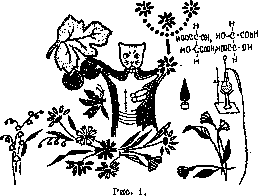
D. of patients in difficult diagnostic cases can serve as an objective criterion for differential diagnosis; they reveal the presence of delusional ideas, hallucinations, their content and character (Mohr). Aschaffenburg was able to make a diagnosis of epilepsy, paranoia based on D. In D. of schizophrenics we see a reflection of the characteristic changes in the psyche, thinking of this disease. They strike us with their incomprehensibility, often absurd accumulation of various images without visible internal connection between them, with their whimsicality, schematism, strange combination of colors (fig. 1); stereotypical repetition of the same mostly graphic image creates the impression of a special ornament. From the drawing it is sometimes possible to establish the progressive nature of the course, the disintegration of the psyche of schizophrenics. In paranoid forms, drawings as a rule preserve the integrity of the composition to a much greater extent, have a less 'torn' character (fig. 2) despite the strange, whimsical architecture and selection of colors. The less the delusional concepts of the patient are systematized, the more individual hallucinatory perceptions prevail in the picture of the psychosis, the more 'torn', absurd, incomprehensible character the drawings of patients have. In contrast to schizophrenia, D. of epileptics are distinguished by special carefulness of finishing of very meager content. The viscosity, pedantry characteristic of the epileptic psyche find abundant nourishment in the creative process. The meagerness in the construction of drawings and in the choice of the object of depiction can
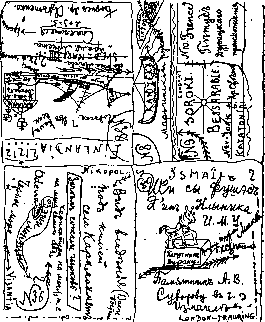
Figure 2.
give a correct idea of the degree of personality degradation. If in their drawings a schizophrenic sometimes with a broad creative stroke tries to convey in separate symbolic images entire delusional concepts, very complex, confused experiences, the epileptic gets hopelessly stuck in the careful senseless combination of forms alongside the lushness of individual ones, disproportion in proportions, strange, unusual combination of colors. The content of the drawing is given by random motives, irritations, especially bright hallucinatory perceptions. The paradoxical nature of delusional formations, their incomprehensible symbolic transmission to some degree resemble the images of primitive peoples. Along with this in the artistic production of the mentally ill one encounters very well-formed and complete works, but even in these cases it is usually possible to establish a connection between the content of the psychosis or the patient's condition and the basic mood of the D. When evaluating the work of a mentally ill artist, one should be cautious in applying psychiatric criteria; it is necessary to subject to detailed study not only the product of creativity, but also the pre-psychotic personality and the artistic trends of the era, etc., because often the manner, style of writing are determined not so much by the psychotic state of the personality being studied as by the artistic education, school. For example, in the era of flourishing symbolism, D. of the mentally ill from cultural strata of the population bore this imprint, without the closest study of both the work and the disease of the author showing anything in common with the torn, symbolic psyche of schizophrenics. Insufficient account of this circumstance can lead to an incorrect evaluation of D. from a diagnostic standpoint-Drawings in general reflect well the condition of the mentally ill and often make it possible to trace changes in the course of the disease. In some pathological states, especially in epileptic equivalents and mild manic phases of circular psychosis, an intensification of creative abilities is observed; drawings are obtained that are significantly more valuable than in the normal condition of the patient. In rare cases mentally ill, who before the illness showed no abilities for drawing, manifest great talent (e.g. Van-Gogh) and due to conditions lying outside the disease, become the head of an entire direction in painting. In other cases the beginning of mental illness gives a bright flash of talent, new stages open in the artist's creativity, until the fatal course of the disease finally destroys the personality (Vrubel). finishing of insignificant details of a meager in content drawing. The special, at times rich combination of colors in D. of schizophrenics is here replaced by one, two tones, and the favorite color of epileptics, as in their fantasies and dreams, is red. In manic-depressive psychosis, corresponding to the manic or melancholic phase of the disease, drawings both in the choice of theme and especially in colors reflect different mood backgrounds. Exaltation phases give bright, joyful drawings with cheerful, often humorous notes, caricature images of the serving personnel, patients, and often the content does not correspond to the size of the D.; the images turn out to be more outlined than fully drawn out, are unfinished, disconnected, resembling at first glance symbolic drawings of schizophrenics, but upon careful examination one can see a sequence in the writing, despite the fact that due to the influx of creative ideas the latter significantly outstrip the technical possibility of their transmission to paper, and hence the fragmentariness, incompleteness of the images. Vrubel's disease (taboparalysis), as is known, gave deep remissions. One of the next exacerbations of the disease gave a state of great manic excitement, during which the artist covered all the walls of the chamber with charcoal, and the flow of ideas was so accelerated that he did not have time to finish any image to the end; all the walls were filled with individual strokes, parts, hints at figures, which however it was not difficult to trace the course of the artist's creative thought (F. A. Usoltsev). It should be noted that in the pre-psychopathic personality of Vrubel cyclothymic components were quite clearly outlined. In melancholic periods the drawings have a corresponding pessimistic tint, the colors are monotonous, in D. there is no brightness of colors, playfulness, they are not rich in content, but well convey the gloomy mood tone and dark perception of life. It is not necessary to speak about the characteristic features of D. in organic psychoses in the proper sense of the word. Here we have to deal with a progressive weakening of creative and technical abilities as the destructive organic process increases. The drawings have an imbecilic character, are extremely meager in content, often filled with coarse, cynical images, are executed very carelessly. From this category of patients those who before the illness had a connection with the fine arts usually take up a pencil. The terrifying content of hallucinatory-delusional experiences in alcoholic deliriums gives rich material for D. (fig. 3); the latter are usually created after emerging from the acute pathological state, from fresh memory. Depending on the artistic giftedness of the patient, D. acquire greater or lesser coherence, but are always fantastic in content, horrifying and have a terrifying effect on the viewer; at the same time a critical attitude of the author and a narrative character of D. are felt, despite the fact that sometimes the entire complex of experienced nightmares is attempted to be clothed in a symbolized form. In experimental-psychological tests D. occupy a significant place. They are applied mainly for the study of intellectual functions, volume of memory, assimilation, comprehension, etc. Drawings were first introduced into experimental-psychological tests by Heilbronner, then by Binet and Simon, Stern (Binet et Simon, Stern), among Russian authors
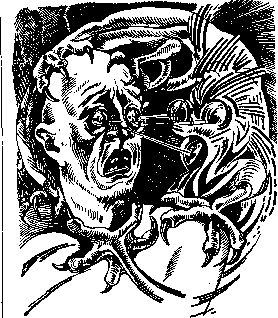
Figure 3.
by Bernstein, Rybakov, Nechaev and others. Drawing-tests are either simple images of everyday objects or depict sequential phases of some event. Further, there are D. with more or less complex content or with obvious irregularities in combination or lack of individual parts. In Binet and Simon, drawing-tests also serve to determine the aesthetic sense of children. Rybakov, and then Rorschach, used the outlines of a blot of ink, smeared on a sheet of paper folded in half, to determine the character of the fantasies of the subject.
Related articles
Cite this page
“Drawing.” Soviet Medical Encyclopedia. English translation of Bolshaya Meditsinskaya Entsiklopediya, 1st ed. (Moscow, 1928–1936), ed. N. A. Semashko. https://sovietmedicalencyclopedia.pages.dev/article/drawing/