Gentiana
Historical document, translated for reference. It reflects medical knowledge of the 1920s–30s and is not medical advice.
Summary
Gentiana is a genus of plants in the Gentianaceae family, primarily found in the mountains of Western Europe. Its roots contain bitter glycosides and are used in medicine as bitter substances to stimulate appetite.
Encyclopedia article (1928–1936)
GENTIANA, gentian, Gentiana lutea L., G. pannonica Sc, G. purpurea L., G. punctata L., family Gentianaceae; grows, predominantly, in the mountains of Western Europe (see illustration). The roots of the plant-Radix Gentianae (Fig VII), up to 60 cm long, usually are cut into long pieces of 10-15 cm, 2-4 cm thick,
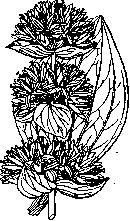
Gentiana lutea L.
on the outside reddish-brown, on the fracture yellowish-red or brown; in the tissues of the root and rhizome of G. there are drops of fat and small needles of calcium oxalate, starch is absent. Of the constituent parts, the glycosides should be noted: gentiopicrin, C16H20O9, up to 3.5%, which gives the bitter taste of gentian,-crystals melting at 191° (hydrate-122°); gentiin- C26H38O14, melting at 274°, and gentiamarin, amorphous; from sugar compounds it contains gentianose, C18H32O16, a trisaccharide, which breaks down into grape sugar and sucrose or gentiobiose and fructose; ash 5-8%. The root of G., due to its strong and purely bitter taste, is often used in medicine as a bitter substance to increase appetite in the form of Tinctura and Extractum Gentianae. It is part of bitter collections and tinctures, such as Tinct. amara, T. Aloe composita, T. Chinae comp. and others. In Switzerland, from the fresh root, due to its high sugar content, vodka is distilled.
Related articles
Cite this page
“Gentiana.” Soviet Medical Encyclopedia. English translation of Bolshaya Meditsinskaya Entsiklopediya, 1st ed. (Moscow, 1928–1936), ed. N. A. Semashko. https://sovietmedicalencyclopedia.pages.dev/article/gentiana/