Immunotherapy
Historical document, translated for reference. It reflects medical knowledge of the 1920s–30s and is not medical advice.
Summary
Immunotherapy is treatment using substances containing ready-made specific antibodies against disease pathogens or their toxic products, as well as substances that stimulate the body's own defense mechanisms or antibody production. It includes vaccinotherapy, specific serotherapy, and non-specific protein therapy.
Encyclopedia entry (1928–1936)
IMMUNOTHERAPY, treatment with substances that contain in ready form specific antibodies directed against the causative agent of a given disease or against its poisonous products (toxins), as well as those that give the body an impulse to mobilize its own protective means or to independently produce antibodies. The first group of substances includes so-called therapeutic serums, which are obtained through the systematic treatment of animals, mainly horses, with various antigens
^Ig^t-
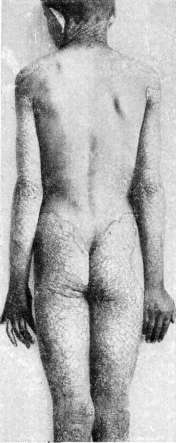
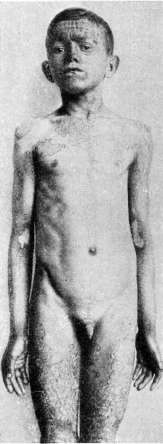
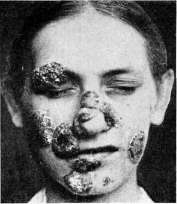
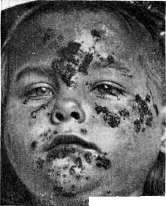
Figure 1. Jododerma tuberosum. Figure 2. Impetigo contagiosa streptogenes. Figure 3 and 4. Ichthyosis vulgaris. (From Frieboes.) (see Hyperimmunization). The second group includes vaccines and non-specific proteins. Thus, the concept of immunotherapy includes: 1) vaccinotherapy including autoserotherapy, 2) specific serotherapy, 3) non-specific protein therapy including autoserotherapy.
Related articles
Mentioned in
Cite this page
“Immunotherapy.” Soviet Medical Encyclopedia. English translation of Bolshaya Meditsinskaya Entsiklopediya, 1st ed. (Moscow, 1928–1936), ed. N. A. Semashko. https://sovietmedicalencyclopedia.pages.dev/article/immunotherapy/