Inula Helenium L
Historical document, translated for reference. It reflects medical knowledge of the 1920s–30s and is not medical advice.
Summary
Inula Helenium L is a perennial herbaceous plant of the composite family found in wild and cultivated forms across Europe, Siberia, and North America. Its medicinal applications include the use of two to three-year-old rhizomes and roots, which contain inulin, alantolactone, and other compounds with therapeutic properties.
Encyclopedia article (1928–1936)
INULA HELENIUM L A HEENIUM., s. Enula Helenium {Inula Helenium, elecampane, tall elecampane, nine-leaf elecampane, wild sunflower, bloodwort}, a perennial herbaceous plant of the composite family. In the wild state, it is found in damp places, near streams, in ditches and along riverbanks throughout middle and southern Europe, in the middle and southern part of the RSFSR, in Siberia (former Tomsk province, Altai); it is cultivated in Western Europe, Japan and North America. The medicinal application is for the two to three-year-old rhizomes and roots of the plant, which are sold in the form of hard, irregularly shaped pieces of horn-like consistency, with a characteristic aromatic smell, spicy, slightly bitter taste. Rhizoma el, |
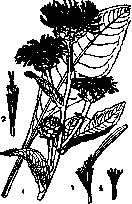
1-basal leaf, flowering top; 2 tubular flower; 3 ligulate flower; 4 fruit.
containing: up to 44% inulin (C6H10O5)x - a carbohydrate that replaces starch in many composite plants; alantol C10H16O - a liquid boiling at about 200°; alantolactone, anhydride of alantolic acid, C14H20O2, melting point xCO 75°; alantol camphor - helenin, first isolated by Dumas; opinions regarding the composition and properties of helenin differ: some authors attribute to it the formula (C9H8O)x and melting point 110°, others consider it to be the anhydride of isoalantolic acid, melting point 115°; a third group considers it to be the anhydride of alantolic acid; according to Schmidt and Thorns (Schmidt, Thorns), commercial helenin represents alantolactin. Alantol and alantol camphor, which have antiseptic properties, are prescribed 0.1 to 10 times a day. The root of elecampane, an old folk remedy, is included in some 'chest' collections; decoctions from 5.0-15.0 in 200.0 are prescribed as an expectorant and for washing in scabies and ringworm; unofficial Extractum and Tinctura Helenii are also prescribed as expectorants. Due to its high inulin content and absence of starch, elecampane root was proposed for making bread for diabetics.
L. Medvedayev.
Related articles
Cite this page
“Inula Helenium L.” Soviet Medical Encyclopedia. English translation of Bolshaya Meditsinskaya Entsiklopediya, 1st ed. (Moscow, 1928–1936), ed. N. A. Semashko. https://sovietmedicalencyclopedia.pages.dev/article/inula-helenium-l/