Iris Root
Historical document, translated for reference. It reflects medical knowledge of the 1920s–30s and is not medical advice.
Summary
Iris root is the rhizome of various iris species, used historically in medicine, dentistry, and perfumery. It contains essential oils, starch, and iridin glycoside, with primary applications in the perfume industry.
Encyclopedia article (1928–1936)
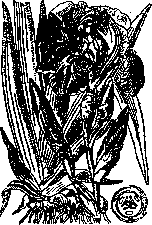
IRIS ROOT, Rhizoma (or Radix) Iridis florentinae, the rhizome of iris (Iris). Plants producing it: Iris florentina L. (Florentine iris), Iris pallida L. (pale iris), Iris germanica L. (German iris), perennial herbaceous plants of the iris family (Iridaceae). Cultivated for decorative purposes (for flowers), for medical purposes, and for the perfume industry. The rhizome is perennial, yellowish, horizontal, thick, fleshy with constrictions, up to 10 cm long. The odor is delicate, aromatic. The taste is first sweetish-mucilaginous, then bitterish. In the USSR, it is cultivated in Crimea. The rhizomes are collected in autumn. Drying lasts 7-8 days, during which the aroma develops. I. R. is stored in well-sealed vessels. The root of the wild pansy (Viola tricolor) is not used for medical purposes. The dried rhizome of I. R. contains up to 17% starch, mucilage, insignificant amounts of tannin and resinous substances and wax, from 3% to 5% ash, from 0.1% to 0.8% essential oil, which gives the pleasant odor to the rhizome, the glycoside iridin, CjjHjjO,,, white, needle-shaped crystals that turn yellow in the air, melting at 208° and decomposing from the action of dilute acids into irigenin, C8H16O8, and dextrose.
The main constituent part of I. R. is the essential oil, formerly called iris root camphor. It is a solid yellowish substance of acid reaction, melting at 44-50°. This oil consists of steareoptene-odorless (80-90% myristic acid and other fatty acids) and very aromatic eleoptene (10-15%; ketone, iron, C13H21O, trimethyl-tetrahydrocinnamyl-methylketone). I. R. turned (R. Iridis tornatum) was used for the mechanical promotion of teething in children (this application should be condemned from a hygienic point of view). Sometimes I. R. is used as an admixture to tea. Its powder is used for dusting pills and as an admixture to tooth powders. It is an ingredient of the chest mixture (Species pectorales; I VII). Its main application, however, is in perfumery, e. shae.
I. R. turned (R. Iridis tornatum) was used for the mechanical promotion of teething in children (this application should be condemned from a hygienic point of view). Sometimes I. R. is used as an admixture to tea. Its powder is used for dusting pills and as an admixture to tooth powders. It is an ingredient of the chest mixture (Species pectorales; I VII). Its main application, however, is in perfumery, e. shae.
Related articles
Mentioned in
Cite this page
“Iris Root.” Soviet Medical Encyclopedia. English translation of Bolshaya Meditsinskaya Entsiklopediya, 1st ed. (Moscow, 1928–1936), ed. N. A. Semashko. https://sovietmedicalencyclopedia.pages.dev/article/iris-root/