Lavender Oil
Historical document, translated for reference. It reflects medical knowledge of the 1920s–30s and is not medical advice.
Summary
This article from the 1928–1936 Soviet Great Medical Encyclopedia details the properties, chemical composition, and medical uses of lavender oil, produced from various species of lavender.
Encyclopedia article (1928–1936)
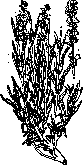
LAVENDER OIL (FUI), Oleum Lavandulae, is obtained from the flowers of lavender (Lavandula vera D. C., Lavand. officin. Chaix, Lav. spica var. a L. and Lavand. angustifolia Moench, family Labiatae-Lavandulaceae), a semi-shrub less than 1 m in height covering large areas in the southern Alps of France. The named species of lavender grow at an altitude of 700–800 meters and are called "Lavande veritable" and "Lavande femelle". The best French lavender oil, which should be used in medicine, is almost colorless or with a green or yellowish tint, has a very pleasant odor, a slightly bitter taste; specific gravity at 15° is from 0.882 to 0.900; it rotates to the left from -3° to -10°; it dissolves in 2–3 volumes of 70° alcohol, sometimes becoming opalescent. The composition of lavender oil consists mainly of linalool (10H17OH) and its acetic ether (not less than 30%); both substances have a very pleasant soft odor. In addition, there are many other substances in small quantities, such as: 1-cineole, cariophyllene, geraniol, borneol, furfural, coumarin, etc. The value of lavender oil is determined by the percentage content of linalool acetic ether. According to new data, lavender oil from Lavandula vera contains from 30% to 60% of this ether. In lavender oil, ethers of linalool with fatty, valerianic, and caproic acids are also found, but all of them are usually converted to the acetic ether during the examination of the oil. English lavender oil, obtained from cultivated lavender, has a somewhat different odor—a camphoraceous tint depending on the presence of fairly large amounts of cineole; it contains fewer ethers than French lavender oil (often 5–10%); its price is higher; it is used only in perfumery. Spanish lavender oil, mainly from Lavandula spica var. a L., differs by the presence of camphor, high specific gravity, and a small right rotation; it is considered the worst grade. According to FUI, lavender oil is part of the tincture of lavender and as such is in Fowler's arsenic solution and in the alcoholic solution of potash soap (Spir. saponis kalini Hebrae), to which it is added as a fragrant oil. It is also applied as an aromatic corrigens in ointments, rubefacients, etc. It is widely applied and valued in cosmetics.

The article continues with a description of its applications and value in cosmetics.
The article continues with a description of its applications and value in cosmetics.
Related articles
Mentioned in
Cite this page
“Lavender Oil.” Soviet Medical Encyclopedia. English translation of Bolshaya Meditsinskaya Entsiklopediya, 1st ed. (Moscow, 1928–1936), ed. N. A. Semashko. https://sovietmedicalencyclopedia.pages.dev/article/lavender-oil/