Rose
Historical document, translated for reference. It reflects medical knowledge of the 1920s–30s and is not medical advice.
Summary
This article covers the rose plant, its historical medical use, and the wind rose, a graphical representation of wind direction and frequency.
Encyclopedia article (1928–1936)
ROSA, a very widespread wild and cultivated shrub of the Rosaceae family. Of the numerous species (Rosa gallica, damascena, centifolia, etc.), only the French rose was previously considered official, the dried petals of which were used in mixtures as a mild astringent. From them, rose honey, rose ointment, and rose water were also prepared. The Great Soviet Encyclopedia (FSE) included only rose oil and rose water, made from the oil; rose water is rarely prescribed in eye and cosmetic lotions. Both rose petals and preparations from them are not used in medicine at present, but the industrial importance of various rose species (in perfumery) is very great.
Rose.
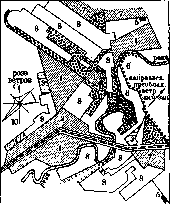
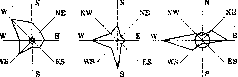
ROSE WIND ROSE, a graphical representation of the recurrence of winds in relation to the 8 main directions of the cardinal points for a given place or locality. The direction of the wind refers to the cardinal point from which the wind blows. The direction of the wind has significant hygienic importance when choosing a location for entire populated settlements as well as for the placement of individual streets, quarters, and the construction of individual buildings within them (smoke and harmful gases from industrial areas, natural ventilation of streets and individual buildings, loss of heat by buildings, etc.). Figure 1 shows a city planning scheme of Grozny, the location of industrial and residential quarters in it, and the direction of prevailing winds (see Planning). (To protect residential quarters from the harmful influence of nearby industrial enterprises, the latter are partly electrified, and part of the industrial quarters is separated from the residential ones by a protective zone of green plantings.) At meteorological stations, observations on air movement are regularly carried out, noting the direction, speed, and force of the wind. Instruments for this are the Wild anemometer (direction and force of the wind) and the Robinson cup anemometer (speed of the wind). The results of observations are summarized in tables and from them rose wind roses are compiled for a given place or locality for certain periods of time: monthly, quarterly, average annual, and average for several years. For this, 8 main directions or rhumbs are drawn through a point assigned to the given place (N-north, NE-northeast, E-east, SE-southeast, S-south, SW-southwest, W-west, and NW-northwest) and on them, in a certain scale, absolute or more often percentage values of the recurrence of winds in that direction are plotted. Sometimes data of observations relating to intermediate rhumbs (NNE, NEE, etc.) are marked in the tables. When compiling a rose wind rose, they should be divided in half and assigned in parts to one or another adjacent main rhumb. The absence of air movement—calm air—is also marked in the tables, and on the rose wind rose it is indicated in the form of a circle, the radius of which is proportional (in the same scale) to the absolute or percentage value—the number of calms for a certain period of time. Tables and graphs are also compiled for wind speeds. As illustrations, tables 1-3 and figures 2-4 are given—the numerical and graphical expression of the recurrence of winds in Moscow in August 1915, in the city of Yarkov, and in Munich (average data for 38 years in %).
SCHEME OF PLANNING OF THE CITY ^1industrial areas |2 food warehouses YMA^ state farms J]4oil depots
Figure 1. absence of air movement—calm air is also marked in the tables, and on the rose wind rose it is indicated in the form of a circle, the radius of which is proportional (in the same scale) to the absolute or percentage value—the number of calms for a certain period of time. So are compiled tables and graphs for wind speeds. As illustrations, tables 1-3 and figures 2-4 are given—the numerical and graphical expression of the recurrence of winds in Moscow in August 1915, in the city of Yarkov, and in Munich (average data for 38 years in %).
ROZANOV Vladimir Nikolaevich, a known surgeon (born in 1872). Rozanov graduated from Moscow University in 1896. Until 1910 he worked at the Old Ekaterininsky Hospital, teaching there at the paramedic courses. During the Russo-Japanese War he was the senior surgeon and commissioner of the 1st Moscow sanitary detachment. Since 1910 he has been in charge of the surgical department of the Botkin Hospital (formerly Soldatenkov Hospital). During this period he is elected a lecturer at the Shanyavsky People's University. During the imperialist war Table 1. Recurrence and speed of wind in August 1915 in Moscow (on 16 rhumbs) (according to the Monthly Statistical Bulletin for Moscow, No. 8, 1915).
Figure 2.
Figure 3.
Figure 4.
Figure 2. Recurrence of winds in August 1915 in Moscow (in %). Figure 3. The same in the city of Yarkov. Figure 4. The same in Munich (average data for 38 years in %). absence of air movement—calm air is also marked in the tables, and on the rose wind rose it is indicated in the form of a circle, the radius of which is proportional (in the same scale) to the absolute or percentage value—the number of calms for a certain period of time. So are compiled tables and graphs for wind speeds. As illustrations, tables 1-3 and figures 2-4 are given—the numerical and graphical expression of the recurrence of winds in Moscow in August 1915, in the city of Yarkov, and in Munich (average data for 38 years in %). Table 2. Recurrence and speed of wind in August 1915 (on 8 main rhumbs) in Moscow (in absolute and percentage values). Winds Calm Number of winds .... 13.5 9.5 5.5 13.5 9.5 22.5 The same in % . 2.2 14.5 9.7 10.2 8.6 5.9 14.5 10.2 24.2 Average speed . . - 4.1 5.25 6.05 4.6 4.7 5.4 5.75 6.15 The same in % . - 9.9 12.6 14.6 11.1 11.3 13.0 12.7 14.8 Table 3. Recurrence of winds in Munich for 38 years (1843-1880) in % (according to Renk Fr., Die Luft, from Handbuch der Hygiene M, Renke-Fegert u. Ziemssen). Winds Calm N w Average recurrence in % 6.54 3.28 11.42 21.08 4.0 1.78 11.2 33.1 7.64 recurrence of winds in Moscow in August 1915, in Yarkov, and in Munich (average for 38 years).

Related articles
Mentioned in
Cite this page
“Rose.” Soviet Medical Encyclopedia. English translation of Bolshaya Meditsinskaya Entsiklopediya, 1st ed. (Moscow, 1928–1936), ed. N. A. Semashko. https://sovietmedicalencyclopedia.pages.dev/article/rose/