Lycopodium
Historical document, translated for reference. It reflects medical knowledge of the 1920s–30s and is not medical advice.
Summary
Lycopodium refers to the spores of the clubmoss plant, historically used as a dusting powder for wounds and in pharmaceutical applications. This article details its physical properties, chemical composition, common adulterants, and various medicinal and industrial uses in the early 20th century.
Encyclopedia article (1928–1936)
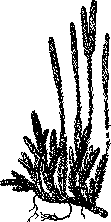
LYCOPODIUM, Lycopodium (Pharmacopoeia), the spores of the clubmoss Lycopodium clavatum, which is a herbaceous creeping plant (family Lycopodiaceae) that branches in a forked manner. Origin: Europe, Siberia, America, Australia, and South Africa. The beginning of the use of clubmoss spores as a dusting powder for wounds and ulcers dates back to the 17th century (in Germany). The commercial product consists of dry, mature spores—a very fine, light-yellow powder without taste or smell. Lycopodium is collected in the RSFSR, predominantly in the Vladimir, Tver, and Novgorod districts. The spores have thin, convex ridges on their surface that form a kind of network, the loops of which are filled with air—one of the reasons for their non-wettability by cold water; this is why, despite a specific gravity of 1.062, they do not sink in water, but when shaken with water, they gather into spherical masses floating on the water.
If the spores are pre-moistened with alcohol, ether, or boiled with water, Lycopodium sinks. When sprinkled onto a flame, Lycopodium flashes strongly and produces a large flame (artificial lightning in theaters). Under a microscope, Lycopodium spores have the appearance of a triangular pyramid with a hemispherical base. The diameter of the spores is about 30 microns. Composition: fatty oil (up to 50%) belongs to the non-drying oils (it solidifies below -22°); the specific gravity of the oil at 18° is 0.925; it consists of triglycerides of lycopodo-oleic, palmitic, stearic, arachidic, and myristic acids and contains a special lycopodium acid C18H36O4 (about 2%), isomeric with distearic acid. Furthermore, Lycopodium contains phytosterin (0.3%), sugar (2-3%), and a volatile alkaloid discovered by Flückiger, lycopodine C32H52O3N2 (which has been called into question). The ash content in Lycopodium is up to 3%. Impurities encountered in Lycopodium—spores of L. annotinum and L. complanatum—almost constantly replace L. clavatum in Sweden and Norway; this is observed less frequently in Switzerland and Germany. In the USSR, pine pollen is mixed into Lycopodium. In Western Europe, hazel pollen (Corylus avellana L.) and cattail pollen (Typha latifolia and T. angustifolia) are mixed in. Additionally, coarse adulterants are encountered, such as starch, sulfur, rosin, heavy spar, gypsum, chalk, and even sand, talc, etc. All these impurities are detected by microscopic examination. Many of the impurities are separated from Lycopodium by shaking with chloroform, in which Lycopodium does not sink. In medicine, Lycopodium is used as a dusting powder, especially often in pediatric practice; in the form of an ointment (with 5-10 parts fat); and also when dispensing pills, as a coating to prevent the pills from sticking to each other. Lycopodium was also given internally in the form of a paste with honey as a diuretic. Among the species of Lycopodium used in folk medicine, the following can be mentioned: Lycopodium complanatum; L. cernuum, used for dysentery and gout; L. alpinum, used against canine rabies; L. phlegmaria (Portugal)—an emmenagogue, among the Indians—an aphrodisiac; L. nidiforme (Mexico)—for pneumonia; L. polytrichoides (Sandwich Islands)—a laxative and tonic; L. saururus (Argentina)—a drastic purgative, contains the alkaloid piligramine; L. rubrum—for elephantiasis; L. selago—possessing drastic properties, represents a poison for some animals, and is also used as an emmenagogue. In industry, Lycopodium is used in foundry work as a powder for molds when casting molten metals; now, in Germany, it has been replaced for this purpose by limestone powder.
In the USSR, Lycopodium is among the important export goods.
Related articles
Mentioned in
Cite this page
“Lycopodium.” Soviet Medical Encyclopedia. English translation of Bolshaya Meditsinskaya Entsiklopediya, 1st ed. (Moscow, 1928–1936), ed. N. A. Semashko. https://sovietmedicalencyclopedia.pages.dev/article/lycopodium/