Productivity
Historical document, translated for reference. It reflects medical knowledge of the 1920s–30s and is not medical advice.
Summary
This article discusses productivity in the context of labor and industrial planning, focusing on measurement techniques and tools like planimeters for calculating areas of cross-sections in anthropometry.
Encyclopedia article (1928–1936)
PRODUCTIVITY, labor productivity
Productivity of labor in the struggle for the fulfillment of the five-year plan. Fig. 19. Fig. 20. Fig. 14-16. Sanitary-educational illustrated slogans. The first of them (Fig. 11) is an example of a purely mechanical combination of text with a drawing, having no relation to it and being politically completely alien. Only two of the targeted slogans (Figs. 15 and 17) are relevant in content and politically sharp. Fig. 19 and 20 are cartoons on sanitary themes ('Quacks', 'Nurseries'). Fig. 16. Fig. 17. BE HEALTHY! HOW TO RAISE A CHILD!
RL V,
if you want to be healthy
Fig. 21. Fig. 21.
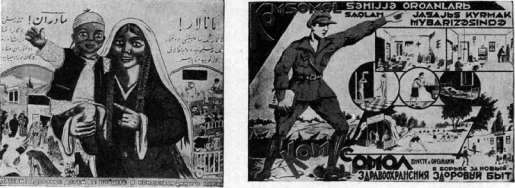
Fig. 24. Fig. 21-24. Sanitary-educational posters of national minorities.
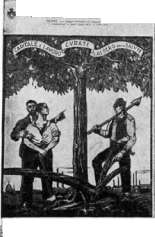
THE BOURGEOISIE AND THE CAPITALISTS ARE TRYING TO FOOL YOU WITH THEIR LIES ABOUT PEACE AND CONCORD IN THE FACTORIES, BUT THE REALITY IS THAT THEY EXPLOIT THE WORKERS. DEI DATORI DEL LAVORO E DEI LAVORATORI. PER OF THE LE HUQVE GEHERAZIOHN DALLE MA, EC CAU IHFOR LVlTAUILr ЧТО DEI DATORI DEL LAVORO E DEI LAVORATORI. t TO RE LA PACE TRA CLASSE DOPO LA REVOLUZIONE PROLETARIA FIG. 25. MENU WITH THE ALCOHOLIC BEVERAGES A QUAND LA GREVE ? Ho no wine or beer or any other alcoholic beverage except once a week of fruit wine may be given Drinking alcohol is harmful to health and work ability Fig. 26. Fig. 27.
if there are rules of the game, full truth is more than once a week of fruit may be given. Drinking alcohol is harmful to health and work ability
alcohol is harmful to health and work ability
if you want to be healthy
no coffee or tea
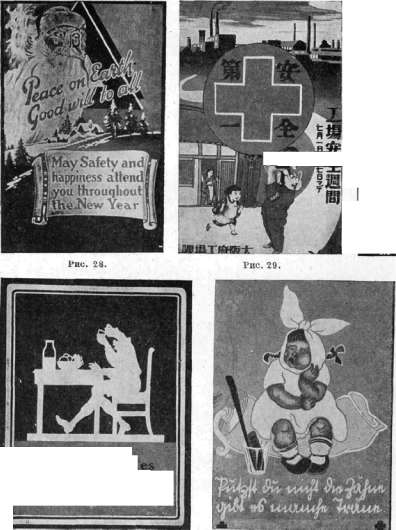
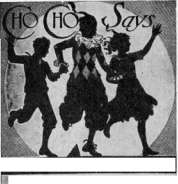
Milk, vegetables, fruits help build strong bodies Fig. 30. Fig.25-32. Examples of foreign posters. In some - undisguised bourgeois class ideology, propaganda of class peace ['Capital and Labor care for health!' (Fig. 25), 'St. Peter' (Fig. 27), 'Peace on earth' (Fig. 28)], in others - detachment from the real living conditions of the broad working masses ['Milk, vegetables and fruits' (Fig. 26)] and so on. Fig. 31. Fig. 32. /N-
millimeter squares, completely included in the area of the figure being measured; to them are added the number of all those squares, the larger part of the area of which (by eye) belongs to the figure being measured; those squares that are occupied by less than half are not counted. For not too small areas of the figures being measured, this method gives quite satisfactory results in terms of accuracy. A more convenient and precise method consists of placing over the figure being measured a grid of equally spaced parallel lines (Fig. 1), the lengths of which from edge to edge of the figure are measured with a compass, or, which amounts to the same thing, by drawing on the drawing itself a series of equally spaced ordinates followed by their measurement. If the lengths of all these ordinates from the first to the last are denoted by Y0, Y1, Y2,..> Yn, then the area P will be expressed with very good accuracy by Simpson's formula:
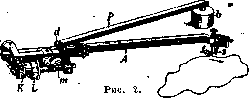
Fig. 1. P = -Y,+ Yn-1 + 4Y1 + 2Y2 + 2Y3 +...+yn-1+y0 + Yn]. where h is the distance between adjacent ordinates or grid lines. 2) The mechanical method of measuring areas is carried out with the help of planimeters. The most common type of planimeter is the polar Amsler planimeter. Its theory is quite complex and cannot be explained here, but the technique of working with it is as follows: the polar planimeter consists of two arms connected by a hinge: the pole arm P and the tracing arm A (Fig. 2).
In a more perfect, so-called compensating model (shown in Fig. 2), the hinge is replaced by a detachable spherical joint B. The pole arm P has at its free end a needle, loaded with a weight b, and is stuck immovably somewhere in the plane of the figure being measured. The tracing arm A also has at its free end a needle f, provided with a handle s. On the other side of the hinge to the tracing arm is attached a wheel with a rim L, divided along the circumference into 100 parts. For greater accuracy of readings, a vernier K is attached to it. The number of full turns of wheel L is counted by disk m. To measure the area of a figure, the pole needle b is stuck somewhere on the contour of the figure, at an arbitrarily chosen point, the needle f of the tracing arm is placed somewhere on the contour of the figure, and the readings of counters L and m are recorded. Then the needle f is carefully traced around the entire contour of the figure in the clockwise direction (necessarily along a closed curve!) and returned back to the starting point. During this operation, wheel L rolls over the plane of the drawing; it is necessary to arrange the drawing and the pole needle b so that the wheel can roll smoothly on the paper all the time, without sliding off it. Upon completion
of the full tracing, the readings of the counters are read again. The difference between the second and first readings gives a measure of the area of the figure in the scale indicated in the planimeter's passport. If such a passport is not available, the scale can be determined as follows. Take a ruler (usually supplied with each planimeter), which has at one end a short needle, and at the other a very small depression, located exactly 2, 4 or 6 cm from the needle. Stick the ruler's needle into the drawing board, and place the planimeter's needle f into the depression, after which it is traced 10 times around the stationary needle of the latter, thus describing 10 perfect circles with a radius of 2, 4 or 6 cm. The area
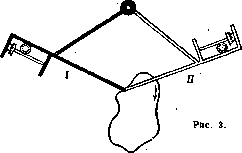
of such a circle is equal to π, 16π or 36π: cm2; if the reading on the planimeter after 10 tracings shows N counter divisions, then N = =10 π cm2 (or 10·16π, or 10·36π), and therefore one counter division equals π cm2 /10 (or 16π/10, or 36π/10). One can (although this gives less accuracy) trace with the planimeter a square with a side of 10 cm (by hand, and not with a ruler, the latter will be less accurate!); if the difference of readings is M, then one division equals M/100 cm2. Planimeters are often equipped with movable tracing arms, allowing the distance R to be changed. The scale of the planimeter changes proportionally to this distance: if R is halved, then each division will express half the area: the planimeter will become twice as sensitive. If the length of R is denoted by R, the radius of the rolling rim of wheel L by r, then the area of the figure being measured P and the counter reading U are related by the equation P = 2πr · R and For greater accuracy it is recommended a) to trace the figure several times and take the arithmetic mean of all results, b) not to set the counter to zero and not to touch it at all during work, but to read the initial and final readings, c) when working with a compensating planimeter to make traversals without changing the position of the pole, first with one, then with the other arrangement of the tracing arm as in Fig. 3, and take the averages of both types of readings. The best polar planimeters are manufactured in Switzerland by Coradi (Coradi; Zurich), in Germany by Ott (Ott; Kempten). The polar planimeter of the described design is suitable only for measur
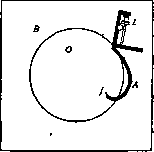
Fig. 4. for 2 8 ing areas from drawings; it cannot measure the cross-sectional area of any body without sawing it in half. In view of the fact that measuring cross-sectional areas is of great interest for anthropometry (for example, the cross-sectional area of the chest, skull, pelvis, muscle masses, etc.), Ott is currently manufacturing according to Bernstein's design a modification of the polar planimeter, designed specifically for such measurements. Such a planimeter consists of a board B (Fig. 4) with a round hole O, around the rim of which rolls the curved tracing arm A, which has a point f at its end. The part of the body being examined is inserted into the hole of the board and fixed; the point f is traced around this part of the body, and then the reading of wheel L gives a measure of the cross-sectional area according to the formula where D is the distance from point f to the plane of the rim of wheel L.

Related articles
Cite this page
“Productivity.” Soviet Medical Encyclopedia. English translation of Bolshaya Meditsinskaya Entsiklopediya, 1st ed. (Moscow, 1928–1936), ed. N. A. Semashko. https://sovietmedicalencyclopedia.pages.dev/article/productivity/