Pump Room
Historical document, translated for reference. It reflects medical knowledge of the 1920s–30s and is not medical advice.
Summary
This article describes the function and construction of a pump room (buvette) at mineral water springs. It details historical examples of spring capturing and water distribution systems in Russian health resorts during the early 20th century.
Encyclopedia article (1928–1936)
PUMP ROOM (from the French buvette—a place for drinking), a special structure serving as a place for dispensing mineral water. A pump room is usually an integral part of another, more complex structure that completes the equipment for the outlet of a mineral spring to the earth's surface. Such a structure as a whole, including the pump room, is called the catchment (see) of the spring. A pump room, usually located in a well-visited area of a resort, is given, if possible, an artistic treatment of its
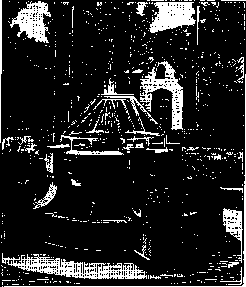
Figure 2. Temporary pump room for dolomite Narzan.
forms. In the conditions of Russian health resorts, the capturing of spring outlets and the construction of a pump room over them was, until recently, to a significant degree primitive. Thus, the catchment of the Smirnovsky spring in Zheleznovodsk as late as 1912 consisted only of a borehole with a diameter of 165.1 cm and a depth of 14.5 m. The upper part of the borehole was secured with a riveted iron 280-centimeter pipe, around which a collection well with concrete walls was built, from which water flowed through pipes to bath buildings and to the bottling plant; from here, it was also scooped up with glasses for patients. At the present time, the same spring is captured by a borehole, with a special water-dispensing device—a pump room—constructed over it. The catchment of Narzan in Kislovodsk (see Figure 4) consists of a well A with a depth of 7.25 m and a diameter of 4.26 m. The well is secured with stone walls KK and serves as a receiving basin for the mineral water gushing from its bottom. From this basin, water is conducted through a whole series of pipes to the water-dispensing taps of the pump room VV, to the baths, the bottling plant, and the gas factory. EE are barriers for fencing off the approaches to the water-dispensing taps. The stone walls of the well have at their base a layer of coquina, located at a depth of about 7 m. To eliminate the leakage of Narzan, which had reached threatening proportions in 1908, a special device was installed, consisting of a series of piles GG and a clay bulkhead, thanks to which the mineral water emerging at the bottom of the well now enters it entirely, finding no other outlet. An example of later capturing and pump room construction can be seen in the bringing to the earth's surface of the Ogilvy dolomite Narzan in Kislovodsk (opened in 1926; see Figure 1). Here, F is a deep borehole bringing mineral water from the dolomites, and B is a pipe conducting this water to the pump room. A-B-C-H are parts of the pump room, executed in the form of an Etruscan vase; G-G are water-dispensing taps, to which water is supplied from pipe B by its branches E-E. The inner part of the pump room A is hollow to allow for easy observation of the installation of pipes B-E. The hollow part of the pump room is covered by a lid B, from which excess water, arriving during the gushing of the jet, flows down through pipe C into the discharge pipe K. Z is the shaft of the well at the head of the borehole, constructed for convenient observation of the pipes.
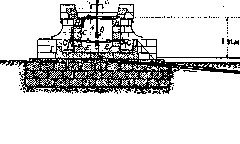
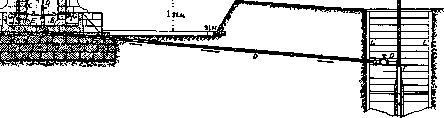
Figure 1. Temporary catchment of the Ogilvy dolomite Narzan in Kislovodsk. F and B. The temporary pump room for dolomite Narzan is shown in Fig. 2. Figure 3 shows the pump room of the Essentuki spring No. 20. Pump room structures, especially at foreign resorts, often have interesting and stylish architectural designs and complex devices that facilitate the dispensing of water with the least

Figure 3. Pump room of the Essentuki spring No. 20.
losses. Special devices are also used that make it possible to heat the mineral water flowing from the spring to a temperature most suitable for medical purposes. The material of the pipes conducting water to the pump room must be such that the influence on it of the mineral components of the mineral water is minimal. For this purpose, the pipes can be made of iron, galvanized iron, copper, various alloys, etc.
Related articles
Mentioned in
Cite this page
“Pump Room.” Soviet Medical Encyclopedia. English translation of Bolshaya Meditsinskaya Entsiklopediya, 1st ed. (Moscow, 1928–1936), ed. N. A. Semashko. https://sovietmedicalencyclopedia.pages.dev/article/pump-room/