Water Pepper
Historical document, translated for reference. It reflects medical knowledge of the 1920s–30s and is not medical advice.
Summary
Water Pepper is a herbaceous plant found throughout the USSR and Western Europe in damp areas. It contains tannic acid and an acrid principle used in medicine as a hemostatic agent for various types of bleeding.
Encyclopedia entry (1928–1936)
Water Pepper, Polygonum hydropiper L., family of buckwheat (Polygonaceae), herbaceous plant growing everywhere in the USSR and Western Europe in damp places, on humus soil, in meadows and forest clearings. Height 36-60 cm. Stems with nodes. Leaves simple, alternate, elongated-lanceolate in shape. Inflorescence narrow, thin, interrupted. Flowers small whitish-pink.
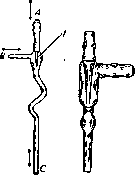
Figure 1.
Figure 2. Water pump Geissler.
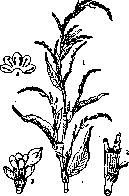
Polygonum hydropiper L.: 1-flowering plant; 2-tube; 3-tube with flower and buds; 4-expanded corolla.
on viscosity or on Constituent parts: tannic acid (up to 3.5%), as well as some sharp, burning principle contained in the fresh plant (hence the name "water pepper"), disappearing upon drying. Used in medicine as a hemostatic agent in the form of Extract. fluid. Polygoni hydropiperis (VII), 3 times a day, 30-40 drops per dose, for haemoptoe, bleeding from the bladder, gastric bleeding, hemorrhoidal, menorrhagias and fibromas of the uterus. This preparation does not cause vasoconstriction. It is assumed that the preparation acts on blood coagulation.
Related articles
Mentioned in
Cite this page
“Water Pepper.” Soviet Medical Encyclopedia. English translation of Bolshaya Meditsinskaya Entsiklopediya, 1st ed. (Moscow, 1928–1936), ed. N. A. Semashko. https://sovietmedicalencyclopedia.pages.dev/article/water-pepper/