Agenesia of the Central Nervous System
Historical document, translated for reference. It reflects medical knowledge of the 1920s–30s and is not medical advice.
Summary
This article from the 1928-1936 Soviet Great Medical Encyclopedia discusses the congenital complete or partial underdevelopment of various organs within the central nervous system. It details the histological findings and symptoms associated with agenesis of the cerebral cortex, corpus callosum, cerebellum, and spinal cord, as well as potential links to endocrine dysfunction.
Encyclopedia article (1928–1936)
AGENESIA OF THE CENTRAL NERVOUS SYSTEM are characterized by congenital, complete, or partial underdevelopment of one or another organ of this system. Agenesias are encountered in the cerebral cortex; agenesis of the great commissure of the brain (corpus callosum), the cerebellum, etc., has also been described. In agenesis of the cerebral cortex, the cortical layer appears thin; the cortex is poor in ganglion cells; the latter
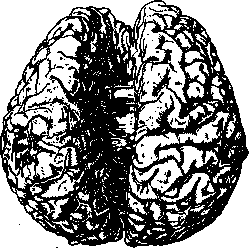
Agenesis of the corpus callosum (after Mingazzini).
resemble embryonic neuroblasts in appearance; normal differentiation of cortical cells is absent, making the laminar structure of the cortex unnoticeable; an predominance of the polymorphic layer is frequently noticeable. Ganglion cells are poor in protoplasmic processes; the nucleus is rich in chromatin; there is little tigroid substance. Neuroglia appears normal or relatively hypertrophied. Cortical myelin fibers are few; they are thin and poor in myelin; association fibers are predominantly affected, especially the tangential system, and to a lesser degree the super-radial and interradial fibers; projection systems appear better developed. Cortical agenesias are a common finding in the study of the brains of patients with congenital feeblemindedness. Aside from cortical agenesias with their various localizations, agenesias of commissural systems are also encountered; among these, agenesis of the corpus callosum deserves special attention, which occurs both completely and partially; in the latter case, sometimes only the knee or thickening can be met; in complete agenesis, the striae Lancisii are also absent; the taeniae tectae are sometimes preserved (see figure). In complete agenesis of the corpus callosum, mental disorders are observed; according to Mingazzini, out of 56 cases of agenesis of the corpus callosum (with complete agenesis in 40 cases), mental disorder was present in 38 cases (most frequently idiocy). Agenesis of the anterior commissure, septum pellucidum, optic chiasm, optic tract, pineal gland, etc., has been described. In the brainstem part, agenesis of the nuclei of the abducens, facial, and hypoglossal nerves has been described. Agenesis of the cerebellum is most often partial; complete agenesis, according to Thomas, is extremely rare. In cases of complete agenesis of the cerebellum, it is nevertheless possible to find parts of the vermis and flocculus; the remaining mass of the cerebellum is replaced by a thickened pia mater; in partial agenesis of the cerebellum, when one of its hemispheres is underdeveloped, the pia mater is also thickened; upon examination of the underdeveloped hemisphere, the absence of the cortical layer can be established while the fastigial and dentate nuclei are preserved; sometimes on the side of the underdeveloped hemisphere the vascular plexus of the fourth ventricle is absent (Brun, Edinger). Symptoms of cerebellar agenesis are usually detected already in early infancy, when the child begins to walk; he falls frequently, tremor of the hands, clumsiness of movements, articulation disorder, and slowness of speech are observed. In partial agenesis of the spinal cord, mostly dependent on delayed development of the cerebrum and cerebellum, the spinal cord appears reduced in its transverse dimensions; on the dorsal side of the lateral columns, a deeply cutting furrow is encountered; the amount of gray matter of the anterior horns is reduced; from the side of the pathways, underdevelopment of the cerebro- and cerebellospinal tracts is noted. The pathogenesis of various agenesias is not fully elucidated. During autopsies of patients with agenesis of the central nervous system, pathomorphological changes in the glands of internal secretion, e.g., the adrenal glands, thymus, thyroid, and pituitary gland, have been found many times; many researchers place the existence of agenesis in a causal relationship with the dysfunction of endocrine glands.
Related articles
Mentioned in
Cite this page
“Agenesia of the Central Nervous System.” Soviet Medical Encyclopedia. English translation of Bolshaya Meditsinskaya Entsiklopediya, 1st ed. (Moscow, 1928–1936), ed. N. A. Semashko. https://sovietmedicalencyclopedia.pages.dev/article/agenesia-of-the-central-nervous-system/