Alveolotomy
Historical document, translated for reference. It reflects medical knowledge of the 1920s–30s and is not medical advice.
Summary
This article from the 1930s Soviet medical encyclopedia describes alveolotomy, a surgical procedure for opening the tooth socket. It details the method for treating chronic inflammation of the periosteum and removing broken root fragments.
Encyclopedia article (1928–1936)
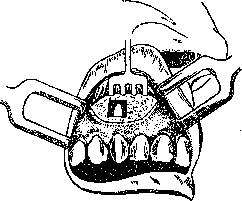
Alveolotomy, the opening of a tooth socket (alveolus). Alveolotomy is most often performed for chronic granulating inflammation of the periosteum of the root (see Resection) and for removing broken root fragments that have become stuck during extraction. The operation is performed under local anesthesia. The outer wall of the socket (alveolus) is exposed by a flap incision (arcuate, trapezoidal, etc.), which is carried out immediately to the bone, after which a periosteal dissector separates the mucosa with the periosteum from the bone and holds the flap in a retracted state with hooks or silk sutures. Depending on the purpose of the operation, the bone is chiseled away with a chisel, or only the apex of the root (in the form of a round or square window in apicoectomy) or the entire outer wall (in the case of hollowing out the remaining roots). The flap is then placed back in its position and the wound is tightly closed with 2–4 silk sutures, which are removed after 3–4 days. A slight inflammatory reaction (pain, swelling of the soft tissues, sometimes an increase in temperature) usually passes on its own.
The second paragraph is missing from the input.
Related articles
Cite this page
“Alveolotomy.” Soviet Medical Encyclopedia. English translation of Bolshaya Meditsinskaya Entsiklopediya, 1st ed. (Moscow, 1928–1936), ed. N. A. Semashko. https://sovietmedicalencyclopedia.pages.dev/article/alveolotomy/