Wertheim Operation
Historical document, translated for reference. It reflects medical knowledge of the 1920s–30s and is not medical advice.
Summary
The Wertheim operation is a surgical procedure used to treat vaginal and uterine prolapse. It involves repositioning the uterus to support the bladder, a technique that evolved from earlier methods and remains a subject of debate regarding its efficacy and complication rates.
Encyclopedia article (1928–1936)
WERTHEIM OPERATION (Wertheim), is used for prolapse of the vagina and uterus. This operation originated from the method of Freund, who proposed suturing the uterus, brought out through a posterior colpotomy, into a vagina with previously freshened walls; an opening was made in the fundus of the uterus, which was intended to replace the os. Subsequently, this operation was modified by Wertheim and Schauta in such a way that the vagina remained patent. Independently of these authors, a similar operation was also proposed by S. Alexandrov (Smolensk). The priority of this operation is also disputed by Watkins from America and Westermark from Stockholm. Some details in the original modifications of Wertheim and Schauta were later altered, and at the present time, the operation, called "interpositio vesicovaginalis Wertheim-Schauta," is performed as follows: an incision is made 1 cm below the urethral opening almost to the edge of the cervix, the vagina is dissected, the bladder is pushed upward, the peritoneum is opened by a transverse incision, and through the formed
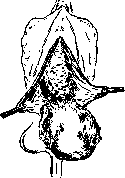
Figure 1. After anterior colpotomy, delivery of the uterus, and resection of the tubes, the edge of the vesical peritoneum is sutured to the posterior wall of the uterus in the region of the internal os (according to Döderlein-Kröning).
opening, the uterus is brought out. If necessary, the uterosacral ligaments are shortened and sutured. The peritoneum of the bladder is sutured to the wall of the uterus at the level of the internal os (see Figure 1). Ligation and resection of the tubes are performed if the woman is of childbearing age. The uterus, significantly anteflexed, is pressed with its posterior surface against the bladder, and the fundus, facing anteriorly, is placed under the urethra (see Figure 2). For greater strength, it is also recommended to fix the uterus to the periosteum of the descending branches
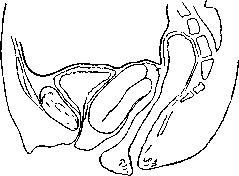
Figure 2. Schematic representation of the position of the uterus after the Wertheim operation.
of the pubic bone and to the urogenital diaphragm. If the uterus is large, Pfannenstiel recommends performing a wedge resection of the uterine body. Anteriorly, the uterus is covered with vaginal flaps. During the dissection of the vagina, it is necessary to ensure good hemostasis; one should avoid excessive grasping of the uterus with sharp instruments during its delivery, as this promotes bleeding, which is not always easy to stop. Some authors recommend inserting a gauze drain into the lower edge of the wound after suturing the vagina. In cases of cervical hypertrophy, the latter is previously amputated. In menstruating women, curettage of the uterine cavity is also performed to be certain of the absence of pregnancy. As the final act of the Wertheim operation, a posterior colporrhaphy and restoration of the pelvic floor are performed. Many authors are very satisfied with the results obtained from the Wertheim operation in the treatment of uterine prolapse, reporting only isolated cases of recurrence and a very low mortality rate (Krivsky, I. N. Alexandrov, Gitelson). On the other hand, however, some point to possible complications during the Wertheim operation (bleeding, disorders of the urinary bladder, etc.) and frequent recurrences. Döderlein and Kröning provide statistical data that are far from speaking in favor of this operation. As for recurrences, in some cases they are explained by poor selection of operative material—with a small and atrophic uterus, the bladder receives insufficient support; in other cases, due to insufficient pressing of the uterine fundus by the vaginal flaps against the urethra and bladder, the uterus begins to descend (hysterocele). Furthermore, after the Wertheim operation, the cervix continues to remain under the influence of intra-abdominal pressure, as a result of which a recurrence occurs. Considering this, Wertheim, with the aim of fixing the cervix, proposed a rather complex and technically difficult addition to his operation, consisting of suturing the uterosacral ligaments to the anterior surface of the cervix. The same task during the Wertheim operation was apparently more successfully accomplished by Kielland, who, after freeing the cervix from its outer covering, excises a wedge from the anterior and posterior surfaces of the cervix. After isolated suturing of the cervix and the mucosa covering it, the angle between the cervix and the body of the uterus is eliminated, and the latter remains straightened, which, in the opinion of Kielland and Franz, to a significant degree prevents the formation of recurrence. At the present time, there is much reason to think that the high, stable position of the cervix and the success of this operation depend on the developed scars that form after the above-described treatment of the cervix.
Related articles
Mentioned in
Cite this page
“Wertheim Operation.” Soviet Medical Encyclopedia. English translation of Bolshaya Meditsinskaya Entsiklopediya, 1st ed. (Moscow, 1928–1936), ed. N. A. Semashko. https://sovietmedicalencyclopedia.pages.dev/article/wertheim-operation/