Vaginofixation
Historical document, translated for reference. It reflects medical knowledge of the 1920s–30s and is not medical advice.
Summary
This article from the 1928–1936 Soviet Great Medical Encyclopedia discusses vaginofixation, a surgical procedure for uterine prolapse and retroflexion. It details the historical development of the technique by Schicking, Mackenrodt, Dührssen, and others, highlighting the frequent complications during subsequent pregnancies and childbirth, and notes its eventual decline in favor of other fixation methods.
Encyclopedia article (1928–1936)
VAGINOFIXATION, vaginofixatio, the surgical attachment of the uterus to the vagina, is used for uterine prolapse and for mobile retroversions and retroflexions of the uterus. Such an operation was first performed by Schicking in 1887 using a special needle introduced into the cavity of a strongly anteflexed uterus; with this needle, armed with a ligature, the fundus of the uterus and then the vagina were punctured; the ligature was then tied. In view of frequent injuries to the bladder and recurrences, this operation did not become widespread. Schicking's idea, however, was subsequently developed by Dührssen and Mackenrodt on purely surgical grounds: a transverse incision of 3–4 cm is made near the edge of the cervix, and the bladder is pushed back as high as possible without opening the peritoneum; the fundus of the uterus is sutured to the vaginal wall (see Figure 1).
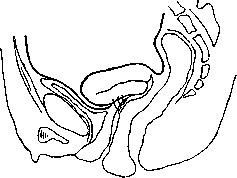
Figure 1. Schematic representation of the position of the uterus after vaginofixation of the uterus.
Mackenrodt's method differed only in a more complex incision shape—a longitudinal incision was added to the transverse one. This method also failed to yield good results and produced frequent recurrences. Therefore, Dührssen and Küstner subsequently proposed opening the peritoneum, which made it possible to clearly fix the uterus. Furthermore, it became possible to suture the uterine fundus directly to the vaginal wall (high vaginofixation), thereby achieving strong fibrous adhesion. Along with this, Winter also proposed resecting a portion of the vaginal wall to make the site of uterine fixation less mobile. According to some authors, such high vaginofixation with fibrous adhesions was accompanied by a comparatively solid outcome. Thus, Pfannenstiel noted 7% recurrences, and Halban 7.5%. Alongside this, however, such uterine fixation often exerts an adverse effect on pregnancy and labor. This is explained by the fact that the fixation site participates little in hypertrophy, and therefore, in the event of an ovum attaching there, termination of pregnancy occurs relatively frequently. According to Strassmann, miscarriage after vaginofixation is noted in 25–27%. Due to the fixation of the uterine fundus and its anterior wall, the gestational sac develops mainly at the expense of the posterior wall of the uterus, which becomes significantly thinned by the end of pregnancy. During pregnancy, the cervix moves far backward and by the end of pregnancy reaches the sacral promontory, often remaining inaccessible to the examining finger (see Figure 2). Under such conditions, the fetus easily assumes an abnormal presentation—frequently oblique, sometimes transverse. Due to the significant tension of the posterior uterine wall, pain is frequently observed during pregnancy. With the onset of labor, dilation of the cervix usually...
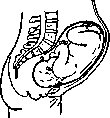
Figure 2. Position of the fetus during vaginofixation of the uterus.
...proceeds slowly and is delayed, while the posterior lip, thinning due to the contraction of the posterior uterine wall, is pulled up even higher. In cases where the cervix dilates quite satisfactorily, the act of labor nevertheless usually cannot take place, because the fetal head is pressed against the sacral promontory or directed into the sacral region. In connection with this, cases of threatened rupture of the uterus in the region of its posterior wall or upper cervical segment are not uncommon. Not a few cases have been published where, after high vaginofixation, labor was terminated by classic or vaginal Cesarean section. Attempts to complete labor by version present insurmountable difficulties due to the high position of the cervix. Mackenrodt, in order to avoid such complications during pregnancy and labor, modified the method of vaginofixation and proposed another method—vagino-vesicofixation, which consisted in fixing the bladder peritoneum to the uterus 3–4 cm higher than the usual location of the vesicouterine fold, after which the bladder itself was attached to the uterus. In view of frequent recurrences, however, this method did not find widespread application. Over time, to eliminate possible complications during labor, Dührssen modified his method and proposed opening the peritoneum and fixing the uterus to the vagina, while closing the peritoneum with separate sutures (vaginofixatio intraperitonealis, see Figure 3), thus achieving sero-serous adhesions. Along with this, the fixation site was changed, and the uterus was secured as low as possible, almost in the region...
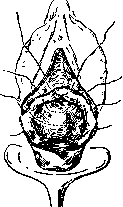
Figure 3. The uterus is fixed to the vagina approximately in the region of the internal os, resulting in a sero-serous adhesion (low vaginofixation intraperitonealis).
...of the internal os (low vaginofixation). After such vaginofixation, according to data from Halban, Wertheim, and Weibel, various kinds of complications during pregnancy and labor are relatively rare. But at the same time, in view of the inadequacy of the sero-serous adhesions at the fixation site, frequent recurrences are noted. It should also be pointed out that, in the presence of adhesions around the adnexa and behind the uterus, separating them can present great difficulties, and with poor hemostasis, new adhesions form which, being unfavorably located, subsequently promote recurrence and malposition of the uterus. On the other hand, the possibility, as Veit notes, of obtaining more extensive adhesions at the fixation site than anticipated and the complications associated therewith during pregnancy prompted Döderlein and Krönig to recommend completely abandoning vaginofixation during the reproductive period in cases of mobile retroflexion and uterine prolapse. Küstner adheres to the same point of view; he performs vaginofixation only when the possibility of conception is completely excluded; in these cases, Küstner performs vaginofixation with the expectation of obtaining strong fibrous adhesions and high fixation of the uterus. To improve results, Wertheim proposed supplementing vaginofixation with shortening of the round ligaments according to Bode's method. The round ligaments are carefully grasped with forceps so that both halves of the ligament are tensioned to an equal degree; then the round ligament is sutured at a distance of 1 cm from the uterine angle, and with the same suture it is grasped a second time at a distance of 5–6 cm from the first puncture; the edges of the loop are brought together with separate sutures, taking care not to disrupt the blood supply to the ligament. Subsequently, for a stronger fixation of the uterus, Wertheim also fixed the formed loop to the vaginal wall closer to the uterine cervix. L. Adler proposed fixing the round ligament loop to the less yielding part of the vagina—closer to the urethra. Such uterine fixation was also performed by Wertheim and Schauta as an independent operation for mobile retroflexions of the uterus. Schauta did not obtain favorable results, noting 23% recurrences. More favorable are the data of D. D. Popov, who fixed the round ligament loops, denuded of their peritoneal covering, to the urogenital diaphragm and to the periosteum of the descending ramus of the pubic bone. This operation was successfully used by D. D. Popov for fixed retroflexions of the uterus; repeated observations of the patients established that the corrected position of the uterus remains long-lasting, and recurrences (5%) are the result only of an exacerbation of an inflammatory process originating in the peritoneum or uterine adnexa. Such results, however, remain isolated, and for correcting the position of the uterus, for the above reasons, vaginofixation in all its forms has not become widely used, having been supplanted by other methods of uterine fixation (see Ventrofixation, Alexander-Adams operation, Wertheim's operation).
Related articles
Mentioned in
Cite this page
“Vaginofixation.” Soviet Medical Encyclopedia. English translation of Bolshaya Meditsinskaya Entsiklopediya, 1st ed. (Moscow, 1928–1936), ed. N. A. Semashko. https://sovietmedicalencyclopedia.pages.dev/article/vaginofixation/