Uterine Rings
Historical document, translated for reference. It reflects medical knowledge of the 1920s–30s and is not medical advice.
Summary
Uterine rings (pessaries) are devices placed in the vagina to maintain the uterus in its normal position, used for treating incorrect uterine positions and prolapse. The article describes various types of pessaries, their application methods, and precautions for use.
Encyclopedia article (1928–1936)
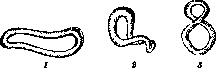
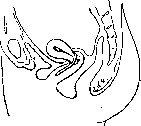
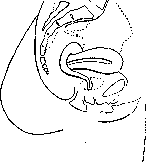
UTERINE RINGS (pessaries), devices placed in the vagina to hold the uterus in its normal position; they are called this because their original form was ring-shaped. Uterine rings were used even in ancient times; accordingly, they are also found in folk medicine. In modern gynecology, their practical application began with Hodge (America, 1860), after which numerous inventions (mainly by American and German authors) appeared, very diverse in appearance and method of application. At present, only a few forms are used; uterine rings are used, first, for treating incorrect positions of the uterus and, second, for its prolapses. 1. For the first purpose, the Hodge pessary is most widely used in the USSR, followed by those of Thomas and Schultze (Fig. 1). All of them are made, since Prochownik's proposal, of hard rubber; rings of celluloid or metal (aluminum) are less appropriate; however, rings with a flexible metal frame (copper wire) covered with soft rubber are also convenient, as they can be easily given any form suitable for the particular case. Rings made of dense rubber and celluloid can also be reshaped if they are first well heated in hot water. The Hodge pessary in its modern form is a ring of uniform thickness of 0.8-0.9 cm; its oval opening is wider on one side and narrower on the other; since the ring is S-shaped along its length, the edge of the wider part of the ring, if the ring is placed on a table, will rise upward; it is given the name of the ring's back. The Thomas ring in general preserves the same form, but has a thickened back. The Schultze figure-eight pessary, as its name indicates, is twisted so that it forms two openings: a smaller one on the back side and a larger one on the opposite side; along its length it is slightly curved, with the concavity facing forward. The rings differ in size, by number; in Hodge rings, the number corresponds to the size of the ring's diameter in centimeters, if the ring is given a proper round shape. Rings are used where the uterus, standing incorrectly due to relaxation of the ligamentous apparatus (retroflexion, retroversion, lateroflexion), is mobile and not connected by adhesions. Previously, it must be placed in a normal position. If it is not corrected, the ring is useless; if there are adhesions, it can cause pain. According to the width and length of the vagina, the size of the ring (its number) is selected: in nulliparous women, most often numbers 6, 7, in multiparous women - numbers 8, 9 and larger. In accordance with the condition of the ligaments and the laxity of the uterus, it is given the most appropriate form: the opening is widened or narrowed, the S-shaped curvature is increased, the back is raised. The washed, soaped or vaselined ring is inserted obliquely at the entrance with the back forward and is positioned in the vagina so that the back is placed in the posterior fornix, with the apex forward; the cervix of the uterus faces into the ring's opening, and the lower edge of the latter is located almost immediately behind the entrance and may sometimes even be visible during straining, especially with insufficient pelvic floor. The figure-eight pessary is inserted in the same way, with the cervical neck inserted into the upper smaller opening of the ring (Figs. 2 and 3); therefore, the latter must be shaped according to the cervix and applied to it; the lower half of the eight is placed in the lower part of the vagina and with its front (lower) end presses against the anterior vaginal wall, pushing the cervix backward. Thus, it promotes the correct position (anteversion - flexion) of the uterus, fixing its cervix; it does not stretch the posterior fornix, which is an advantage, but its front part (limb) can cause unpleasant pressure on the urethra and bladder; therefore, sometimes this part has to be bent downward (backward), giving the pessary the usual S-shaped curvature of other rings. The Hodge ring acts by stretching the fornices and increasing the tension of the uterosacral ligaments; its back, filling the posterior fornix, prevents the tilting of the body of the uterus into the Douglas space; the entire ring, lying in the vagina, receives support in the muscular pelvic floor. A correctly positioned ring causes no sensations and does not interfere with urination and defecation or coitus. By keeping the uterus in its normal position, the rings allow the relaxed ligamentous apparatus to return its tone, which can be promoted by appropriate measures (gymnastics, massage). After 2-3 months, one can try to remove the ring, and if the uterus maintains its correct position, the goal is achieved; but often for curing the condition, the ring has to be worn for a long time (up to a year or more), and then it is necessary to periodically (after 1-2 months) check its position, remove and clean it; otherwise, concrements may form on the ring, and bedsores and inflammations may form in the vagina. It is clear that while wearing the ring, vaginal douches with warm water, clean or with the addition, as needed, of disinfecting and astringent means are necessary.
Fig. 2. The uterine Hodge ring in the vagina holds the uterus in its normal position.
after 2-3 months one can try to remove the ring, and if the uterus maintains its correct position, the goal is achieved; but often' / .(^)"~f^'-<-J
for curing the condition the ring has to be worn for a long time (up to a year and more) and then it is necessary to periodically (after 1-2 months) check its position, remove and clean it; otherwise, concrements may form on the ring, and bedsores and inflammations may form in the vagina. It is clear that while wearing the ring, vaginal douches with warm water, clean or with the addition, as needed, of disinfecting and astringent means are necessary. 2. In prolapses and descents of the uterus, if for some reason surgical treatment is impossible, rings are also used. In mild cases, one can be satisfied with Hodge rings and even Schultze rings, which, by holding the uterus in anteflexion, thereby prevent its prolapse. In older and more significant prolapses, rings having a round shape and acting on a somewhat different principle are used. Such are the Meyer rings with a thick hollow rim (2-21/2 cm thick) and a relatively small opening. They are made either elastic (so that they can be more easily inserted into the vagina in a compressed form) or solid, of hard rubber or celluloid. In folk medicine, one encounters rings made of twigs poured with wax. The size of the ring is determined by the degree of stretching of the vaginal walls, which must be supported in a state of certain tension; on the other hand, an excessively large ring can quickly cause injury to the vagina. A solid ring is chosen of such a size (diameter) that it passes with some difficulty through the dilated entrance to the vagina. There it is placed in the same way as the Schultze ring, i.e., pressing with its posterior edge against the posterior fornix and fixing the cervical neck in its opening. It stretches the vagina and fornices, rests on the remnants of the muscular pelvic floor, and together with the uterus forms a mass (pelotte), which, being fixed by the tension of the tissues, cannot pass through the genital cleft and, remaining in place, helps maintain the balance of the overlying pelvic and abdominal organs. These rings require special care, as they remain in the vagina for years, and sometimes for a lifetime, where, if they are not periodically removed, they become overgrown with concrements, grow into the tissues, causing ulcers with purulent discharges and the formation of synechiae and sometimes even perforations into the bladder and rectum. If complications have already occurred, the ring must be removed entirely, which presents difficulties in the presence of adhesions. Then the ring is sawn (with a Gigli saw) in the most accessible place (at the entrance), it is turned in its plane by 120-180°, so that the sawn place goes to the posterior fornix, it is sawn again at the entrance, and thus, dividing the ring into 2-3 parts, each segment is freed separately. Devices are sometimes also called rings, which are inserted into the vagina with the aim of preventing the penetration of semen into the uterus ("locking pessaries") and thus protecting against pregnancy (see Contraceptives).
Related articles
Mentioned in
Cite this page
“Uterine Rings.” Soviet Medical Encyclopedia. English translation of Bolshaya Meditsinskaya Entsiklopediya, 1st ed. (Moscow, 1928–1936), ed. N. A. Semashko. https://sovietmedicalencyclopedia.pages.dev/article/uterine-rings/