Lethality
Historical document, translated for reference. It reflects medical knowledge of the 1920s–30s and is not medical advice.
Summary
This article from the 1928–1936 Soviet medical encyclopedia defines lethality as the percentage of deaths relative to the number of cases for a specific disease. It explains how this rate is calculated using registered cases versus hospital data, and details how it varies by disease, time, location, age, and social conditions.
Encyclopedia article (1928–1936)
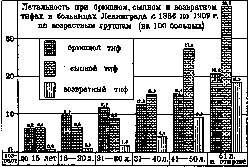
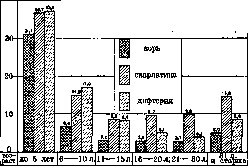
LETHALITY (French lethalité), mortality, the percentage ratio of the number of deaths to the number of people sick with the same disease. Lethality is calculated for a specific period, usually for a year. For example, in Moscow in 1926, 10,774 cases of scarlet fever were registered; 904 cases died from scarlet fever; lethality for that year is 8.4%. In Leningrad for the same year, 9,454 people were sick and 653 died from scarlet fever; lethality is 6.9%. Calculating lethality in relation to the number of registered sick does not give a true indicator of lethality, since not all sick people are registered; on the other hand, not all death certificates contain an accurate diagnosis (possibility of an erroneous diagnosis, death of the sick without medical supervision, etc.). Another method of calculating lethality, which is more accurate, is the use of hospital material. In this case, the number of deaths for a certain period is calculated in relation to the number of those who left (recovered and died) the hospital for the same period. For example, in Leningrad from 1922 to 1926, 6,192 people with measles left the hospitals (discharged home and died), of whom 806 died; lethality for measles during this period in Leningrad hospitals is 13%. However, lethality calculated from hospital material also does not give fully accurate data, since only more severe cases get into the hospitals. For example, it would be completely incorrect to establish the overall indicator of lethality for influenza, measles, whooping cough, and other diseases based only on hospital material, since in these diseases patients are rarely hospitalized. Lethality has a definite indicator for each given disease. Below are the indicators of lethality (per 100 sick) for some acute infectious diseases according to the data of Leningrad hospitals for 1886–1926 (according to Binshtok) and Germany for 1889–97 (according to Prinzing). When comparing these indicators, one must remember the difference in the periods to which they relate. Lethality for some acute infectious diseases in Leningrad (for 1886–1926) and Germany (for 1889–97). Leningrad Germany 5.6 5.3 10.4 11.4 10.5 20.5 16.4 6.7 18.2 12.0 Diseases Lobar pneumonia Diphtheria Smallpox Leningrad Germany 18.2 19.4 21.9 21.4 24.5 12.2 The indicator of lethality is not a constant value. It fluctuates depending on various causes. 1) From the nature of the epidemic. The ordinary, so-called endemic influenza gives a negligible percentage of lethality. Epidemic influenza, as was the case, for example, in 1918, gives an extremely high lethality. Lethality during malaria, usually very low, during its pandemic in the period of the civil war rose in the USSR to unprecedentedly high figures: in individual places up to 2% and higher. Over many years, diphtheria gives epidemic waves both with very high and with relatively low mortality. 2) Lethality is different at the beginning of the epidemic, in its height, and at the end. As a rule, it is higher at the beginning and height of the epidemic. 3) At the same time it is different in different countries, for example, lethality for smallpox (see). Lethality for scarlet fever in the same years (1925–27) was in England, Germany, Denmark, Sweden and Switzerland about 1%, in Romania and Japan about 5%, in Leningrad about 10%. 4) Lethality over a long period decreases due to the improvement of sanitary conditions of the population, improvement of the hospital situation and care for the sick. Thus, in most European countries over the last 50 years, lethality for measles, whooping cough and scarlet fever has noticeably decreased. In Leningrad hospitals it was for the last one with a period from 1886 to 1909 above 20%, in 1922–26 – 11%. For lobar pneumonia it was in Leningrad hospitals from 1886 to 1900 above 20%, in 1922–26 – 10.6%. 5) It changes in the direction of decreasing due to the introduction of specific methods of treatment, for example, for diphtheria. Lethality is strongly influenced by social conditions. For whooping cough, measles and other diseases it is higher among the poor layers of the population living in unsanitary conditions than among the wealthy groups of it (see these diseases). 6) Famine and public disasters, worsening the sanitary well-being of the broad masses of the population and weakening the organism, lead to an increase in lethality for the most diverse diseases. This is in particular what should explain the high lethality for malaria during the civil war and famine, mentioned above. 7) The age factor plays a large role in the height of lethality. The most striking example can be the colossal difference in lethality of infants and adults in acute gastroenteritis. In typhoid fever lethality is low among children; it increases with age and reaches a maximum in old age (Figure 1). The same applies to typhus and some other diseases. The opposite picture is observed in so-called "childhood infections": in measles, scarlet fever, whooping cough and diphtheria it is highest in age up to 5 years; with increasing age it decreases, so as to rise again in age over 30 years (Fig. 2). Lethality for measles, scarlet fever and diphtheria in Leningrad hospitals from 1886 to 1909 by age groups (per 100 sick). Figure 2. Pneumonia gives high lethality in early childhood and old age. 8) Lethality is different among men and women. According to the data of Leningrad hospitals, it is higher among men in all age groups in typhus and, conversely, higher among women in lobar pneumonia. 9) Lethality is influenced by the time of seeking medical help (and therefore its availability), timely application of specific treatment (for example, in diphtheria, anthrax), care for the sick, condition of the treatment institution where the sick is placed (overcrowding, unsanitary condition, unqualified personnel – all this worsens the outcome of the disease and increases lethality), etc. 10) All else being equal, the severity of the disease has the strongest influence on lethality: at the same time and in the same age, septic forms of scarlet fever give immeasurably higher lethality than toxic ones. Among the causes influencing lethality, many remain unexplained. It is necessary to further accumulate materials on this issue, which has enormous importance in the prognosis of the course of both epidemics as a whole and individual diseases (one should not confuse the terms lethality, or "mortality", with the term "mortality"; the latter means the ratio of the number of deaths to the population in which death cases occurred).
Related articles
Mentioned in
Cite this page
“Lethality.” Soviet Medical Encyclopedia. English translation of Bolshaya Meditsinskaya Entsiklopediya, 1st ed. (Moscow, 1928–1936), ed. N. A. Semashko. https://sovietmedicalencyclopedia.pages.dev/article/lethality/