Ergotism
Historical document, translated for reference. It reflects medical knowledge of the 1920s–30s and is not medical advice.
Summary
Ergotism is poisoning from ergot (Claviceps purpurea), a fungus that grows on rye and other grains. This article describes the historical background, clinical forms, pathology, and treatment of ergotism as understood in the 1930s.
Encyclopedia article (1928–1936)
ERGOTISM, poisoning from ergot (Claviceps purpurea). Reliable historical information about E. dates back to the 10th century. In France in the early Middle Ages, E. was known under the name "holy fire" or "fire of St. Anthony," obviously characterizing its gangrenous form. A symptomatic name is borne by E. in German as "Kriebelkrankheit"-itching disease, and in Russian as "zelaya korch" (evil cramp). In the 17th century, the term "ergotism" from French ergot (ergot) became established in Romance countries. Linnaeus introduced the term "raphania." He believed that the disease develops in connection with the consumption of a plant from the radish family (Raphanus raphanistrum) growing among grain crops. In France, the old name for E. has been preserved-maladie céréale (bread disease). In Russia, from 1710 to 1909, 24 major epidemics of E. were recorded. In 1926-1927, cases of ergotism were observed in the Urals. Maksudov proposed the term "toxidemia" for mass cases of E.
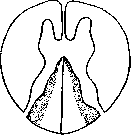
Usually, toxidemia of E. appears in the autumn after the harvest. High humidity promotes the growth of ergot; therefore, outbreaks of E. more often occur after a rainy summer. Freshly harvested ergot is most poisonous; after 5-8 months its toxicity decreases. E. primarily affects the adult population; infants and the elderly are little susceptible to it. Low or monotonous nutrition, the state of recovery after acute infections predispose to E.; endocrine-constitutional factors may also be important. The latter is supported by the significance of age and the different susceptibility to E. of members of the same family with the same diet. The pathological anatomy of E. comes down to a degenerative process in the posterior columns, mainly the Burdach (see figure), and a mild diffuse infiltrate in the brain. In experiments, Grinfeld, by administering strongly acting preparations of ergot to chickens and piglets, did not cause any changes in their spinal cord. The active principle of ergot is the alkaloids-ergotoxin and ergotamine. Together with amines, they form the main part of cornutin, which Kobert attributed the predominant role in ergot poisoning.
According to the course, acute, subacute, and very rare chronic E. are distinguished. Acute cases last about a day and give a high mortality rate. In them, symptoms of digestive tract damage (vomiting, diarrhea) are combined with severe disorders of the nervous system-psychotic state, paresthesias, painful convulsions (convulsions cereales). Sometimes the entire disease proceeds as an acute psychosis without hyperkinesias. The subacute form begins with precursors: general malaise, a sensation of crawling ants, profuse sweating. Subsequently, the nervous or gangrenous form develops. In the first, psychotic and convulsive variants are distinguished. In the first, stupor, delirium, manic state or depression appear; sometimes epileptic convulsions are added. Often, in this case, the knee reflexes are absent. The convulsive form is now most common. It is characterized by painful tonic convulsions, mainly in the flexors of the limbs; to them are added or independently appear root pains and paresthesias and tendon areflexia (ergot pseudotabes). In the hydrophobic form of E., convulsions of the swallowing muscles come to the forefront. In some cases, to tabetic symptoms are added severe atrophies and paralyses, and thus a syndrome of combined systemic disease of the spinal cord is created. Various transitions exist between the psychotic and convulsive forms with a combination of symptoms of both forms. The convulsive form lasts from 3 to 6 weeks; sometimes relapses occur with it. In addition to nervous symptoms, clouding of the cornea or lens and amenorrhea are noted with it. The gangrenous form is significantly less frequent than the convulsive one. In it, limited necrotic foci form on the limbs, developing according to the type of dry gangrene. The degree of penetration of necrosis into the depth varies. In advanced cases, spontaneous amputation of large parts of the limbs occurs. Wet gangrene is less common. The chronic form of E. sometimes is limited to disorders of the gastrointestinal tract with moderately expressed nervous symptoms (paresthesias, mild pains), sometimes only by amenorrhea or general weakness. The diagnosis of E. is not difficult when establishing the consumption of bread contaminated with ergot. With painful tonic flexor convulsions or spontaneous gangrene, E. should be included in the diagnostic possibilities. The prognosis in the convulsive form is somewhat worse than in the gangrenous form. There is no specific therapy for E. Strengthening treatment comes first. In the convulsive form, anticonvulsants (chloral hydrate, scopolamine) and organ preparations of the parathyroid glands are used; in the gangrenous form-dry heat: diathermy, light baths. With the spread of the gangrenous process, surgical treatment may be indicated, initially in the form of "gentle" operations (Leriche, Molotkov, Oppel). In extreme cases, amputation is resorted to. Prevention of E. consists in cleaning grain and flour from ergot. According to the instructions of the People's Commissariat of Health, the maximum content of ergot in grain delivered to the mill should not exceed 0.2%. After reducing it on cleaning machines to 0.06%, the grain goes to grinding. A major role in the fight against E. belongs to sanitary education among the rural population.
Related articles
Mentioned in
Cite this page
“Ergotism.” Soviet Medical Encyclopedia. English translation of Bolshaya Meditsinskaya Entsiklopediya, 1st ed. (Moscow, 1928–1936), ed. N. A. Semashko. https://sovietmedicalencyclopedia.pages.dev/article/ergotism/