Appretura (Textile Finishing) and Apraxia
Historical document, translated for reference. It reflects medical knowledge of the 1920s–30s and is not medical advice.
Summary
This entry describes the textile finishing process (appretura), including the substances used and the associated occupational health hazards, such as high heat and humidity. It also includes a discussion on apraxia, detailing the localization of apractic disorders in the brain, including the role of the corpus callosum and the supramarginal gyrus.
Encyclopedia article (1928–1936)
APPRETURA, APPRETIROVANIE
APPRETURA, APPRETIROVANIE (from French appreter—to prepare). Appret is the name given to substances applied to finished fabric during its final processing; the very process of applying the appret is called appretura or appretirovanie (finishing). Finishing does not constitute an independent production; it is an integral part of the fabric finishing process. Finishing is applied, mainly, to cotton fabrics, and partly to silk. Various substances are used as finishing agents: those that impart stiffness to the fabric (starch, dextrin, glue), softness and gloss (castor oil, cottonseed oil, etc., oleic acid, etc.), weighting agents (kaolin, gypsum), antiseptics, tints (ultramarine), and many others. The process of producing the finishing agent consists of preliminary boiling of starch with other substances in open or closed boilers or vats, after which it is rubbed and filtered. The finished finishing agent is brought to the machine and poured into a box; the finishing agent is applied to the goods passing through the box over rollers, after which the goods are squeezed and sent to drying drums (or drying frames) for drying. Subsequently, the goods undergo further operations—moistening, stretching, finishing on calenders, etc. From a sanitary-hygienic point of view, it is necessary to note the work of starch boilers, machine operators at starch drums, and female workers at the edges (straightening the edges of the goods entering the drying drums). A general hazard for all these professions is working at high temperatures and high humidity. The conditions are especially burdensome for starch boilers, who have to stay at high temperatures (up to 35–40°C) and humidity (75–90% relative humidity and higher), and their work is accompanied by significant physical exertion (dragging sacks of starch, stirring in vats with an oar). The premises allocated for boiling are usually very unsatisfactory and are almost nowhere equipped with proper ventilation. Near the drums, the temperature and humidity are somewhat lower, but still quite high: at the places where the female workers sit at the edges, the temperature reaches 32–35°C; with improper guarding of the drums, there is also the effect of radiant heat on the workers. The latter remain in a sitting position the whole time, constantly making small, rapid movements with the fingers of both hands (straightening the edge). When the fabric breaks between the drums, the machine operator has to go in there and search for the broken ends. Here he is exposed to temperatures up to 50°C and radiant heat. Preventive measures: proper equipment of the boiling room; closed, sufficiently insulated equipment for boiling with a mechanical stirrer; installation of rational supply and exhaust ventilation with a sufficient number of air exchanges per hour; at the drums—their proper insulation and the installation of supply and exhaust ventilation.
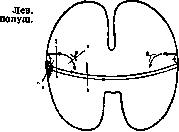
Right hemisphere.
Diagram of apractic disorders: 1—focus in the supramarginal gyrus causes bilateral apraxia; 2—focus causes paralysis of the right hand and apraxia of the left; 3—focus in the corpus callosum leads to apraxia of the left hand; 4—focus in the internal capsule causes right-sided hemiplegia; a—internal capsule (pathway to the right hand), b—internal capsule (pathway to the left hand). Brain. A focus in the corpus callosum, which isolates the center of the left hand, located in the right hemisphere, from the left hemisphere, causes isolated apraxia of the left hand. The question of the localization of bilateral apraxia is still subject to discussion. Hartmann, Goldstein, and others explain it by a focus in the frontal lobes. Kroll and Schauffenberg showed that foci in the left supramarginal gyrus in the parietal lobe lead to bilateral apraxia. The latter view is now almost universally accepted. However, Monakow speaks out generally against the localization of apraxia, as well as aphasia, explaining them by diaschisis (see). Consequently, bilateral motor apraxia in a right-handed person points to a focus in the left supramarginal gyrus, more precisely, in field 40 according to Brodmann, PE according to Economo. Apraxia of the left hand, sometimes combined with paresis of the right limbs, points to a focus in the corpus callosum. In a left-handed person, conversely, bilateral apraxia is caused by a focus in the right hemisphere, and a focus in the corpus callosum causes apraxia of the right hand. Ideational apraxia points to general arteriosclerosis of the brain with foci in the left hemisphere. An interesting form of apraxia is apparently connected with a focus in the narrow strip separating the superior parietal gyrus from the inferior (visual-sensory band or field PBE according to Economo); apraxia in such cases is accompanied by a loss of the ability to distinguish the right side from the left and the involuntary participation in the movement of one hand by other limbs as well, especially the lower ones. This concerns insufficient denervation, a disorder in the inhibition of other impulses associated (ontogenetically and phylogenetically) with the action of one limb. A similar disorder of denervation likely lies at the basis of mirror writing, often observed in apractics, as well as in children and left-handed people (Leonardo da Vinci). Apraxia is caused by tumors, parasites, circulatory disorders, especially arteriosclerotic softening, syphilis, encephalitis, etc. Prognosis depends on the nature of the underlying disease, age, and the condition of the cerebral vessels. Skull wounds in the last war yielded many cases of apraxia with a good outcome, which is explained by the youth of the patients, the limitation of the focus, good vessels, and, perhaps, less differentiation of functions in the young. The latter is partly supported by contradictory experiments on trained animals with transection of the corpus callosum. While some authors find that in animals (cats, monkeys) the ability to perform learned actions is lost after transection, others deny this. Treatment must address the underlying disease. Literature: Kroll M., On the clinic and topical diagnosis of aphasic and apractic disorders, Journal of Neuropathology and Psychiatry named after S. S. Korsakov, 1911; Kroll M., Beitrage zum Studium der Apraxie, Zeitschr. f. d. ges. Neurol. u. Psych., B. II, 1910; Brun R., Klinische und anatomische Studien uber Apraxie, 1922; Hartmann F., Beitrag zur Apraxielehre, Monatsschr. f. Psychiatrie, B. XXI, 1907; Kleist, Gang und gegenwartiger Stand der Apraxieforschung, Ergebn. d. Neurol. u. Psych., 1911; Liepmann H., Drei Aufsatze aus dem Apraxiegebiete, 1907, 1908; Monakow C., Die Lokalisation im Grosshirn, 1914; Stauffenberg, Klinische u. anatomische Beitrage zur Kenntniss der aphasischen, agnost. u. apraktischen Symptome, Zeitschr. f. d. ges. Neurol. u. Psych., B. XXXIX, 1918.
Related articles
Cite this page
“Appretura (Textile Finishing) and Apraxia.” Soviet Medical Encyclopedia. English translation of Bolshaya Meditsinskaya Entsiklopediya, 1st ed. (Moscow, 1928–1936), ed. N. A. Semashko. https://sovietmedicalencyclopedia.pages.dev/article/apraxia/