Babinski Reflex
Historical document, translated for reference. It reflects medical knowledge of the 1920s–30s and is not medical advice.
Summary
The Babinski reflex is a neurological response where stroking the sole of the foot causes the big toe to dorsiflex. It is considered pathognomonic for organic lesions of the pyramidal motor pathway and normally appears in infants before being replaced by the plantar reflex by age 2-3 years.
Encyclopedia article (1928–1936)
BABINSKI REFLEX (signe des orteils), described by Babinski in 1896, is caused by deep stroking irritation of the outer edge of the sole (see figure 1 and 2).
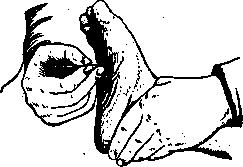
Figure 1. Normal condition. Irritation of the sole causes plantar flexion of the toes.
In some cases, only the big toe responds to irritation with slow tonic extension (dorsal flexion), while the other toes remain motionless.
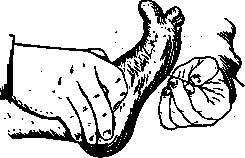
Figure 2. Pathological condition. Irritation of the sole causes dorsal flexion of the big toe - Babinski reflex.
In other cases, the other toes also participate in the extension, spreading out like a fan (so-called fan-shaped sign - signe de l'eventail Dupre). The symptom is pathognomonic for organic lesions of the pyramidal (corticospinal) motor pathway. The question of whether simultaneous lesions of other nerve fiber systems are also necessary for its occurrence remains open. The question of the pathophysiology of the reflex is also not fully clarified. Much speaks in favor of evaluating it as a component of the general shortening protective reflex (P. Marie). In newborns, irritation of the sole also gives the B. r. in the normal state. From the 6th month, it begins to be gradually replaced by the usual plantar reflex, and from 2-3 years (rarely from 5-6 years) the latter is usually observed (Dejerine).
Related articles
Mentioned in
Cite this page
“Babinski Reflex.” Soviet Medical Encyclopedia. English translation of Bolshaya Meditsinskaya Entsiklopediya, 1st ed. (Moscow, 1928–1936), ed. N. A. Semashko. https://sovietmedicalencyclopedia.pages.dev/article/babinski-reflex/