Blastopore
Historical document, translated for reference. It reflects medical knowledge of the 1920s–30s and is not medical advice.
Summary
An embryological term referring to the opening connecting the cavity of the gastrula with the external environment, crucial in the development of lower vertebrates and chordate axis formation. The article discusses its morphology in lancelets and amphibians, its role in the formation of the canalis neurentericus, and its phylogenetic significance according to O. Hertwig's blastopore theory.
Encyclopedia article (1928–1936)
BLASTOPORE (from Greek blastos—germ and poros—opening), primary mouth (German Urmund), an embryological term proposed by Haeckel to designate the opening connecting the cavity of the gastrula (primary gut) with the external environment. The blastopore is clearly expressed in amphioxus and amphibians. In the former (see Figure 1), the gastrula has the appearance of a two-layered sac opening outward by a wide blastopore; when the larva elongates, the blastopore appears at the posterior end of the body in the form of a wide oval slit running longitudinally. In amphibians, the blastopore appears as a crescent-shaped slit at the posterior end of the blastula, at the border between the animal and vegetative poles; at this place in the triton, invagination is observed—the beginning of gastrulation. As a result of a complex process of gastrulation, the crescent-shaped slit gradually closes into a ring (see Figure 2), from which the so-called yolk plug of Rusconi protrudes. The further fate of the blastopore is connected with the formation of important organs running along the body axis—the notochord, mesodermal somites, and the neural tube. They are laid down in front of the blastopore, at the posterior end of the embryo's body; hence their
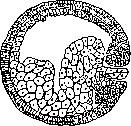
Figure 2. Blastopore of a triton with a plug.
differentiation proceeds toward the head end. Simultaneously, the blastopore turns into a narrow slit running longitudinally and overgrows from front to back. The resulting neural tube closes over the remainder of the blastopore, which thus transforms into a canal connecting the cavity of the neural tube with the intestine (canalis neurentericus). These facts were used by O. Hertwig as the basis for his "Urmundtheorie" (blastopore theory), which linked the blastopore and its closure with the process of formation of axial organs (chordulation), thereby making it possible to find formations homologous to the blastopore in all vertebrates in which gastrulation proceeds differently, without the participation of invagination, and there is no reason to speak of the blastopore as a primary mouth. Such a homologue of the blastopore in birds and mammals is the primitive streak, in front of which the notochord is laid down, and the head node gives rise to the canalis neurentericus. Experimental studies by Spemann and his pupils on amphibians confirmed the close dependence of axial organs on the blastopore. A section of the anterior lip of the blastopore transplanted to any part of the embryo's body induces the formation of the neural plate, notochord, and mesoderm in front of it. These organs do not grow out of the primordium, but are formed by the differentiation of the host cells, for which the transplanted piece serves as an "organizer." O. Hertwig proved that irregularities in the development of the blastopore (absence of edge closure) lead to malformations, specifically to the splitting of organs in the posterior part, known as spina bifida, rhachischisis. Lit.: Hertwig O., Lehrbuch der Entwicklungsgeschichte, Jena, 1902; by the same author, Urkunde der spina bifida, Archiv f. mikroskopische Anatomie, B. XXXIX, 1892; Spemann H., Über Organisatoren in der tierischen Entwicklung (reviews of works on "organizers"), Die Naturwissenschaften, B. XII, 1924, B. XV, 1927.
Related articles
Mentioned in
Cite this page
“Blastopore.” Soviet Medical Encyclopedia. English translation of Bolshaya Meditsinskaya Entsiklopediya, 1st ed. (Moscow, 1928–1936), ed. N. A. Semashko. https://sovietmedicalencyclopedia.pages.dev/article/blastopore/