Neoteny
Historical document, translated for reference. It reflects medical knowledge of the 1920s–30s and is not medical advice.
Summary
Neoteny is a developmental anomaly in amphibians characterized by the permanent retention of larval characteristics. This condition can be naturally occurring or artificially induced through surgical removal of the thyroid gland or pituitary gland.
Encyclopedia article (1928–1936)
Neoteny, a developmental anomaly in amphibians, consisting of the permanent larval state. The ability to reproduce in neotenic amphibians can be preserved. An example of natural neoteny is the axolotl (see), the larva of the Mexican tailed amphibian (Amblystoma tigrinum). The term N. was introduced by Kolman (1885).
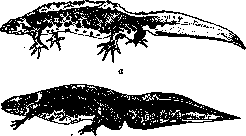
Male Triton cristatus: a - before removal of the pituitary gland; b - after removal of the pituitary gland.
In the axolotl, the cause of N. is apparently decreased function of the thyroid gland, since exposure to preparations of the latter leads to the transformation of the axolotl into a terrestrial form (amblystoma). Cases of natural N. in normally transforming amphibians have been described repeatedly (crested newton - according to Kuhn's data). Artificial neoteny was induced by surgical removal of the thyroid glands in tadpoles, resulting in the arrest of metamorphosis, the larvae reaching giant sizes, and their gonads sometimes continuing normal development. Removal of the glandular lobe of the pituitary gland in tailed amphibians also leads to N. (see figure). It is very possible that in this case neoteny also depends on hypofunction of the thyroid gland, which is a consequence of hypophysectomy.
"
Related articles
Mentioned in
Cite this page
“Neoteny.” Soviet Medical Encyclopedia. English translation of Bolshaya Meditsinskaya Entsiklopediya, 1st ed. (Moscow, 1928–1936), ed. N. A. Semashko. https://sovietmedicalencyclopedia.pages.dev/article/neoteny/